
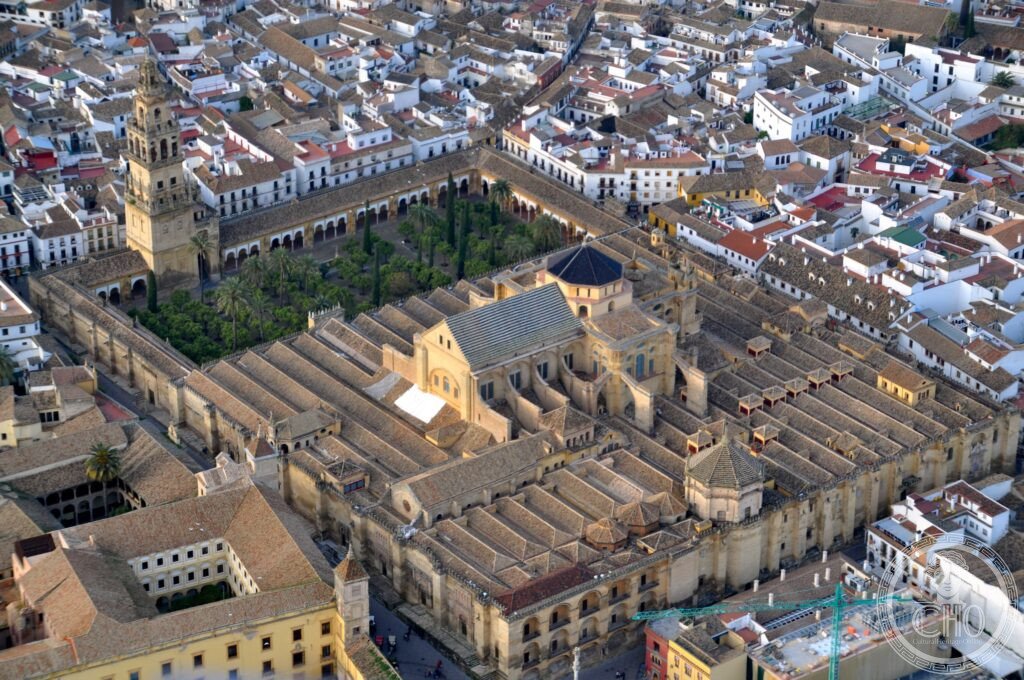
Córdoba Mosque-Cathedral
The most extraordinary palimpsest of religious architecture in the Western world and the crowning achievement of Umayyad art in Europe — the Mosque-Cathedral of Córdoba (Mezquita-Catedral; Andalusia, Spain; UNESCO WHS 1984) is the greatest mosque built in al-Andalus, begun by Abd al-Rahman I (784 CE) and extended three times over 200 years, before a Gothic cathedral was inserted into its centre by King Charles I in 1523 CE.
At a glance
Córdoba Mosque-Cathedral (the most precisely CórdobaMezquitaSpain single 784 CE Abd al-Rahman I first mosque built Visigothic San Vicente Church half purchased demolished 786 CE expanded 833 CE Hisham I 961 965 CE al-Hakam II greatest expansion mihrab maqsura Byzantine mosaics 987 CE al-Mansur final expansion 856 columns different marble jasper stone Roman spolia Visigothic columns Egyptian marble red white alternating horseshoe arches voussoirs Damascus Great Mosque influence 1236 CE Fernando III Castile reconquista Catholic cathedral installed Mihrab small chapel then 1523 CE Charles I Holy Roman Emperor constructed full Gothic cathedral nave into center mosque controversy 1526 CE Charles I visited first time horrified wrote bishop You have destroyed something unique to build something ordinary Council architects warned 1523 CE mayor fined for demolishing any structure you would have to answer with your lives 857 columns remained survive today Caliphate Córdoba 929 956 CE Abd al-Rahman III caliph title 300000 population largest city Western Europe medieval Córdoba UNESCO heritage: the Umayyad Córdoba caliphate (929-1031 CE; the most sophisticated civilization in medieval Europe): the Caliphate of Córdoba at its peak (929-1031 CE) was the dominant power of medieval Europe and the most sophisticated civilization west of Constantinople; the city of Córdoba had a population of 300,000-500,000 in the 10th century CE — the largest city in Europe west of Constantinople; the court of Caliph Abd al-Rahman III (912-961 CE) attracted scholars, physicians, poets, and philosophers from across the Muslim world and from Christian Europe; the Córdoba caliphate had public libraries with 400,000 volumes at a time when the largest library in Christian Europe (the monastery of St. Gall, Switzerland) had approximately 400 manuscripts; the philosopher Maimonides (1138-1204 CE) was born in Córdoba; the physician and philosopher Averroes (Ibn Rushd; 1126-1198 CE), whose translations of Aristotle transmitted Greek philosophy to medieval Europe, was born in Córdoba)) — the most precisely CórdobaMezquitaSpain single 784 CE Abd al-Rahman I Visigothic church demolished 786 833 CE extensions 961 965 CE al-Hakam II Byzantine mosaics 987 CE al-Mansur 856 columns Roman spolia marble jasper red white alternating horseshoe arches Damascus influence 1236 CE Fernando III 1523 CE Charles I cathedral nave center Charles visited 1526 CE horrified you destroyed unique 300000 population largest city Western Europe medieval 929 956 CE caliph title Maimonides 1138 1204 CE born Averroes 1126 1198 CE Aristotle translations UNESCO heritage in any UNESCO world heritage site)).
Key facts
- The Byzantine mosaics of al-Hakam II (965 CE): the most precisely CórdobaMezquitaSpain single 961 965 CE al-Hakam II great expansion 1163 m2 added mihrab new maqsura royal enclosure 9 bays finest mosaic arches requested Byzantine Emperor Nikephoros II Phokas Constantinople sent gold mosaic craftsmen mosaics tiles workshops Byzantine school Constantinopolitan mosaic Byzantine Emperor sending craftsmen Christian mosaics for Muslim mosque most significant religious artistic exchange 10th century CE Europe mihrab door gold mosaic arch polylobed arch octagonal chamber inscriptions 99 names God gold tiles mosaics direct from Constantinople imperial workshops UNESCO heritage — one of the most remarkable acts of artistic exchange in medieval history: in 961 CE, Caliph al-Hakam II (961-976 CE) undertook the expansion of the mosque and, desiring gold mosaic decoration for the new mihrab (prayer niche), wrote to the Byzantine Emperor Nikephoros II Phokas (963-969 CE) requesting Byzantine mosaic craftsmen and tesserae; the Emperor sent a team of Byzantine mosaic workers along with a gift of 1,600 kg of gold mosaic tesserae (from the imperial workshops in Constantinople); the result was the mihrab arch and the maqsura bays (the 9 bays in front of the mihrab, decorated with intertwined geometric and vegetal mosaics that exactly follow Byzantine Christian church decoration techniques, but applied to Islamic geometric and epigraphic patterns); this is the most significant Byzantine-Islamic artistic collaboration of the 10th century CE
- GPS: 37.8789° N, 4.7794° W
History
From Roman temple to Visigothic church to Umayyad mosque to Gothic cathedral (the most precisely CórdobaMezquitaSpain single 169 BCE Roman colonia Corduba Julius Caesar 572 CE Leovigild Visigothic king took Córdoba 572 CE 584 CE capital Visigothic Spain 711 CE Tariq ibn Ziyad Muslim conquest Iberian Peninsula 711 714 CE Córdoba Umayyad capital Spain 756 CE Abd al-Rahman I sole survivor Umayyad dynasty Damascus slaughter Abbasid revolt escaped founded Emirate Córdoba independent Umayyad 784 786 CE first mosque built half San Vicente Visigothic church purchased half demolished 833 CE Hisham I son extension 961 965 CE al-Hakam II spectacular expansion Byzantine mosaics 987 CE al-Mansur chief minister Hisham II doubled mosque size 856 columns survive 1009 1031 CE civil wars fitna collapse Caliphate 1031 CE multiple taifa kingdoms 1236 CE Fernando III Castile reconquista July 29 mosque immediately designated cathedral minor restructuring small Christian chapels inserted main prayer hall 1523 CE Charles I Bishop Alonso Manrique authorization to build cathedral nave inside mosque against wishes city council bishop council warned 1526 CE Charles I first visit horrified by destruction said you have destroyed something unique to build something ordinary Cathedral completed 1599 CE Plateresques Gothic Renaissance mixture UNESCO heritage: the contested nature of the monument today: the Mosque-Cathedral is owned by the Roman Catholic Diocese of Córdoba (purchased for the symbolic price of 1 peseta from the Spanish government in 2006 CE); entry fee (€13 for the general public); the morning prayer access (free entry daily 8:30-9:30 AM for Christian prayer in the cathedral section, not the whole mosque); since 2004 CE, the Spanish Islamic Council has made repeated requests to the Vatican to permit Muslims to pray in the mosque section; the Vatican has consistently refused; the Spanish government has refused to overrule the Church; this remains an active political and religious dispute in Spain; the debate: the building was a mosque for 468 years (784-1236 CE) and a cathedral for 787 years (1236-2026 CE); neither faith has exclusive historical claim)) — the most precisely CórdobaMezquitaSpain single 169 BCE Roman colonia 572 CE Visigothic capital 711 CE Muslim conquest 756 CE Abd al-Rahman I Umayyad Damascus survivor founded Emirate Córdoba 784 786 CE mosque built San Vicente half 833 CE 961 965 CE al-Hakam II Byzantine mosaics 987 CE al-Mansur 856 columns 1031 CE taifa collapse 1236 CE Fernando III reconquista 1523 CE Charles I cathedral nave Charles 1526 CE horrified destroyed unique 2006 CE Diocese purchased 1 peseta since 2004 CE Islamic Council requests refused UNESCO heritage in any UNESCO world heritage site)).
What you see
Prayer hall, mihrab, maqsura, and the inserted cathedral nave (the most precisely CórdobaMezquitaSpain single prayer hall main hypostyle forest columns 856 remaining original 1000 19 aisles red white alternating horseshoe arches alternating brick stone voussoirs first horseshoe arches Islamic architecture two-tier system upper arch lifts ceiling height lower arch spreads lateral thrust column Roman spolia multi-colored different marble jasper onyx some columns built drums others single shaft Roman columns Visigothic capitals recycled Corinthian Byzantine capitals four different column sizes different origins Roman Visigothic Byzantium Islamic mihrab south wall golden polylobed arch Byzantine 965 CE Byzantine mosaics gold arch band inscribed Quran bismillah 99 names God octagonal mihrab chamber tiered muqarnas ceiling ribbed vault inside sacred beyond mihrab maqsura nine bays royal enclosure caliph prayer space finest mosaic decoration 1163 m2 Byzantine craftsmen Constantinople gift 1600 kg gold tesserae ribbed vaults intersecting arches Central nave Gothic cathedral 1523 1599 CE Plateresque Gothic Renaissance choir stalls 109 18th century CE carved mahogany entrance west Patio de los Naranjos orange tree courtyard ablutions Roman Visigothic Roman columns portico some original Roman temple columns Alminar tower minaret 10th century CE base integrated Christian bell tower 1664 CE UNESCO heritage: the two-tier arch system (the defining engineering innovation of the Córdoba mosque): the challenge: the Roman spolia columns available for the mosque were too short — raising the ceiling to a useful height (approximately 10m) would require columns of at least 8-9m; the available columns were only 3-4m tall; the solution (the two-tier arch system, unique in Islamic architecture): a lower horseshoe arch (spanning between adjacent columns) combined with an upper semicircular arch (connecting the tops of pillars placed on top of the columns) raises the effective ceiling height by approximately 6m; the red-and-white alternating voussoirs (the arch wedges) are a visual reference to the striped arches of the Umayyad Great Mosque of Damascus (705 CE); the innovation was so successful that it was copied in later Umayyad and Moorish buildings across al-Andalus)) — the most precisely CórdobaMezquitaSpain single prayer hall 856 columns 19 aisles red white alternating horseshoe arches 2-tier system Roman spolia marble jasper onyx Corinthian Byzantine Visigothic capitals 4 different column sizes mihrab 965 CE golden polylobed Byzantine mosaics 1600 kg gold tesserae Constantinople maqsura 9 bays finest mosaics ribbed vaults Gothic cathedral nave 1523 1599 CE Plateresque choir stalls 109 18th century CE mahogany Patio Naranjos orange courtyard Alminar minaret 10th century CE bell tower 1664 CE UNESCO heritage in any UNESCO world heritage site)).
Practical information
- Getting there: fly to Seville Airport (SVQ; 150 km; AVE high-speed train 45 min from Seville to Córdoba) or to Madrid Barajas Airport (MAD; 410 km; AVE high-speed 1h45m from Madrid to Córdoba (€30-50)); Córdoba is a major stop on the Madrid-Seville AVE high-speed rail line; the train station is 1 km from the Mosque-Cathedral (15 min walk); entry ticket (€13; online purchase reduces queue time; book the morning entry 8:30-9:30 AM for free entry during Christian prayer hours; audio guide recommended (€4)); the visiting time (minimum 1h30m; 2-3h for a serious visit); the best time (spring (March-May) or autumn (September-November); the summer (June-August) is extreme heat in Córdoba (38-42°C; among the hottest cities in Europe); visit early morning or late evening); the Jewish Quarter (the Judería) and the Synagogue (one of only 3 medieval synagogues surviving in Spain; 1315 CE; free for EU citizens) are 300m from the Mosque-Cathedral
Getting there
Madrid (MAD) → AVE 1h45m or Seville (SVQ) → AVE 45 min → Córdoba station (15 min walk to Mezquita). Entry €13 (free 8:30-9:30 AM during morning prayers). Allow 2-3h. Best: spring or autumn (summer 38-42°C). GPS: 37.8789, -4.7794.
Nearby
- Medina Azahara — 8 km west (UNESCO WHS 2018; the palace-city of the Umayyad Caliphate of Córdoba: built by Caliph Abd al-Rahman III beginning in 936 CE as a royal residence and administrative capital; named after his favourite wife al-Zahraa; the construction took 25 years and employed 10,000 workers; the palace was sacked and burned in 1010 CE during the civil wars (fitna) and abandoned; the ruins were rediscovered in 1910 CE; approximately 10% of the site has been excavated; the reception hall (Salón Rico; “Rich Hall”) with its carved marble walls is the most completely restored section)
- Seville — 150 km southwest (UNESCO WHS 1987; the Cathedral of Seville (the largest Gothic cathedral in the world; completed 1506 CE; the tomb of Christopher Columbus inside); the Alcázar of Seville (the oldest palace still used by a European royal family; UNESCO WHS; Moorish architecture from 1364 CE; the Patio de las Doncellas); the Plaza de España (1929 CE; the finest Moorish Revival building in Spain))
Sources
- Wikipedia, Mosque–Cathedral of Córdoba; Caliphate of Córdoba; al-Hakam II, accessed June 2026
- UNESCO, Historic Centre of Córdoba, WHS reference 313, inscribed 1984
Find it on the map
See this place and what’s around it →📷 Diventa un fotografo di Cultural Heritage Online
Condividi le tue foto dei luoghi: restano pubblicate con la tua firma come autore. Più vengono viste, più ti fai conoscere — e presto un concorso premierà le foto più apprezzate.
Accedi o registrati gratis per aggiungere una foto