
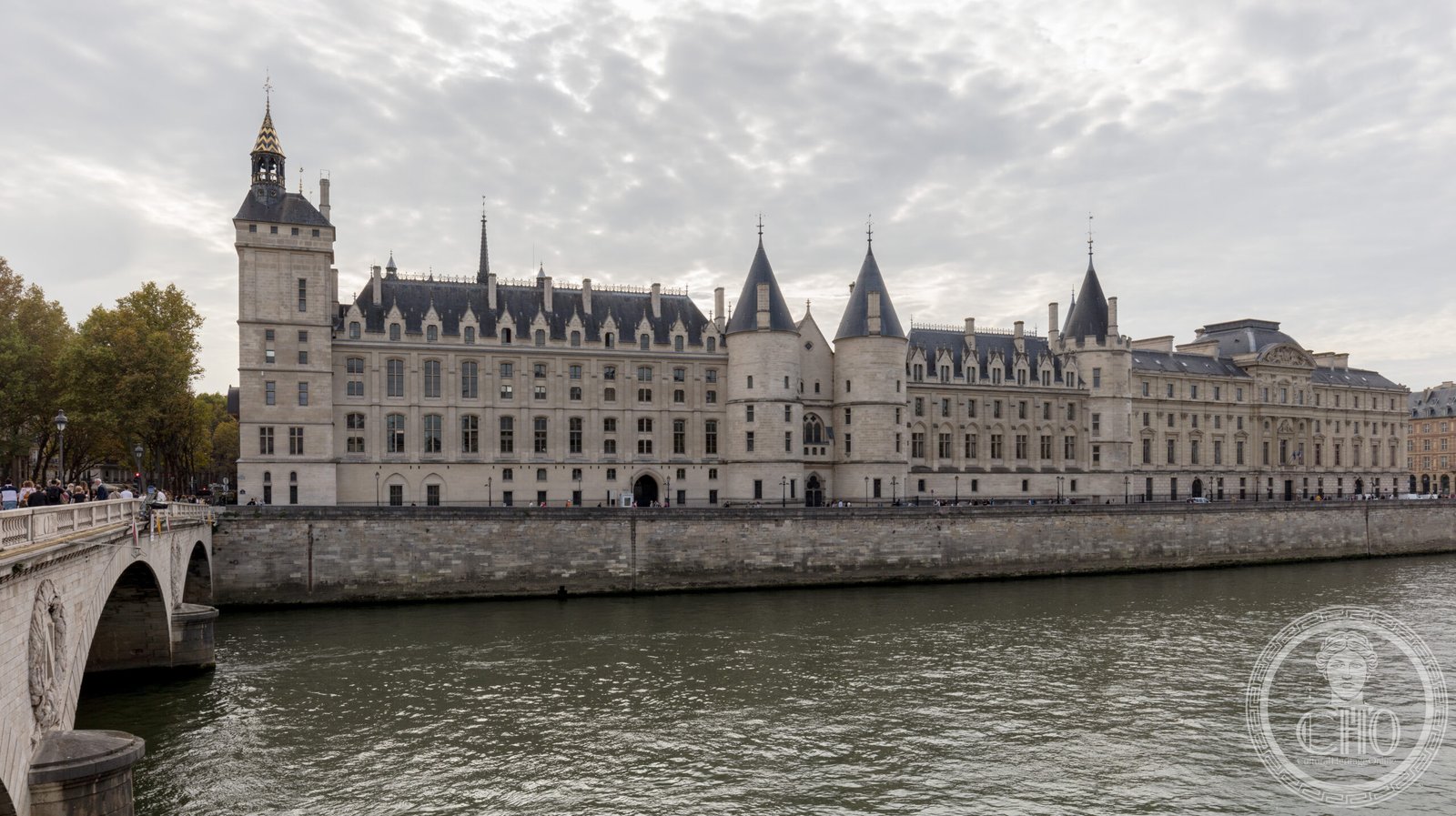
Conciergerie
The Conciergerie is a former royal palace and prison on the west end of the Île de la Cité in Paris, now preserved as a national monument and museum. Originally the seat of French royal government in the 10th century, it became a place of detention during the French Revolution, incarcerating 2,781 prisoners including Marie Antoinette before they were sent to the guillotine. Today it is one of the most visited heritage sites in France, notable for its two intact medieval great halls and its harrowing Revolutionary-era cells.
At a glance
- Type
- Former royal palace, prison, and national monument museum
- Period
- Royal palace: 10th century; Gothic halls: 1310–1315; prison in continuous use 1391–1914
- Style
- Gothic Rayonnant (great halls); later additions in Neoclassical and medieval revival styles
- Location
- 2, boulevard du Palais, 75001 Paris, France (Île de la Cité)
- Coordinates
- 48.8554° N, 2.3457° E
Overview
The Conciergerie forms the northern wing of the Palais de la Cité, the complex that also houses the Sainte-Chapelle. It served as the administrative heart of French royal power from the Merovingian period until Charles V relocated the court to the Louvre in the 14th century. The building takes its name from the concierge — the royal steward who managed the palace and later the prison. After the Revolution it became a symbol of the Terror, and its cells and registers are among the most complete documentary records of that period in Paris.
History
The Capetian kings commissioned new great halls in the early 14th century under Philip IV (the Fair), resulting in the Salle des Gens d’Armes (completed around 1315), one of the largest surviving Gothic secular interiors in Europe. When the Crown left the island palace in 1358 following the revolt of Étienne Marcel, the complex was entrusted to a concierge and progressively converted into a courthouse and prison. During the Reign of Terror (1793–1794), the Revolutionary Tribunal condemned thousands from this building. Marie Antoinette was held here from August to October 1793 before her execution; her cell has been reconstructed as a chapel and is a focal point of the museum visit.
What you see
The museum experience is anchored by the immense Salle des Gens d’Armes, a four-aisled Gothic hall of 1,800 square metres supported by 64 columns, still breathtaking in scale and largely original. Adjacent is the smaller Salle des Gardes and the kitchens with four monumental fireplaces. The Revolutionary-era section recreates prison conditions with reconstructed cells, including the Chapelle des Girondins and Marie Antoinette’s cell, alongside original registers listing condemned prisoners. The exterior Seine-front façade with its three rounded towers (Tour d’Argent, Tour Bonbec, Tour de César) defines the iconic medieval silhouette of the Île de la Cité.
Cultural significance
As one of the oldest intact medieval secular buildings in France and the principal site of Revolutionary detention, the Conciergerie operates on two layers of historical memory simultaneously: the grandeur of medieval kingship and the violence of republican Terror. It is inscribed within the UNESCO World Heritage designation of the Banks of the Seine and is managed by the Centre des monuments nationaux.
Practical information
- Address
- 2, boulevard du Palais, 75001 Paris, France
- Opening hours
- Daily 09:30–18:00 (last admission 17:30); closed 1 January, 1 May, 25 December. Check the Centre des monuments nationaux website for current hours.
- Admission
- Paid; combined tickets with Sainte-Chapelle available. Free for under-18s and EU residents under 26.
- Website
- monuments-nationaux.fr/monument/la-conciergerie
Getting there
Metro line 4, station Cité (exit boulevard du Palais), a 2-minute walk. RER B and C, station Saint-Michel–Notre-Dame. Bus lines 21, 38, 85, and 96 serve the Île de la Cité. Cyclists can use Vélib’ stations on both banks; the nearest car park is Parking Notre-Dame on the Right Bank.
Sources & resources
Find it on the map
See this place and what’s around it →📷 Diventa un fotografo di Cultural Heritage Online
Condividi le tue foto dei luoghi: restano pubblicate con la tua firma come autore. Più vengono viste, più ti fai conoscere — e presto un concorso premierà le foto più apprezzate.
Accedi o registrati gratis per aggiungere una foto