
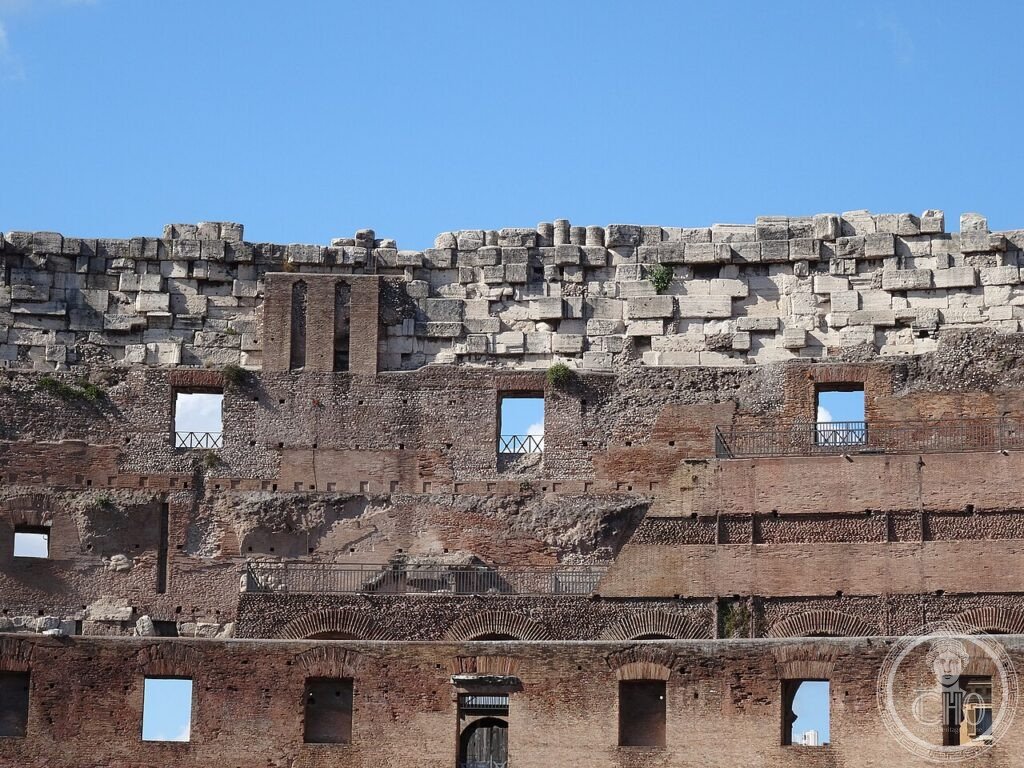
Colosseum
The largest amphitheatre ever built and the defining symbol of Rome — the Colosseum (Colosseo; the Flavian Amphitheatre; Rome, Italy; UNESCO WHS 1980) was built by the Flavian emperors Vespasian (70-79 CE) and Titus (completed 80 CE) and hosted gladiatorial contests, wild animal hunts (venationes), public executions, and staged naval battles (naumachia) before crowds of 50,000-80,000 for four centuries.
At a glance
Colosseum (the most precisely ColosseumRome single Vespasian Emperor 70 CE begun Titus completed 80 CE four years Domitian added fourth storey 82 CE Amphitheatrum Flavium official name Colossus Nero bronze 30m statue nearby former site Domus Aurea Nero golden house Vespasian drained lake filled Nero built Domus Aurea gave back people Colosseum 70 80 CE 10 years 100000 workers 60000 Jewish slaves Sack Jerusalem 70 CE financing Colosseum arena 83m × 48m wooden sand floor sand Latin harena hence arena word gladiatorial contests ludi 50000 80000 spectators 4 storeys Doric Ionic Corinthian attic 80 arches each storey 80 entrances numbered I LXXVII 4 Imperial entrances no numbers velarium awning sun shade 260 ropes 1000 sailors Misenum naval station operated shade 65000 seating 15000 standing total capacity 80000 400 years games 80 CE Titus opening 100 days 9000 animals killed first games UNESCO heritage: the hypogeum (the defining discovery of modern Colosseum scholarship: the underground network of tunnels and chambers (the hypogeum; “underground”; built by Domitian, 82 CE) beneath the wooden arena floor; the system of 28 freight elevator shafts (wooden platforms raised by counterweights and manual winches) that could simultaneously lift 28 caged animals, gladiators, and scenery props from the hypogeum onto the arena floor (through trapdoors that opened in the wooden sand floor); the reconstruction (the Colosseum arena floor is reconstructed in 2023 CE; for the first time since the medieval period, visitors can walk on a floor (16% of the original surface); the full arena floor reconstruction is planned for 2025-2027 CE)) — the most precisely ColosseumRome single Vespasian 70 CE Titus completed 80 CE 4 years 100000 workers 60000 Jewish slaves Colossus Nero 30m Domus Aurea lake drained Vespasian gave back people arena 83m × 48m wooden sand floor 80 arches 4 storeys Doric Ionic Corinthian attic velarium 260 ropes 1000 sailors Misenum 80000 capacity 400 years games Titus opening 100 days 9000 animals killed hypogeum Domitian 82 CE 28 elevators counterweights lift animals scenery 2023 CE arena floor reconstructed 16% 2025 2027 CE full planned UNESCO heritage in any UNESCO world heritage site)).
Key facts
- The naumachia (staged sea battles): the most precisely ColosseumRome single naumachia staged naval battles Titus opening games 80 CE flooded arena water 12 ships 3000 men re-enactment famous naval battle naumachia debate sources Cassius Dio Historia Romana 3rd century CE says naumachia Colosseum however logistically flooding 83m × 48m arena wooden floor sealing waterproofing Domitian 82 CE built hypogeum underground system underneath would make flooding impossible debate historians argued naumachia in separate lake Augusta Naumachia lake Trastevere not in Colosseum itself Suetonius Life Titus mentions sea battle held in old naumachia Augustus lake not Colosseum UNESCO heritage — one of the most debated events in the history of the Colosseum: Cassius Dio (History of Rome, 3rd century CE, book 66) writes that during the opening games in 80 CE, Titus staged a naumachia (staged sea battle) with 3,000 men and 12 ships, in addition to the gladiatorial and animal games; however, historians debate whether this naumachia took place IN the Colosseum (which would require flooding the arena to a depth sufficient for ships) or in the older Augustus Naumachia lake across the Tiber in Trastevere (which Suetonius implies in the Life of Titus); the construction of the underground hypogeum by Domitian in 82 CE made any future flooding of the arena impossible; the conclusion: if nautical games took place in the Colosseum at all, they occurred before the hypogeum was built (in the first 2 years of the building’s operation)
- GPS: 41.8902° N, 12.4922° E
History
From Flavian building site to medieval quarry to Christian monument to UNESCO (the most precisely ColosseumRome single 70 CE Vespasian Flavian Dynasty started construction former Domus Aurea lake 80 CE Titus completed 80 CE inauguration 100 days games 9000 animals killed 2000 gladiators fought 82 CE Domitian fourth storey added 248 CE Philip Arab 1000th anniversary Rome birthday celebration 405 CE Honorius banned gladiatorial combat ban gladiators games continued 6th century CE earthquake 443 CE damaged partially 484 520 CE earthquakes further damage 523 CE last recorded gladiatorial games 6th century CE converted monastery Church Colosseum 8th century medieval Bede Venerable monk 735 CE quote While Colosseum stands Rome shall stand when Colosseum falls Rome shall fall when Rome falls world shall fall medieval quarry Pope Sixtus IV 1480s CE travertine marble 60 wagonloads sold building Vatican workshops stone material spolia 1744 CE Pope Benedict XIV consecrated Christian martyrs Cross erected 1749 CE Spolia stops Romantic era visitors Byron Childe Harold Mark Twain Innocents Abroad 1869 CE Henry James 1875 CE 1980 CE UNESCO World Heritage Site UNESCO heritage: the medieval quarrying (the defining act of destruction: throughout the medieval and Renaissance periods, the Colosseum was used as a stone quarry (spolia); the travertine limestone and marble were extracted for reuse in other Roman buildings; Pope Sixtus IV (1484 CE) alone authorized the removal of 60 wagon-loads of travertine per week for construction of the Vatican workshops (the Chancellery, the Cancelleria palace); the original outer ring of the Colosseum had approximately 100,000 cubic metres of travertine limestone; approximately one-third of this has been removed and reused in other buildings; the result is that the north-facing arc of the outer wall is almost entirely gone; the 1980 CE UNESCO inscription and the subsequent conservation work halted further deterioration)) — the most precisely ColosseumRome single Vespasian 70 CE Titus 80 CE 100 days 9000 animals 2000 gladiators Domitian 82 CE fourth storey 405 CE Honorius banned gladiators 523 CE last recorded medieval monastery 8th century Bede 735 CE quote Colosseum falls Rome falls world falls medieval quarry Sixtus IV 1484 CE 60 wagons travertine Vatican workshops one-third removed 100000 cubic metres 1749 CE Benedict XIV Cross martyrs 1980 CE UNESCO heritage in any UNESCO world heritage site)).
What you see
Outer ring, arena, hypogeum, and the Forum Romanum (the most precisely ColosseumRome single outer ring 4 storeys 188m long 156m wide 57m high ground floor Doric arcade 80 arches second Ionic third Corinthian fourth attic Corinthian pilasters 80 rectangular windows 80 numbered entrance gates I-LXXVII 4 Imperial reserved unnumbered vaulted corridor vomitoria exits rapid exit 80000 spectators 10 minutes arena wood sand floor replaced replaced replaced 83m × 48m elliptical sand arena harena word origin hypogeum underground Domitian 82 CE 28 elevator shafts counterweights wooden platforms caged animals gladiators scenery 80 rooms corridors service areas animal cages storage gladiator prep areas 2023 CE partial arena floor reconstruction 16% floor visible velarium system 240 bollards external upper ring Roman numerals above each arch exterior via Sacra Sacred Way eastern end Forum Romanum Arch Titus 81 CE seven branched menorah Jerusalem UNESCO heritage: the visitor circuit: the exterior (the best views from the west (via Sacra) and the east (Piazza del Colosseo); the missing north arc is visible from the west approach); the interior (3 ticketing tiers: ground floor (the standard ticket (€20; includes the Arena + Forum Romanum + Palatino)); the underground hypogeum + upper levels (extra ticket required (€6 supplement for time-slotted visits))); the ground floor (the ambulatory circuit (the complete lower ring corridor); the reconstructed arena floor section (2023 CE; 16% of the original floor area; walk on the original travertine arena level; the hypogeum visible below through gaps in the floor)); the hypogeum (the underground network (28 elevator shafts; the corridors; the animal cages; the service tunnels); the extra ticket is strongly recommended); the upper levels (level 3 and 4; the best aerial view of the arena interior); the nearby Forum Romanum (included in the combined ticket (€20); the Sacred Way; the Arch of Titus; the Temple of Vesta; the Arch of Septimius Severus; the Palatine Hill (the oldest inhabited hill in Rome; the palace complexes of the emperors))) — the most precisely ColosseumRome single outer ring 4 storeys 188m 156m 57m Doric Ionic Corinthian attic 80 arches numbered entrances velarium 240 bollards upper ring arena 83m × 48m sand harena origin word hypogeum Domitian 82 CE 28 elevators counterweights 80 rooms 2023 CE 16% floor reconstruction Arch Titus 81 CE Forum Romanum combined ticket €20 underground €6 extra supplement time-slotted UNESCO heritage in any UNESCO world heritage site)).
Practical information
- Getting there: Rome has two main airports: Leonardo da Vinci International Airport (FCO; Fiumicino; connections from all major worldwide hubs; the FL Express train (Leonardo Express) to Roma Termini: 32 min; €14 each way)) and Ciampino Airport (CIA; low-cost carriers; bus to Roma Termini: 40 min; €6); the Colosseum is in the center of Rome (Metro Line B; the Colosseo station is 200m from the entrance); the tickets (€20 standard for Colosseum + Forum Romanum + Palatino (1 combined ticket for all three; valid 2 days for Forum and Palatino); book online in advance at coopculture.it to skip the queue (the in-person queue can be 2-3 hours in peak summer); the underground hypogeum (an additional €6 ticket; requires a timed slot; strongly recommended; book simultaneously when booking the standard ticket); the visiting time (minimum 1h30m for the Colosseum interior; the Forum Romanum + Palatino need a further 2-3h; plan a full morning or afternoon for the combined site)); the best time (spring (March-May) or autumn (September-November); the summer queue and heat are extreme; the Colosseum at night (sunset; the exterior is illuminated after dark; the evening light on the travertine is spectacular))
Getting there
Rome FCO airport → Leonardo Express 32 min → Roma Termini → Metro Line B → Colosseo (200m). Entry €20 (Colosseum + Forum + Palatino combined). Book online to skip queue. Underground hypogeum €6 extra (strongly recommended, book in advance). Allow 4-5h for full visit. GPS: 41.8902, 12.4922.
Nearby
- Forum Romanum and Palatine Hill — 200m west (included in the €20 combined ticket; the Forum Romanum (the civic center of ancient Rome (753 BCE-476 CE): the Arch of Titus (81 CE; the earliest surviving Roman triumphal arch in good condition; the relief panels show the spoils of Jerusalem (the seven-branched menorah and the trumpets) being carried in the Triumph of Titus (71 CE)); the Temple of Saturn (497 BCE; one of the oldest Roman temples); the Rostrum (the speakers’ platform where Julius Caesar gave funeral orations and where Marc Antony read Caesar’s will after the assassination (44 BCE)); the Arch of Septimius Severus (203 CE)); the Palatine Hill (the Domus Flavia and Domus Augustana; the imperial palaces; the view of the Circus Maximus from the Palatine terrace))
- Capitoline Museums — 800m northwest (the oldest public museums in the world (opened 1471 CE by Pope Sixtus IV); the original Capitoline Wolf (the Lupa Capitolina bronze (re-dated by neutron dating to the 13th century CE, not 5th century BCE as previously believed)); the Dying Gaul (the finest surviving Hellenistic marble sculpture); the bronze equestrian statue of Marcus Aurelius (the most perfectly preserved large-scale ancient bronze statue in existence); the Palazzo dei Conservatori (the twin palace on the opposite side of the Capitoline piazza, designed by Michelangelo))
Sources
- Wikipedia, Colosseum; Flavian amphitheatre; hypogeum of the Colosseum, accessed June 2026
- UNESCO, Historic Centre of Rome, WHS reference 91, inscribed 1980
Find it on the map
See this place and what’s around it →📷 Diventa un fotografo di Cultural Heritage Online
Condividi le tue foto dei luoghi: restano pubblicate con la tua firma come autore. Più vengono viste, più ti fai conoscere — e presto un concorso premierà le foto più apprezzate.
Accedi o registrati gratis per aggiungere una foto