
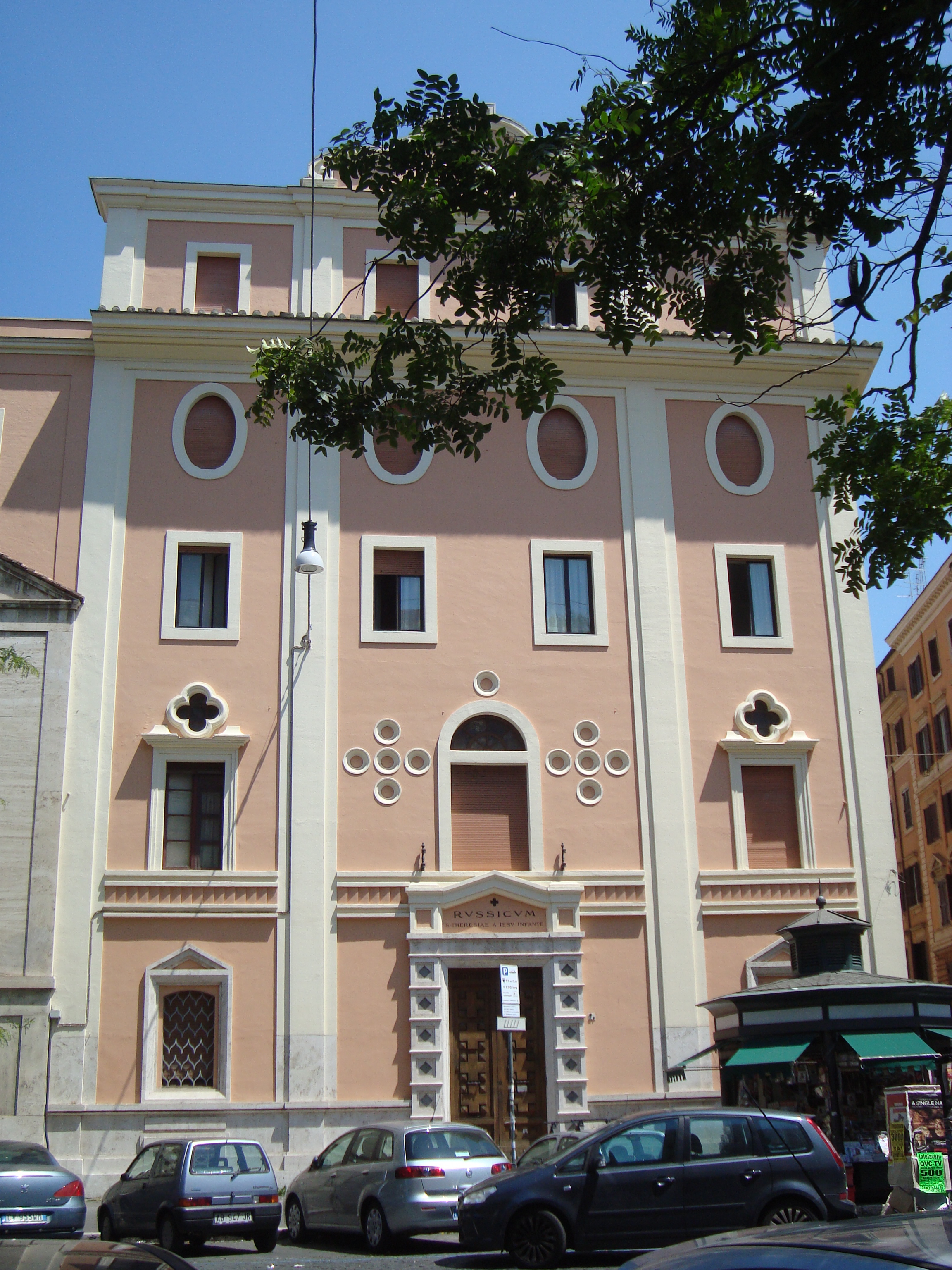
Collegium Russicum, Rome
The Collegium Russicum, formally the Pontificio Istituto Orientale russicum, is a Catholic college in Rome founded by Pope Pius XI in 1929 with the mission of training priests for pastoral work among Russian and Eastern Christian communities. Staffed by Jesuits, the college was established during a period of intense concern within the Holy See for the fate of Christians living under the Soviet regime, and its graduates were trained in Russian language, Byzantine rite liturgy, and the theology of the Eastern churches. The Collegium Russicum remains active today as an institution dedicated to Eastern Catholic and Orthodox studies.
At a glance
- Type
- Pontifical Catholic college — Eastern church studies
- Period
- Founded 1929 by Pope Pius XI
- Affiliation
- Society of Jesus (Jesuits); Pontifical Oriental Institute
- Location
- Via Carlo Cattaneo 2, 00185 Rome, Italy · 41.8969° N, 12.4984° E
Overview
The Collegium Russicum is a Catholic college in Rome, originally founded by Pope Pius XI and dedicated to training priests for the Russian Greek Catholic Church and related Eastern Christian communities. The college specialises in Byzantine rite liturgy, Russian language and culture, and Eastern Christian theology, forming clergy who can serve communities in Russia and the broader Orthodox and Eastern Catholic world. As part of the Pontifical Oriental Institute network, it continues to be an important centre for East-West ecclesiastical dialogue and scholarship.
History
Pope Pius XI established the Collegium Russicum in 1929 in the context of the Russian Revolution and the systematic persecution of the Catholic Church in the Soviet Union, with the aim of preparing priests who could minister clandestinely in Russia if circumstances allowed. The Jesuits were entrusted with its direction, and the college developed a rigorous curriculum combining theological formation with deep immersion in Russian language, history, and Byzantine liturgical tradition. During the Cold War, the Collegium Russicum attracted considerable attention as an institution whose graduates might one day serve in a post-Soviet Russia; several of its alumni were active in underground Catholic networks in Eastern Europe. After the fall of the Soviet Union, its mission adapted to encompass open pastoral work and ecumenical scholarship.
What you see
The college occupies a building in the Esquilino district of Rome, near the Basilica of Santa Maria Maggiore, in a neighbourhood with a concentration of pontifical institutes and Eastern Christian communities. The chapel of the Collegium Russicum is celebrated for its Byzantine rite iconography and liturgical furnishings, offering visitors a rare glimpse of Eastern Christian worship in the heart of Rome. The college library holds important holdings related to Russian church history, Eastern Christian theology, and Soviet-era religious history.
Cultural significance
The Collegium Russicum represents a distinctive chapter in 20th-century church history, embodying the Holy See’s determined efforts to maintain connection with Eastern Christian traditions during decades of Soviet repression. It remains a living institution bridging Latin and Eastern Christianity and serves as a reminder that Rome is home to numerous Eastern rite communities and institutions alongside the dominant Roman Catholic tradition.
Practical information
- Address
- Via Carlo Cattaneo 2, 00185 Rome, Italy
- Access
- The college is an active ecclesiastical institution; visits by appointment
- Nearby
- Basilica of Santa Maria Maggiore (0.3 km), Termini Station (0.4 km)
Getting there
The Collegium Russicum is located in the Esquilino neighbourhood of Rome, a short walk from Roma Termini, the city’s main railway hub. Metro lines A and B intersect at Termini. Numerous bus lines serve the area. From the historic centre the college is approximately 2 km, reachable by tram 5/14 or bus.
Sources & resources
Find it on the map
See this place and what’s around it →Historical events at this place (1)
📷 Diventa un fotografo di Cultural Heritage Online
Condividi le tue foto dei luoghi: restano pubblicate con la tua firma come autore. Più vengono viste, più ti fai conoscere — e presto un concorso premierà le foto più apprezzate.
Accedi o registrati gratis per aggiungere una foto