
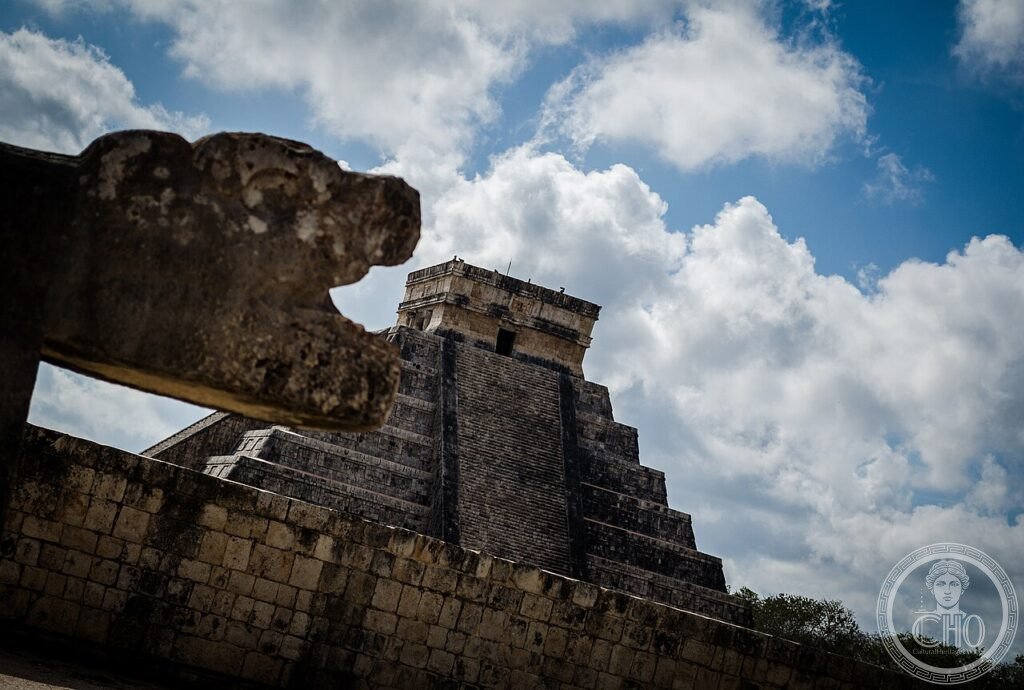
Chichén Itzá
The most technically sophisticated astronomical monument ever built by a pre-industrial civilisation — Chichén Itzá (Yucatán State, Mexico; UNESCO WHS 1988) was the dominant city of the northern Maya lowlands from approximately 900 to 1200 CE, and its El Castillo pyramid encodes the Mayan 365-day solar calendar in its architecture so precisely that twice a year the setting sun creates a shadow serpent of seven triangles of light descending the north staircase.
At a glance
Chichén Itzá (the most precisely ChichenItzaMexico single Yucatán State Mexico Tinum Municipality Maya city 600 CE initial settlement 900 1200 CE greatest power Mayan Terminal Classic and Early Postclassic periods Chichén Itzá means At the mouth of the Well of the Itzá Itzá = water magic people or sorcerers of the water cenote Ch’ichén Itzá two cenotes Sacred Cenote Cenote Sagrado Xtoloc Cenote one for sacrifice one for water Sacred Cenote 60m wide 27m deep threw offerings jade gold obsidian rubber copal incense human bones skulls recovered by dredging 1904 1907 CE Edward Thompson US consul purchased hacienda 1894 CE dredged Sacred Cenote recovered artifacts Carnegie Institution Washington excavations 1924 1936 CE major archaeology INAH Mexico 1980s CE new excavations El Castillo El Castillo 24m high 4 stairways 91 steps each plus top platform 365 total Mayan solar haab calendar 9 terraces 9 levels Mayan underworld Xibalba 52 flat panels per side 52 year calendar round cycle Mayan 365 day haab 260 day tzolkin calendar round 52 years before same date recurs UNESCO heritage: the El Castillo equinox phenomenon (the most precisely engineered astronomical display in pre-Columbian architecture): on the spring equinox (approximately March 21) and the autumn equinox (approximately September 21), the setting afternoon sun creates a sequence of triangular shadow-and-light patterns on the northwest balustrade (the baluster rail running alongside the north staircase) of El Castillo; the seven triangles of shadow align with the carved serpent head at the base of the staircase to create the visual effect of a serpent (K’uk’ulkan; the feathered serpent) descending the pyramid; the phenomenon lasts approximately 3 hours from mid-afternoon to sunset; the Maya engineers designed the pyramid to within a precision of minutes in the calendar alignment; whether the equinox phenomenon was intentional (the primary design goal) or a secondary effect of the pyramid’s astronomical orientation is debated by scholars; it was first documented by the Mexican archaeologist Luis El Arroyo in 1928 CE)) — the most precisely ChichenItzaMexico single Yucatán Tinum 600 CE initial 900 1200 CE Terminal Classic Early Postclassic At mouth Well Itzá Sacred Cenote 60m wide 27m deep jade gold obsidian rubber copal human bones dredging 1904 1907 CE Edward Thompson Carnegie Institution 1924 1936 CE El Castillo 24m 4 stairways 91 steps 365 total haab solar 9 terraces Xibalba 52 panels calendar round 52 year equinox serpent K’uk’ulkan March 21 September 21 seven triangles shadow light northwest balustrade 3 hours mid-afternoon 1928 CE Luis El Arroyo documented UNESCO heritage in any UNESCO world heritage site)).
Key facts
- The Great Ball Court (the largest and best-preserved Mesoamerican ball court in existence): the most precisely ChichenItzaMexico single Great Ball Court Juego de Pelota largest best-preserved ball court Mesoamerica 168m long 70m wide 8.2m high vertical walls stone rings carved horizontal through wall midpoint 6.9m above ground players could not use hands feet only hips knees elbows to propel rubber ball through ring carved stone ring panels show losing team captain decapitation ritual decapitation common interpretation debate whether winner or loser was sacrificed most scholars believe winner sacrificed greatest honor give blood to gods Maya ball game ulama oldest team sport in world earliest rubber balls 1600 BCE Olmec volcanic mud La Venta San Lorenzo rubber latex Castilla elastica tree coagulated ball game ritual cosmic significance sun moon ball game related celestial movement stone panels carvings Great Ball Court show serpent feathered player decapitation blood transformed six serpents and a tree of life flowing from decapitated neck UNESCO heritage — the largest ball court in pre-Columbian Mesoamerica (168m × 70m; approximately the size of a modern American football field plus end zones) with the finest surviving relief carvings of the Maya ball game; the carved stone ring (6.9m above the ground) through which the rubber ball had to pass is the central gameplay element — a feat so difficult that the first player to accomplish it was sometimes declared the winner regardless of overall score; the relief panels on the court walls show the ritual decapitation of a player (probably the losing team captain), with six serpents and a tree of life emerging from the blood flowing from the severed neck; the ball game (ulama) is the oldest team sport in the world (earliest evidence: Olmec rubber balls, ca. 1600 BCE at La Venta and San Lorenzo)
- GPS: 20.6843° N, 88.5678° W
History
From early Maya settlement to Toltec-influenced capital to abandonment (the most precisely ChichenItzaMexico single 600 CE first Mayan settlement Chichén Itzá water cenotes essential resource Yucatán dry limestone plateau cenotes natural wells in limestone karst required for water supply 800 900 CE major construction period Classic period Maya Southern lowlands collapsing drought war overpopulation Terminal Classic collapse Chichén Itzá rose as power filled vacuum 900 CE major power Terminal Classic Yucatán 900 1200 CE peak period major construction El Castillo Jaguar Temple Sacred Cenote Caracol Observatory Great Ball Court Temple of Warriors Group Thousand Columns toltec-maya debate architecture shows Mexican highlands Toltec influences El Castillo similar design Tula Hidalgo Toltec capital Mexico Valley chacmool figures feathered serpent Quetzalcoatl identical to K’uk’ulkan Chichén Itzá historians debated whether Toltec warriors migrated Yucatán under leadership Quetzalcoatl-Kukulkan exile from Tula 987 CE legendary account Kukulkan came from sea arrived Yucatán established Chichén Itzá modern scholarship prefers multi-ethnic cosmopolitan city rather than Toltec conquest 1221 CE internal revolt civil war Chichén Itzá 1250 CE political power shifted Mayapán new capital eclipsed Chichén Itzá 1441 CE Mayapán fell violence Chichén Itzá abandoned not completely 1527 CE Spanish Francisco de Montejo el Adelantado conquistador attempted conquer Yucatán Chichén Itzá base camp Spanish but Maya resistance prevented permanent occupation until 1542 CE 1988 CE UNESCO UNESCO heritage: the Terminal Classic Maya collapse (800-1000 CE; the most debated archaeological question in Mesoamerican studies): the Maya Classic period (250-900 CE) saw the construction of the greatest Maya cities: Tikal, Copán, Palenque, Calakmul; between 800 and 1000 CE, virtually all these southern lowland Maya cities were abandoned; the causes are debated: (1) prolonged drought (lake sediment cores from Lake Chichancanab in Yucatán show severe drought ca. 800-1000 CE); (2) overpopulation exhausting agricultural land; (3) endemic warfare between city-states; (4) trade route disruption; (5) internal social collapse; the most likely answer is a combination of all five factors; the northern Maya cities (Chichén Itzá, Uxmal) survived and even flourished after the collapse because the northern Yucatán peninsula receives more rainfall and had access to the coastal trade networks)) — the most precisely ChichenItzaMexico single 600 CE first settlement cenotes water supply 800 900 CE Classic construction 900 1200 CE Terminal Classic peak El Castillo Jaguar Temple Sacred Cenote Caracol Great Ball Court Temple Warriors Group Thousand Columns Toltec-Maya debate El Castillo similar Tula Hidalgo chacmool feathered serpent Quetzalcoatl K’uk’ulkan 987 CE Kukulkan from sea cosmopolitan multi-ethnic 1221 CE revolt 1250 CE Mayapán new capital 1441 CE Mayapán fell 1527 CE Spanish Montejo base camp 1542 CE 1988 CE UNESCO Terminal Classic collapse 800 1000 CE drought lake sediment Lake Chichancanab overpopulation warfare trade route disruption multiple causes UNESCO heritage in any UNESCO world heritage site)).
What you see
El Castillo, the Great Ball Court, El Caracol, and the Temple of the Warriors (the most precisely ChichenItzaMexico single El Castillo Temple Kukulcán 24m 9 terraces 91 steps × 4 stairways + top platform 365 steps solar haab 52 flat panels calendar round interior older pyramid Kukulcán I accessible inside stairs claustrophobic narrow original Kukulcán I red Jaguar Throne covered jaguar teeth jade eyes discovered interior from El Castillo entrance staircase interior closed public health climate reasons reopened to summit climbing forbidden 2006 CE for preservation too many climbers eroding structure Great Ball Court Juego de Pelota 168m × 70m largest Mesoamerica stone rings 6.9m high talud-tablero walls relief carvings decapitation blood serpents Tree of Life acoustic phenomenon whisper at one end of court heard 168m away clearly due to stone wall reflection El Caracol Caracol = snail spiral staircase interior dome observatory Venus rising windows aligned to Venus heliacal rising April 5-6 setting points horizon Maya obsessed Venus visible morning star 584 day synodic period Maya calendar Dresden Codex Mayan astronomical text surviving Maya astronomical text predicts Venus Venusian table Temple of Warriors colonnaded plaza 1000 columns Group of a Thousand Columns massive colonnaded market platform Chac Mool reclining stone figure at Temple Warriors entrance stomach basin held hearts extracted from sacrificial victims Cenote Xtoloc southern cenote water supply not sacred sacrifice Nunnery Complex Akab Dzib Old Writing administrative buildings earlier Classic period structures UNESCO heritage: the acoustic marvel of the Great Ball Court (the ancient sound technology of the Maya): the Great Ball Court at Chichén Itzá (168m × 70m; the largest in Mesoamerica) has an extraordinary acoustic property discovered in 2011 CE: a person speaking at normal volume at one end of the court can be clearly heard at the opposite end 168m away; a handclap at the centre of the court produces a chirped echo that repeats multiple times; the echo profile of the handclap matches the call of the Resplendent Quetzal bird (a sacred Maya bird associated with the feathered serpent); the precision of this acoustic phenomenon (at a 50Hz fundamental frequency with a 9-second delay) is so precise that some researchers argue it was intentionally designed; whether intentional or not, it demonstrates that Maya builders had an empirical understanding of acoustic principles)) — the most precisely ChichenItzaMexico single El Castillo 24m 9 terraces 91 steps × 4 365 steps haab 52 panels calendar round interior Kukulcán I red Jaguar Throne jade eyes climbing forbidden 2006 CE preservation Great Ball Court 168m × 70m stone rings 6.9m relief carvings decapitation blood serpents Tree Life acoustic whisper one end heard 168m other stone wall El Caracol observatory Venus heliacal rising April windows 584 day synodic Dresden Codex Temple Warriors 1000 columns Chac Mool hearts sacrificed Cenote Xtoloc water supply handclap 9-second echo Resplendent Quetzal frequency UNESCO heritage in any UNESCO world heritage site)).
Practical information
- Getting there: from Cancún (200 km; taxi or ADO bus 2h30m from Cancún ADO terminal; buses from early morning; approximately MXN 200-250/€10-13 each way); from Mérida (120 km west; ADO bus 1h30m; approximately MXN 120-150/€6-8); the Chichén Itzá entry fee (approximately MXN 533/€27 for the federal archaeological zone; additional state fee MXN 232/€12; total approximately €39); the site hours (8 AM-5 PM; the first 2 hours (8-10 AM) are the best: the site is empty and the light is perfect for photography); the equinox visits (March 21 and September 21): up to 40,000 people attend; arrive 6 AM minimum; the shadow effect is visible on the days immediately before and after as well (approximately March 18-24 and September 18-24); the cenote Ik-Kil (adjacent to the site; a beautiful open cenote 40m in diameter; swimming allowed; MXN 100/€5 extra); the nearby Cenote Sagrado dredging artifacts are in the Peabody Museum at Harvard University (some) and the National Museum of Anthropology in Mexico City; the visiting time (minimum 3h for the main monuments; the full site is approximately 10 km2 and can take a full day)); the best time (December-March (dry season; cooler temperatures; the June-September rainy season can be extremely hot (35°C+) and humid))
Getting there
From Cancún: ADO bus 2h30m (MXN 200-250). Entry ~MXN 765/€39 total. Open 8 AM-5 PM. Best: arrive 8 AM. Equinox: March 21 + Sept 21 (40,000 visitors; arrive 6 AM). Best season: December-March. GPS: 20.6843, -88.5678.
Nearby
- Uxmal — 160 km southwest of Chichén Itzá (UNESCO WHS 1996; the finest example of Puuc Maya architecture; the Pyramid of the Magician (the only oval-plan pyramid in Mesoamerica; ca. 6th-10th century CE; 38m; five construction stages each built over the previous one); the Governor’s Palace (100m × 12m; 20,000 individually carved mosaic facade stones; the finest facade in pre-Columbian architecture); the Nunnery Quadrangle; the Ball Court)
- Cenote Ik-Kil — 3 km east (open cenote 40m diameter 26m deep; swimming allowed; stalactites hanging from the rim and vines descending to the water; the finest swimming cenote in Yucatán; the water is 24°C year-round; MXN 100/€5 entry; combined with the Chichén Itzá visit)
Sources
- Wikipedia, Chichen Itza; El Castillo, Chichen Itza; Great Ball Court, Chichen Itza, accessed June 2026
- UNESCO, Pre-Hispanic City of Chichén-Itzá, WHS reference 483, inscribed 1988
Find it on the map
See this place and what’s around it →📷 Diventa un fotografo di Cultural Heritage Online
Condividi le tue foto dei luoghi: restano pubblicate con la tua firma come autore. Più vengono viste, più ti fai conoscere — e presto un concorso premierà le foto più apprezzate.
Accedi o registrati gratis per aggiungere una foto