
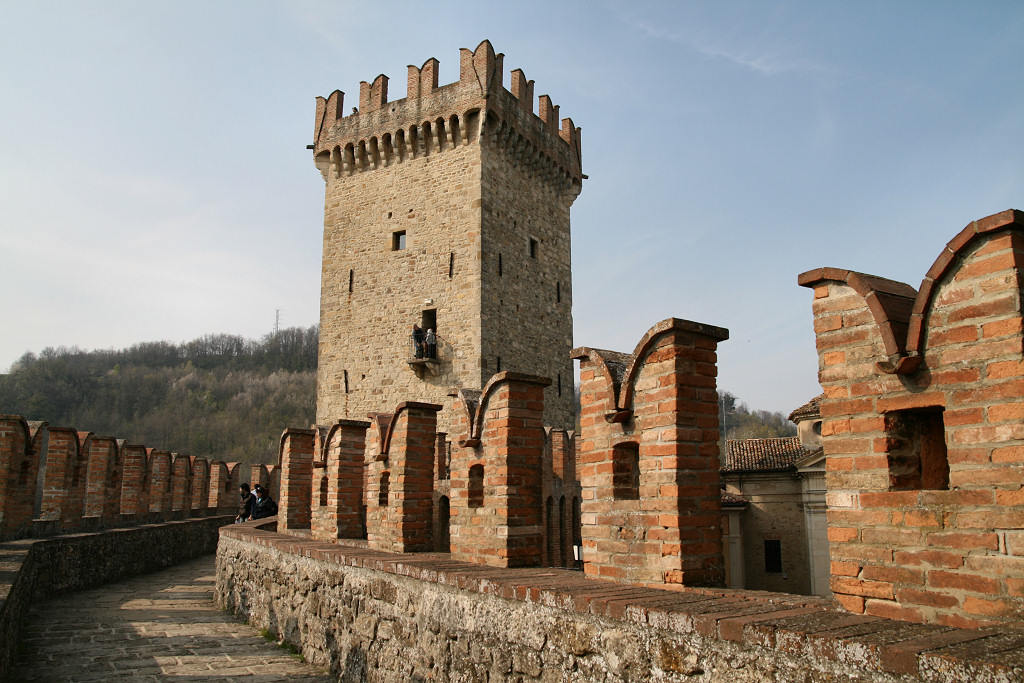
Castle of Vigoleno
The Castle of Vigoleno is a remarkably well-preserved medieval fortified village in the municipality of Vernasca, in the Piacenza Apennine foothills of Emilia-Romagna, Italy. First documented in 1050 and substantially expanded in the 14th century, the castle retains its complete ring of crenellated walls, towers, and internal borgo, making it one of the most intact examples of medieval military architecture in northern Italy. The castle became famous in the early 20th century as the summer retreat of Marchesa Pauline Bonaparte Borghese and other European aristocrats drawn to its romantic hilltop isolation.
At a glance
- Type
- Fortified medieval castle and walled village
- Period
- First documented 1050; major works 13th–14th century
- Style
- Medieval military architecture; Romanesque-Gothic
- Location
- Vigoleno, Vernasca, Province of Piacenza, Emilia-Romagna, Italy
- Coordinates
- 44.8166° N, 9.9012° E
Overview
Vigoleno occupies a naturally defensive ridge overlooking the Stirone river valley at an elevation of approximately 560 metres, with views extending across the Po Plain toward the Alps on clear days. The fortified complex comprises the castle proper with its keep, a walled borgo of medieval houses, a Romanesque parish church dedicated to San Giorgio, and a complete circuit of curtain walls with round and square towers. The entire settlement — castle, village, and walls — is enclosed within a single ring of defences that has remained almost unchanged since the 14th century.
History
The site appears in written records from 1050 as a possession of the Scotti family, one of the great noble dynasties of Piacenza, who held it for several centuries. The castle was substantially rebuilt and reinforced in the 13th and 14th centuries, taking the form that survives today, including the distinctive square keep and the circuit of walls with their evenly spaced towers. In the early 20th century, the property was acquired by Count Giuseppe Cora, who carried out a careful restoration and turned the castle into a fashionable aristocratic retreat, attracting notable guests including Eleonora Duse, Gabriele d’Annunzio, and members of the European nobility. The castle remains privately owned and is managed as a heritage accommodation and events venue.
What you see
The approach along a ridge road reveals the castle’s dramatic silhouette: a tall square keep rising behind a curtain wall punctuated by round corner towers, all in pale local limestone. Passing through the main gate, visitors enter a cobbled medieval village street lined with stone houses and a small piazza facing the Romanesque church of San Giorgio, whose interior contains 14th-century fresco fragments. The keep’s upper floors offer panoramic views of the surrounding Apennine valleys, and the walkway along the top of the walls provides a complete circuit of the fortifications.
Cultural significance
Vigoleno is one of the few Italian medieval villages to survive intact within its complete ring of defensive walls, a rarity that has led to its inclusion in the I Borghi più belli d’Italia (The Most Beautiful Villages of Italy) association. The castle’s early 20th-century associations with Italian literary and artistic figures — particularly Eleonora Duse and Gabriele d’Annunzio — give it additional cultural resonance as a site of the Belle Époque intellectual world. Its extraordinary state of preservation makes it a reference point for historians of medieval military architecture in the Po Valley.
Practical information
- Address
- Vigoleno, 29010 Vernasca PC, Italy
- Hours
- Check official website for current opening times; the castle operates as a private accommodation and events venue
- Admission
- Check official website for visit and accommodation bookings
Getting there
Vigoleno is located in the Apennine foothills approximately 40 kilometres south-east of Piacenza. The most practical access is by car via the SS359 from Alseno or Vernasca; the nearest railway station is at Fidenza (Parma–Milan line), from which the castle is approximately 25 kilometres by road. Limited local bus services connect Vernasca with Piacenza on weekdays, but a private vehicle is strongly recommended for visiting the castle.
Sources & resources
Find it on the map
See this place and what’s around it →📷 Diventa un fotografo di Cultural Heritage Online
Condividi le tue foto dei luoghi: restano pubblicate con la tua firma come autore. Più vengono viste, più ti fai conoscere — e presto un concorso premierà le foto più apprezzate.
Accedi o registrati gratis per aggiungere una foto