
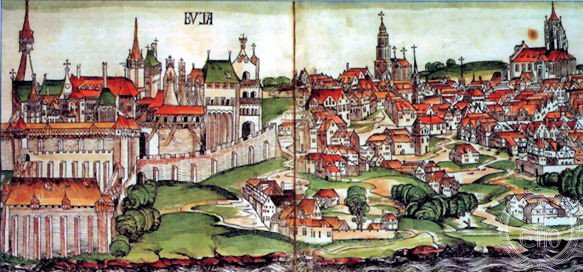
Buda Castle (Castello di Buda)
Buda Castle, formerly known as the Royal Palace and the Royal Castle, is the historical castle and palace complex of the Hungarian kings on Castle Hill in Budapest. First completed in 1265, the Baroque palace that dominates the site today was constructed between 1749 and 1769 under Empress Maria Theresa, severely damaged during the Siege of Budapest in World War II, and rebuilt in a simplified Baroque style during the communist era. The complex now houses three of Hungary’s most important cultural institutions: the Hungarian National Gallery, the Budapest Historical Museum, and the National Széchényi Library.
At a glance
- Type
- Royal castle and Baroque palace complex
- Period
- First completed 1265; Baroque palace 1749–1769; post-WWII reconstruction 1950s–1980s
- Style
- Gothic origins; Baroque; simplified Baroque (reconstruction)
- Location
- Castle Hill (Várhegy), Budapest I district, Hungary
- Coordinates
- 47.4962° N, 19.0374° E
Overview
Buda Castle crowns the southern end of Castle Hill, forming the centrepiece of the Budapest Castle District UNESCO World Heritage Site designated in 1987. The complex spans over 200 rooms in the Baroque main wing and commands panoramic views over the Danube and the Pest cityscape from its terraced gardens and the iconic Matthias Fountain courtyard. Together with the adjacent Castle District historic quarter, it constitutes the most visited cultural destination in Hungary.
History
King Béla IV of Hungary ordered the construction of a royal palace on the hill following the Mongol invasion of 1241–42, and the first significant palace complex was completed in the mid-thirteenth century. The castle reached its greatest medieval splendour under King Matthias Corvinus (r. 1458–1490), who transformed it into one of the leading Renaissance courts of Europe, adorned with humanist scholars, Italian craftsmen, and an extensive library. The Ottomans occupied the castle from 1541 to 1686, after which it lay in ruins; the Habsburgs commissioned a new Baroque palace from 1715 onward, expanded to its current imposing scale by Empress Maria Theresa between 1749 and 1769. During the Siege of Budapest in 1944–45 the palace was nearly totally destroyed; reconstruction under the communist government retained the external Baroque form while converting the interiors for museum use.
What you see
The main Baroque wing presents a long, symmetrical Baroque facade facing the Danube, punctuated by the large central dome and flanking wings; the Habsburg Steps and the Matthias Fountain (depicting the legendary hunt of King Matthias) animate the courtyards. Underground, medieval excavations have revealed the vaulted cellars and foundations of the Árpád-era and Angevin palaces, accessible through the Budapest Historical Museum. The Hungarian National Gallery within the palace holds the most comprehensive collection of Hungarian painting and sculpture from the medieval period to the twentieth century, including works by Mihály Munkácsy and László Paál.
Cultural significance
Buda Castle embodies over seven centuries of Hungarian royal ambition, foreign occupation, destruction, and reconstruction — a palimpsest of national history inscribed in stone and brick. Its inclusion in the UNESCO World Heritage Site underscores its exceptional universal value as a complex that has repeatedly served as the political and cultural centre of a Central European state. The ongoing debate over restoration priorities — particularly efforts to recover medieval fabric beneath the communist-era reconstruction — reflects broader Hungarian conversations about national memory and heritage identity.
Practical information
- Address
- Szent György tér 2, Budapest 1014, Hungary
- Museums on site
- Hungarian National Gallery, Budapest Historical Museum, National Széchényi Library
- Opening hours
- Museums generally Tuesday–Sunday; check individual museum websites for current hours
- Admission
- Entrance to the grounds is free; museum tickets required for interiors
Getting there
From Clark Ádám tér (foot of the Chain Bridge on the Buda side), take the Castle Hill funicular (Budavári Sikló) — a short and scenic ascent. Alternatively, bus lines 16 and 16A run from Széll Kálmán tér (Metro M2) directly into the Castle District. On foot, the castle is accessible via the steep stairways from the Danube embankment or the Bécsi kapu (Vienna Gate) entrance from the north.
Sources & resources
- Wikipedia — Buda Castle: en.wikipedia.org/wiki/Buda_Castle
- Hungarian National Gallery: mng.hu
- Cultural Heritage Online: culturalheritageonline.com
Find it on the map
See this place and what’s around it →📷 Diventa un fotografo di Cultural Heritage Online
Condividi le tue foto dei luoghi: restano pubblicate con la tua firma come autore. Più vengono viste, più ti fai conoscere — e presto un concorso premierà le foto più apprezzate.
Accedi o registrati gratis per aggiungere una foto