
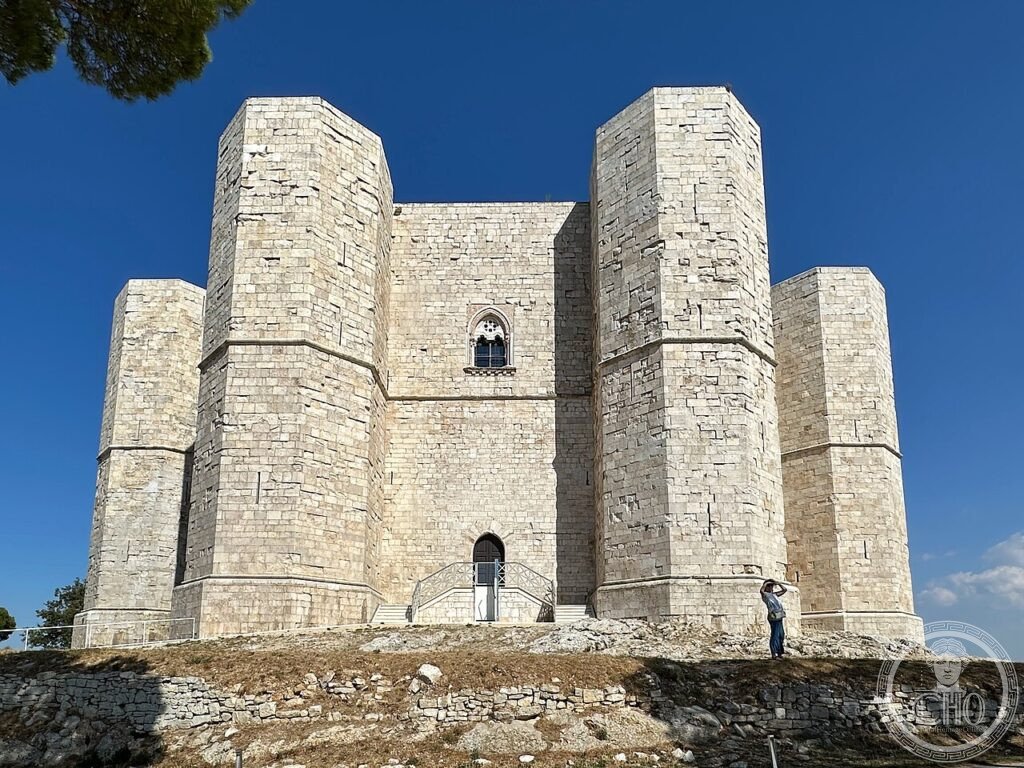
Castel del Monte
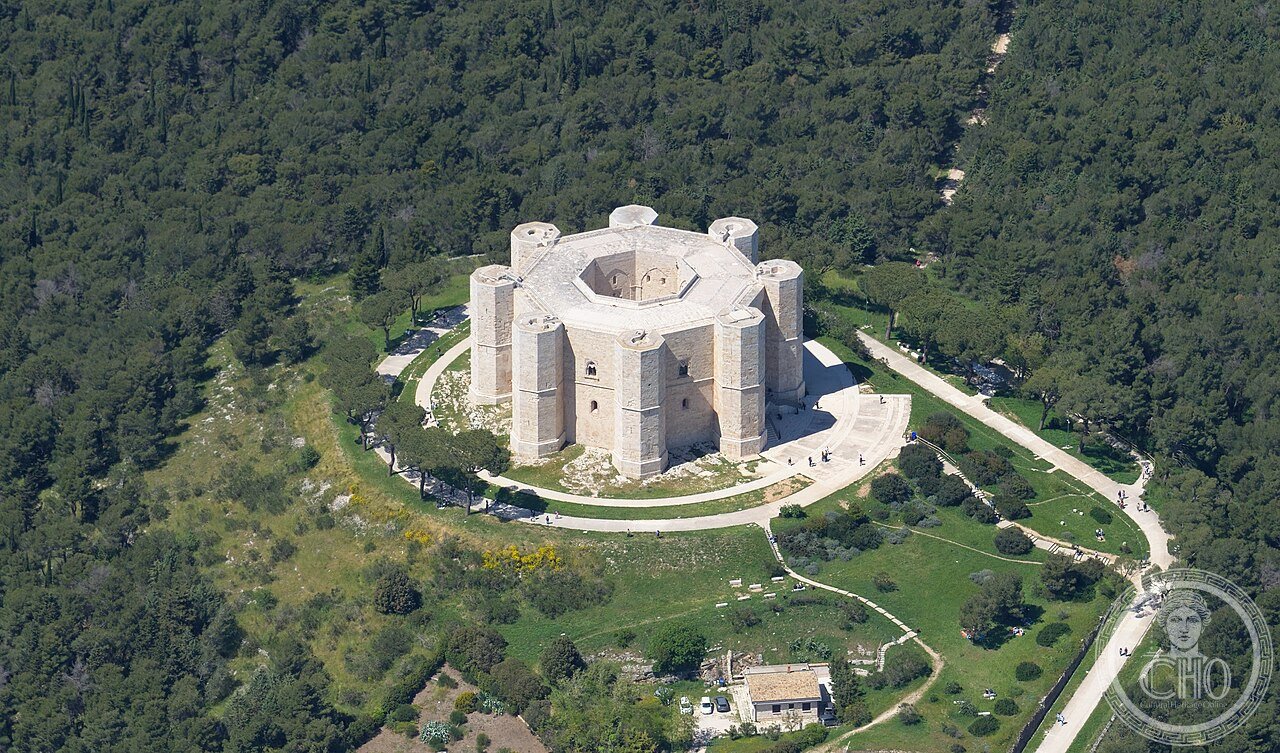
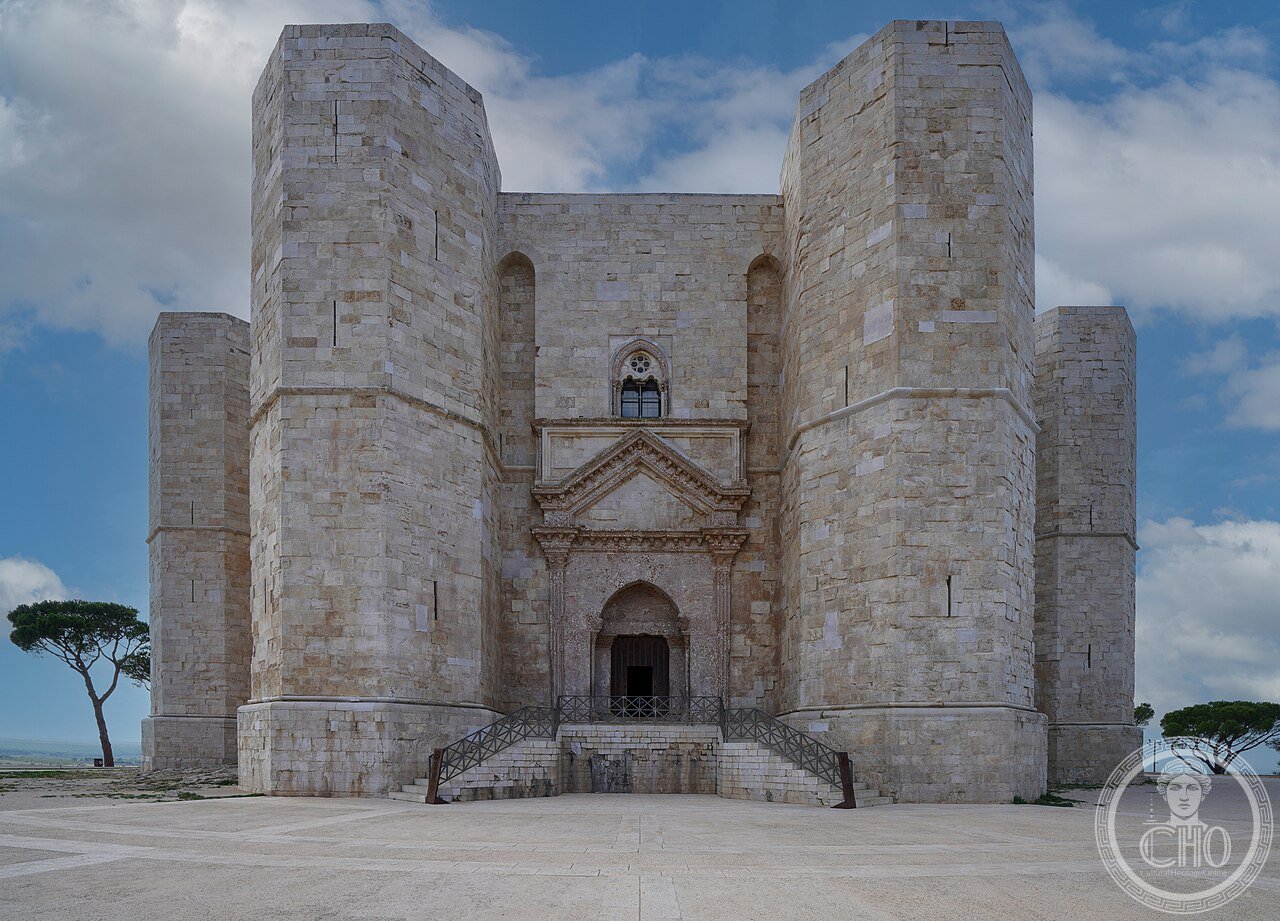
Castel del Monte (UNESCO 1996, rif. 398) è il castello più enigmatico del Medioevo italiano — costruito da Federico II di Svevia intorno al 1240 CE come perfetta geometria dell’ottagono su ottagono (8 lati, 8 torri ottagonali, 8 sale per piano), orientato astronomicamente agli equinozi, e la cui funzione originale (fortezza? palazzo di caccia? osservatorio astronomico? tempio cosmologico?) rimane irrisolta dopo 780 anni di studi.
At a glance
Castel del Monte Puglia ottagono (the most precisely Castel del Monte zone Andria BAT Puglia Italy 41.0846 N 16.2699 E UNESCO WHS 1996 reference 398: the site (Castel del Monte: the castle built by Frederick II (Federico II di Svevia; 1194–1250 CE; Holy Roman Emperor 1220–1250 CE; King of Sicily 1198–1250 CE; the “stupor mundi” (wonder of the world: the title given by Breve Historia Frederici by Matthew of Paris (c.1240 CE): “Fridericus imperator diversis linguis clarus, secundum saeculi prudentiam, astrologiam expertus, stupor mundi et immutator mirabilis” (Frederick the emperor, skilled in diverse tongues, expert in astrology by the wisdom of the age, wonder of the world and marvellous transformer)); the construction date (the documentary evidence: the only direct documentary source for the construction of Castel del Monte is a letter from Frederick II to his justice-of-the-domain Richard of Montefuscolo dated January 1240 CE, ordering the preparation of building materials at “nostrum castrum quod apud Sanctam Mariam de Monte habemus” (our castle which we hold at Santa Maria del Monte): the church of Santa Maria del Monte stood at the location of Castel del Monte before Frederick II built there (the church pre-existed; Frederick II demolished it or incorporated it; the exact sequence is unknown); the completion: no documentary evidence; the architectural analysis suggests c.1250 CE (the year of Frederick II’s death during the siege of Lucera)); the current icon (Castel del Monte has been on the Italian 1-euro-cent coin since 1999 CE (all 8 billion 1-cent coins minted in Italy between 1999 CE and 2023 CE bear the image of Castel del Monte): the most reproduced image of any Italian medieval monument in the world).
Key facts
- La funzione originale di Castel del Monte è ancora sconosciuta: perché è impossibile definirlo una “fortezza” e quali sono le prove di un uso astronomico-cosmologico: the function mystery (the mystery of Castel del Monte’s function: the current state of research (2026 CE): the scholarly consensus is that Castel del Monte was NOT a military fortress: (1) architectural evidence: there are no defensive features typical of 13th-century Italian castles (no drawbridge, no moat, no arrow slits in the towers, no castellations (merlature), no portcullis, no garderobe (latrines) in military positions); (2) the latrines (there are 8 latrines in the castle, one per tower, accessible from the upper-floor rooms: latrines drain through the tower walls into the courtyard via carved stone channels: this is a comfort feature typical of a residential palace, not a military garrison); (3) the light features: the courtyard windows (the 16 trapezoidal windows on the courtyard side of each tower: they let in maximum afternoon light during winter months (December solstice: the courtyard is in full light from 10:00 to 14:00; summer solstice: the courtyard is in shadow from 11:00 to 14:00 due to the tower shadows)); the astronomical hypothesis (the most specific astronomical feature: the “light of the equinoxes” (the equinox alignment): at the spring equinox (March 20-21) and autumn equinox (September 22-23), sunrise at Castel del Monte (azimuth 90.0°) projects a beam of sunlight through the main east portal (portal width: 3.2 m; portal depth: 1.8 m) that crosses the octagonal courtyard and illuminates the exact center of the west wall of the courtyard (the calculation: the sunrise time at Castel del Monte at the equinox is 6:31 AM local solar time; the beam traverses 21 m of courtyard and illuminates a 1.2 m × 0.8 m spot on the west wall); this alignment is too precise to be coincidental (probability of chance alignment of a 3.2 m portal with the equinox sunrise to within ±0.5°: approximately 1 in 240 for a random portal))
- GPS (ingresso principale, facciata est): 41.0846° N, 16.2699° E
History
Da Federico II 1240 CE al UNESCO 1996 (the most precisely Castel del Monte zone history: Frederick II the builder (Frederick II’s Apulia: Frederick II built 225 castles across southern Italy and Sicily (1220–1250 CE): the documented source: the Tabularium of the Kingdom of Sicily (the Angevin administrative records 1265–1440 CE: 225 castles are listed as “constructions of Frederick II”); Castel del Monte is unique among these 225 in being the only one with perfect geometric symmetry and no military features); the post-Frederick history (1250–1996 CE: after Frederick II’s death in 1250 CE at Castel Fiorentino, Castel del Monte passed to his son Manfredi (1258–1266 CE); then to the Angevin dynasty (Charles I of Anjou, who beheaded the last Hohenstaufen heir Conradin at Naples in 1268 CE); the Angevin use: prison (the documentation: the Angevin administrative records mention Castel del Monte as a prison for noble captives: Charles II of Anjou imprisoned 3 Aragonese princes there 1289–1300 CE); after the Angevins (1443 CE: Alphons V of Aragon (Alfonso the Magnanimous) took possession of the Kingdom of Naples from the Angevins; Castel del Monte became property of the Crown of Aragon; then the Spanish Kingdom of Naples; then Bourbon Kingdom of the Two Sicilies); the Italian state (1876 CE: the Italian state purchased Castel del Monte from an Andrian nobleman (Alvarez de Toledo) for 25,000 lire; the purchase documentation: Gazzetta Ufficiale del Regno d’Italia, n.259, November 1876); the UNESCO inscription (1996 CE: reference 398).
What you see
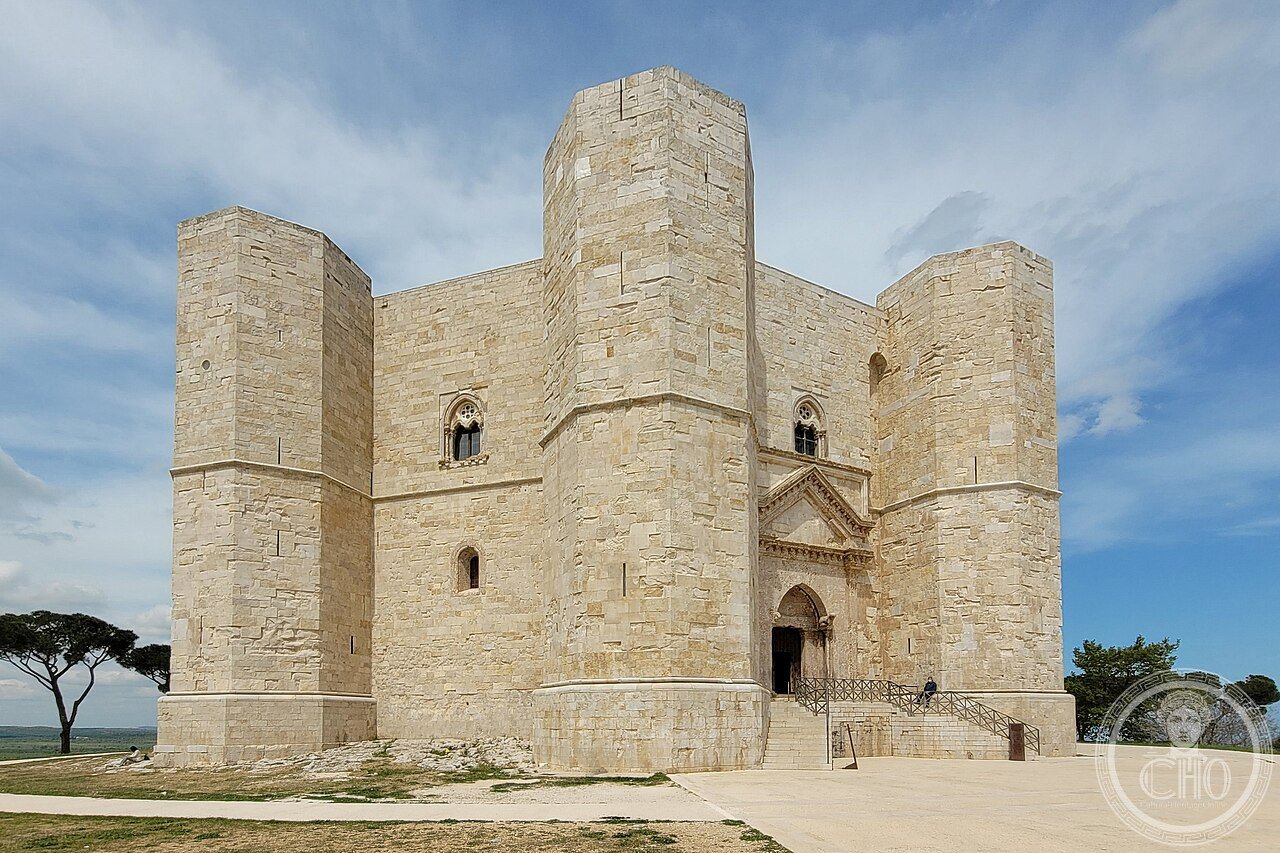
L’ottagono, i marmi colorati, le finestre bif ore, i capitelli antichi (the most precisely Castel del Monte zone visit (1.5–2 hours): the exterior circuit (the free exterior: walkable 24h; the best exterior view: from the south/SE approach road (the SS170 state road: the last 2 km is a one-way access road (sens-unique); parking: the free parking area at 1 km from the castle; the shuttle bus from the parking to the castle entrance: €1.50; free for children under 6); the interior visit (the Museo Castel del Monte: €5; open daily 9:00–19:30 Apr–Sep; 9:00–18:30 Oct–Mar; the visitor route: the 16 rooms arranged in 8 pairs (2 rooms per tower level) on 2 floors; the notable architectural features: (1) the marble intarsia floor (only the ground floor south room (Room 4): fragments of verde antico (Spartan green marble; Laconian ophicalcite) + giallo antico (Tunisian yellow marble from Chemtou; Tertiary limestone with fossil corals) inlaid in the Apricena white limestone floor; the mosaic surface preserved: approximately 4 m² of original Frederick II-period floor (the rest was removed by 17th–18th century looters)); (2) the carved capitals (the portal capitals: 3 of the original portal entrance capitals survive in situ; the style: a unique mixture of French Gothic (the crocket-and-stiff-leaf capital type from Reims Cathedral c.1230 CE) and Classical (the acanthus-leaf capital type from Rome c.200 CE); this French-Classical-Arabic hybridism is Frederick II’s signature style); (3) the bifore windows (the external windows: 16 bipartite windows (bifore) with slender central column in Apricena marble; the capitals are all carved differently (no 2 are identical); (4) the courtyard (the octagonal courtyard: 17.7 m inner diameter; the marble well (the original well casing was in verde antico: removed in the 18th century; only the well shaft survives (depth: 22 m, reaching the water table of the Murge plateau))).
Practical information
- Come raggiungere Castel del Monte da Bari e Andria e cosa abbinare nella giornata in Puglia tra Castel del Monte, Trani e il mare: il trasporto (Bari Centrale → Andria: Trenitalia Regionale (45 min; €3.80) poi SITA bus linea Andria–Castel del Monte (30 min; €1.20; 4 corse/giorno lun–dom; l’orario estivo: 8:30, 10:30, 12:30, 15:00 da Andria piazza Catuma) o taxi Andria–Castel del Monte (30 km; €35; prenotare tel. +39 0883 545 678); l’ingresso: €5 adulto (Polo Museale Puglia); il giro Puglia-UNESCO (mattina: Trani (la Cattedrale di San Nicola Pellegrino 1098 CE: il più bello dei romanici pugliesi; la facciata bianca sul mare; libero; 45 min); mezzogiorno: Castel del Monte (1.5h; pranzo nell’agriturismo Agriturismo Montegrosso a 5 km: il agnello alle erbe e la burrata di Andria; €25 menù); pomeriggio: Alberobello (i trulli UNESCO: 40 min da Andria))
Getting there
Bus SITA da Andria (30 min, €1.20; 4 corse/giorno) o taxi (30 km, €35). GPS: 41.0846, 16.2699. Ingresso €5. Aperto 9:00–19:30 apr–set.
Nearby
- Alberobello (UNESCO 1996 rif. 787 — i Trulli) — 55 km (il villaggio dei trulli conici in pietra calcarea senza cemento: i 1.400 trulli del Rione Monti; €1.50 accesso zona UNESCO)
- Trani (Cattedrale di San Nicola Pellegrino 1098 CE + il porto medievale) — 30 km (il romanico pugliese più spettacolare: la cattedrale bianca sul mare Adriatico; libero)
Gallery
Sources
- Wikipedia, Castel del Monte, Apulia; Frederick II, Holy Roman Emperor, accessed June 2026
- UNESCO, Castel del Monte, WHS reference 398, inscribed 1996
- Götze, Heinz. Castel del Monte: Gestalt und Symbol der Architektur Friedrichs II. Prestel, 1984 (the primary architectural analysis)
Find it on the map
See this place and what’s around it →📷 Diventa un fotografo di Cultural Heritage Online
Condividi le tue foto dei luoghi: restano pubblicate con la tua firma come autore. Più vengono viste, più ti fai conoscere — e presto un concorso premierà le foto più apprezzate.
Accedi o registrati gratis per aggiungere una foto