
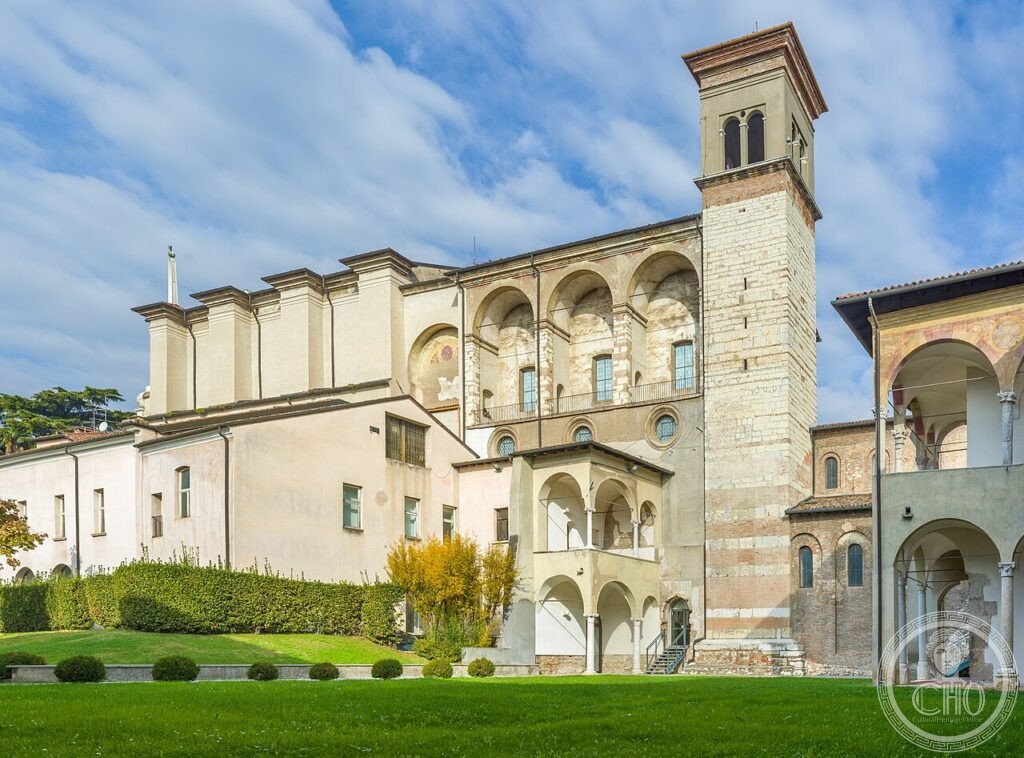
Museo di Santa Giulia e la Brescia Longobarda (VIII sec. d.C.): il Complesso di San Salvatore-Santa Giulia, la Croce di Desiderio (774 d.C.) e le Domus Romane Sotto il Monastero (UNESCO 2011)
The Monastero di San Salvatore-Santa Giulia in Brescia — founded in 753 CE by Desiderius, last King of the Lombards, and his queen Ansa, on the site of a Roman residential complex whose floor mosaics and painted walls are still visible under the church floor — preserves the most important ensemble of Lombard architectural and decorative arts in Lombardia: the church of San Salvatore (built with Roman columns reused from the earlier domus), the crypt (9th century, with 9 surviving frescoes from the original 753 CE decoration), the oratory of Santa Maria in Solario (12th century, with the Croce di Desiderio — a processional cross covered in 212 gemstones and antique cameos, made for Desiderius at the moment of his defeat by Charlemagne in 774 CE).
At a glance
The Brescia component of the UNESCO Longobards serial property (ref. 1318, 2011) is the largest and most complex of the seven sites: a multi-layered urban monument covering approximately 15,000 m² in the historic centre of Brescia (Via dei Musei, adjacent to the Roman Capitolium and the Roman theatre), encompassing pre-Roman, Roman, late antique, Longobard, Carolingian, Romanesque, Renaissance, and post-Tridentine layers all visible simultaneously in the Museo di Santa Giulia (MuSa), which opened in its current form in 1998 (with successive expansions through 2012). The UNESCO inscription covers specifically the Longobard-period remains: the church of San Salvatore (753 CE, the monastic church founded by Desiderius), the crypt of San Salvatore with its 9th-century frescoes, and the oratory of Santa Maria in Solario (12th century), which houses the Croce di Desiderio. The museum surrounding these monuments displays Roman, late antique, and medieval collections from the broader Brescia area.
Key facts
- Foundation by Desiderius (753 CE): Desiderius (also known as Didier; r. 757-774 CE as King of the Lombards, earlier Duke of Tuscany) founded the monastery of San Salvatore in Brescia in 753 CE for his wife Ansa and daughter Anselperga; it became one of the wealthiest monasteries in Lombard Italy, receiving royal donations and developing a major scriptorium. Desiderius was the last King of the Lombards: he was defeated by Charlemagne at Pavia in 774 CE (after a political quarrel involving the Pope, Charlemagne's divorce, and claims to Lombard territory) and deposed, ending the independent Lombard Kingdom after 206 years (568-774 CE). The monastery continued as a Benedictine house under Carolingian and later rule
- La Croce di Desiderio: The processional cross (donated by Desiderius to the church of San Salvatore at the moment of his defeat and exile by Charlemagne, according to tradition; the actual date of the object is disputed — some art historians date it to the 10th or 11th century rather than the 8th) is covered on the front face with 212 gems, antique cameos, and miniature portraits from various periods (some Roman, some late antique, some medieval): the cross is both a reliquary and a display cabinet of recycled precious objects from the Roman world, making it one of the most spectacular surviving examples of early medieval luxury metalwork. The most famous element is the portrait cameo of a woman identified (on debated grounds) as Galla Placidia (the 5th-century Roman empress and regent) or as a local Lombard noblewoman
- The church of San Salvatore (753 CE): The main monastic church, built by reusing Roman columns from the pre-existing domus (the 10 surviving Roman marble columns with their Corinthian capitals, recut and adapted to the lower Lombard nave, are the most visible structural element of the church); the outer walls of the nave preserve fragments of the original Lombard exterior plasterwork. The church plan (three naves, with a crypt below the elevated presbytery) is the standard Lombard monastic church type also seen at the other Longobard sites
- The Roman domus (I-IV century CE): Excavated and visible under the church floor and in the adjacent museum spaces; two Roman domus of the 1st-4th centuries CE, with extensive black-and-white mosaic floors (geometric patterns and marine subjects), painted walls (surviving fresco fragments in the fourth Pompeian style, 1st-2nd century CE), and a private bathing suite are displayed in situ
- UNESCO: 2011, ref. 1318 (as part of “Longobards in Italy: Places of the Power”)
- GPS: 45.5395, 10.2240 — Google Maps
History
The site of the Museo di Santa Giulia has been continuously occupied since at least the 1st century BCE: the pre-Roman (Gallic) settlement was followed by a Roman residential quarter that reached its height of wealth and decoration in the 1st-2nd centuries CE (the domus visible under the museum floors). In the late Roman period (4th-5th century), the site was modified as the city's residential character changed; in 753 CE Desiderius founded the monastery, which was then substantially enlarged in the 9th century (the Carolingian additions include the upper church and the crypt frescoes), the 11th-12th centuries (the oratory of Santa Maria in Solario), and the Renaissance (the large conventual buildings now housing the museum spaces, built 1490-1530). The monastery was suppressed by Napoleon in 1797; the buildings were used as a prison until 1919 and then as barracks; restoration and conversion to museum use began in the 1980s and the museum opened in 1998.
What you see
The Museo di Santa Giulia (entrance from Via dei Musei 81b) offers a circuit of approximately 2 hours through: the Roman domus in situ (ground floor, visible through glass floors and ramps below the museum level); the church of San Salvatore (the Lombard nave with Roman columns; the 9th-century crypt below the choir with frescoes); the oratory of Santa Maria in Solario (the 12th-century two-storey oratory with its spiral staircase and the Croce di Desiderio on the upper level in a dedicated room); and the museum galleries with finds from Roman Brescia (the Winged Victory bronze, 1st century BCE, found in the Capitolium — one of the finest Roman bronzes surviving from northern Italy) and the early medieval and medieval collections. The Capitolium itself (the Roman temple of the 1st century CE, on Via dei Musei adjacent to the museum entrance; the finest surviving Roman temple complex in northern Italy) is separately administered but a combined ticket is often available.
Gallery
Practical information
- Museo di Santa Giulia (MuSa): Via dei Musei 81b, Brescia; open Tuesday-Sunday 10:00-18:00 (November-March), 10:00-19:00 (April-October); closed Monday. Admission ~€10 (full), ~€7 (reduced); combined with Capitolium ~€14. Book online at bresciamusei.com.
- The Capitolium: Adjacent to the museum on Via dei Musei; the Roman temple (AD 73, Emperor Vespasian) has three cellae (for Juno, Jupiter, and Minerva) with surviving marble pavements; open same hours as the museum; often on combined ticket.
- Duration: 2-3 hours for the full museum circuit. Allow extra time for the Capitolium and the Roman theatre (partially excavated, visible from Via dei Musei).
Getting there
Via dei Musei 81b, Brescia (BS), Lombardia. GPS 45.5395, 10.2240. By train: Trenitalia high-speed from Milan (Brescia is on the Milan-Venice line; 30 min from Milan Centrale; 45 min from Verona); regional from Verona (45 min), Milan (45 min). Brescia station to Via dei Musei: 15-min walk or metro (Brixia Metro line B to Brescia station then bus 10). By car: from Milan, A4 east to Brescia Ovest exit (85 km, 1h); from Verona, A4 west to Brescia Est exit (55 km, 40 min).
Nearby
- Capitolium romano (Tempio Capitolino) — adjacent, Via dei Musei; the finest Roman temple complex in northern Italy (AD 73); combined ticket with MuSa available
- Lago di Garda — 30 km east; the largest lake in Italy; the western shore (Salò, Gardone Riviera with the Vittoriale degli Italiani — the extraordinary villa of Gabriele D'Annunzio) is 25-35 km from Brescia; the eastern shore (Sirmione, with the Roman Grotte di Catullo and the Scaligero castle) is 30 km
- Bergamo — 50 km west; the Città Alta (medieval upper city on a hill, entirely within Venetian walls from the 16th-17th centuries; the Piazza Vecchia with the Palazzo della Ragione and the Torre del Campanone; the Cappella Colleoni with Tiepolo frescoes)
Sources
- UNESCO: whc.unesco.org/en/list/1318
- Wikipedia EN: Santa Giulia (Brescia)
- Brogiolo, Gian Pietro and Gelichi, Sauro: La città nell'alto medioevo italiano, Laterza, 1998
- Museo di Santa Giulia: bresciamusei.com
Find it on the map
See this place and what’s around it →📷 Diventa un fotografo di Cultural Heritage Online
Condividi le tue foto dei luoghi: restano pubblicate con la tua firma come autore. Più vengono viste, più ti fai conoscere — e presto un concorso premierà le foto più apprezzate.
Accedi o registrati gratis per aggiungere una foto