

Brescia — Brixia Romana e Longobarda
Brescia (UNESCO 2011, rif. 1312) conserva nel cuore della città il Foro romano con il Capitolium (73 CE) e il Monastero di Santa Giulia (VIII sec. CE): la stratificazione di un millennio di civiltà — il più intatto tempio capitolino della Lombardia e il complesso monastico longobardo fondato dal re Desiderio (756–774 CE) per la figlia Anselperga.
At a glance
Brescia Lombardia (the most precisely Brescia zone Brescia Lombardia Italy 45.5400 N 10.2167 E UNESCO WHS 2011 reference 1312 Longobards in Italy, Places of the Power: the Brescia component (the site): the Capitolium (73 CE): the Capitoline temple of Roman Brixia (Brescia: the Roman colonia (founded c.89 BCE as Colonia Civica Augusta Brixia): the Forum of the Roman city; the Capitolium: a triple-cella temple (3 cellae dedicated to the Capitoline Triad: Jupiter (central cella; the largest), Juno (left cella), Minerva (right cella)); the dimensions: 37.8 m × 25.9 m × 11.2 m height; the surviving elements: the pronaos (4 Corinthian columns × 2 rows = 8 columns: 4 complete columns surviving); the podium (the raised platform 3.8 m above the forum paving); the construction (the dedication inscription found 1823 CE: “IMP. VESP. CAES. AVGVST. TRIB. POT. IIII” = the 4th year of Vespasian’s tribunicial power = 73 CE); the interior (the mosaic floors (the largest 1st-century CE Roman mosaic floors in northern Italy: the 3 cellae mosaics covering 400 m² total); the Vittoria Alata (the “Winged Victory”: the bronze sculpture found in the temple in 1826 CE: a 123 cm gilded bronze female figure writing on a shield (the Nike/Victoria writing the deeds of the emperor); now in the Museo di Santa Giulia)); the Monastero di Santa Giulia (the “New Jerusalem”: the Benedictine monastery founded c.753 CE by Desiderio (the last Lombard king 756–774 CE) and his wife Ansa (the queen) on the site of a Roman domus of the 1st century CE; the name “San Salvatore e Santa Giulia”: the monastery was dedicated to San Salvatore (Savior) first; the name “Santa Giulia” was added in 764 CE when relics of the martyr Julia of Carthage were brought from Sardinia); the imprisonment (Ermengarda (the daughter of Desiderio and Ansa; the wife of Charlemagne 770–771 CE): repudiated by Charlemagne in 771 CE and imprisoned in the Monastero di Santa Giulia until her death c.800 CE: the same event that Alessandro Manzoni dramatized in his ode “Adelchi” (1822 CE))).
Key facts
- La Croce di Desiderio (800 CE ca.) e la Rosa di Desiderio (IX sec. CE): i due oggetti più importanti della oreficeria longobarda e carolingia a Brescia, e perché la Croce contiene forse la Vera Croce: the Cross of Desiderius (the “Croce di Desiderio” (c.800 CE): a gem-encrusted processional cross (80 cm × 62 cm) now in the Museo di Santa Giulia; the material: wood core + silver-gilt casing + 212 cameos + intaglios + ancient gems (including 1 Byzantine cameo of the 6th century CE) + 450 glass stones; the relic (the tradition: a small crystal-covered reliquary in the center of the cross contains a fragment of the True Cross (from the Crucifixion); this relic tradition cannot be verified but was the basis for the cross’s sacred prestige); the inscription (the vertical beam: “CHRISTVS VINCIT CHRISTVS REGNAT CHRISTVS IMPERAT” (the standard Carolingian victory formula: not specifically Lombard)); the Rose of Desiderius (the “Rosa di Desiderio” (9th century CE): a gem-encrusted reliquary shaped like a rose (14.5 cm diameter) in silver-gilt; it contains a relic of the Madonna (the “Milk of the Virgin”: the white material inside the crystal-covered center: a common type of medieval Marian relic); the goldsmith quality (both the Cross and the Rose are examples of the highest quality Lombard-Carolingian goldsmithing (the “opus longobardicum”): the same tradition as the Iron Crown of Monza (the crown made c.594 CE, with a nail from the Crucifixion embedded in the iron band))
- GPS (Piazza del Foro, Capitolium di Brescia): 45.5400° N, 10.2167° E; Museo di Santa Giulia: 45.5394° N, 10.2205° E
History
Da Brixia 89 BCE al UNESCO 2011 (the most precisely Brescia zone history: the Roman foundation (Brixia (the Roman colony Brixia): founded c.89 BCE after the Social War; the Flavian development (the Flavian dynasty (69–96 CE): Vespasian (69–79 CE) and his successors rebuilt the Roman Forum of Brixia and constructed the Capitolium (73 CE); the dedication inscription: the temple was dedicated in the 4th tribunicial year of Vespasian = 73 CE); the Lombard conquest (568 CE: the Lombards conquered Brescia under King Alboin; the city became a Lombard duchy; the Duchy of Brescia (568–774 CE): the dukes of Brescia were military commanders for the Po valley; the founding of the Monastero di Santa Giulia (c.753 CE): by King Desiderio (the last Lombard king: 756–774 CE) and his queen Ansa; the purpose (the monastery as the “dynastic mausoleum” of the Lombard royal family: Desiderio’s daughter Anselperga was the first abbess; the remains of several Lombard kings and queens were interred here)); the Carolingian period (774 CE: Charlemagne destroyed the Lombard kingdom and imprisoned Ermengarda (Desiderio’s daughter and Charlemagne’s first wife) in the monastery); the UNESCO inscription (2011 CE: reference 1312).
What you see
Capitolium 73 CE (3 celle, mosaici 400m²), Vittoria Alata bronzo, Museo di Santa Giulia (Croce di Desiderio 800 CE, Rosa di Desiderio IX sec. CE), Oratorio Santa Maria in Solario (affreschi XII sec.) (the most precisely Brescia zone visit (3–4 hours): the combined ticket (€10 (Capitolium area + Museo di Santa Giulia); booked at museosantagiulia.it or at the ticket office; the Capitolium (Piazza del Foro 1A; the visit: the pronaos (the 4 surviving Corinthian columns: observe the 3 sizes of column fluting: the bottom third plain (the Roman convention to prevent damage to the delicate flutes at the vandalism-height level); the 3 mosaics (Room 1/Cella Destra: the black-and-white geometric mosaic (73 CE); Room 2/Cella Centrale: the polychrome mosaic with fish and sea monsters (1st century CE restored 4th century CE); Room 3/Cella Sinistra: the red-and-white geometric mosaic (73 CE))); the Museo di Santa Giulia (Via Musei 81 B; the visit route (2h): the basement (the Roman-era domus: the original 1st-century CE Roman house that was the building site for the monastery: the original domus mosaics visible under a glass floor); Room 3: the Vittoria Alata (the Winged Victory bronze: the 123 cm gilded figure writing on a shield; the gaze: the turning head creating a sense of movement that is unusual in Roman bronzes of this period); Room 6: the Croce di Desiderio (the gem-encrusted cross: the 450 glass stones of 35 different colors; the 212 cameos and intaglios (the oldest: 4th century BCE)); Room 7: the Rosa di Desiderio; the Oratorio di Santa Maria in Solario (the small 12th-century CE tower-oratory in the monastery complex: the 12th-century CE fresco cycle (the most complete Romanesque fresco cycle in Lombardia)).
Practical information
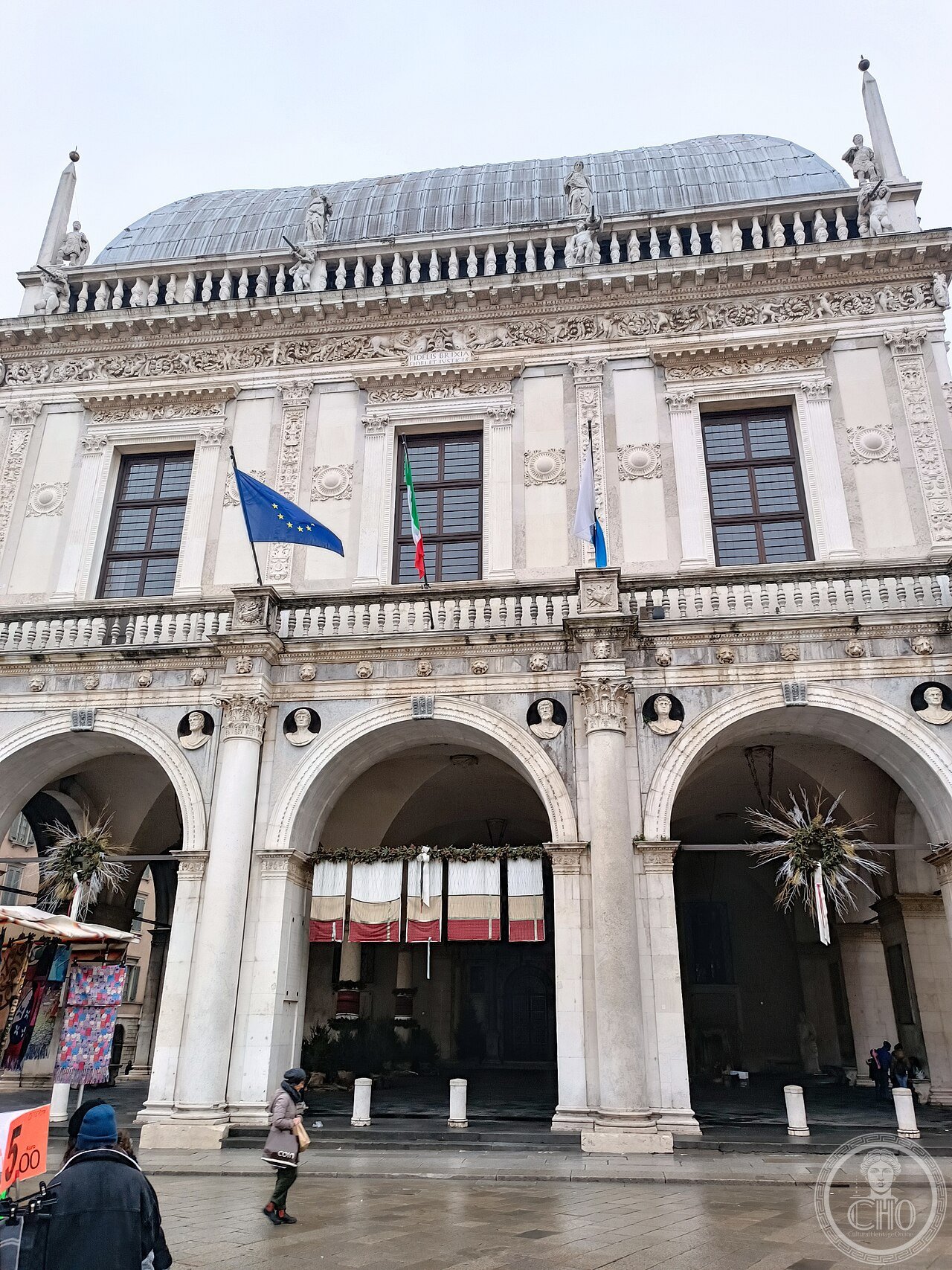
- Come raggiungere Brescia da Milano e Verona, e come organizzare la visita combinata Capitolium + Museo Santa Giulia in una mattina: il trasporto (Milano Centrale → Brescia: Trenitalia (45 min Frecciarossa €12.50; o 1h regionale €6.50; ogni 30 min); Verona Porta Nuova → Brescia: Trenitalia (35 min Frecciarossa; €8.50; ogni 30 min)); il programma mezza giornata (mattina): 9:30 Capitolium (1h30: i mosaici delle 3 celle + la Vittoria Alata visibile dalla porta est della cella destra: controllare se è temporaneamente esposta nella cella o in prestito al Museo) → 11:30 Museo di Santa Giulia (2h: la Croce di Desiderio + Rosa di Desiderio + il percorso nella domus romana sotterranea) → 14:00 pranzo al mercato di Piazza della Loggia (il mercato del martedì-venerdì: casoncelli bresciani (i ravioli di carne macinata + spezie + uvetta + mostacciolo); Piazza della Loggia: la loggia rinascimentale di Jacopo Sansovino 1492–1574 CE (incompiuta; Palladio ne terminò la parte superiore 1570 CE))
Getting there
Trenitalia da Milano (45 min Frecciarossa €12.50) o Verona (35 min €8.50). GPS Capitolium: 45.5400/10.2167. Biglietto combinato €10. 10:00–18:00 (lun chiuso).
Nearby
- Cremona (Torrazzo 1284 CE — 112 m; l’orologio astronomico; i liutai Amati + Guarnieri + Stradivari) — 50 km (Trenitalia 45 min; €5; il Torrazzo 1284 CE (112 m: la torre di mattoni più alta del mondo; l’orologio astronomico (1583 CE: il secondo orologio più antico d’Italia dopo quello di Milano 1386 CE)); il Museo del Violino (€12; la collezione: 1 Amati + 3 Stradivari + 1 Guarnieri (tutti suonabili in concerto))
- Lago d’Iseo + Monte Isola (la più grande isola lacustre abitata d’Europa) — 25 km (bus ARRIVA da Brescia; 40 min; traghetto Sarnico→Monte Isola 7 min; €3.50; l’isola (12 km² di area; 1.800 abitanti; 6 km di perimetro con pista ciclabile senza auto); la Christo “The Floating Piers” (2016 CE: le piattaforme arancioni sul lago; rimosse ma il paesaggio resta il protagonista))
Gallery
Sources
- Wikipedia, Santa Giulia Museum; Capitolium, Brescia; Desiderius, King of the Lombards; Cross of Desiderius, accessed June 2026
- UNESCO, Longobards in Italy, Places of the Power, WHS reference 1312, inscribed 2011
- Barello, Fabio; Gori, Mauro. Museo di Santa Giulia. Guida breve. Brescia: Museo di Santa Giulia, 2017
Find it on the map
See this place and what’s around it →📷 Diventa un fotografo di Cultural Heritage Online
Condividi le tue foto dei luoghi: restano pubblicate con la tua firma come autore. Più vengono viste, più ti fai conoscere — e presto un concorso premierà le foto più apprezzate.
Accedi o registrati gratis per aggiungere una foto