
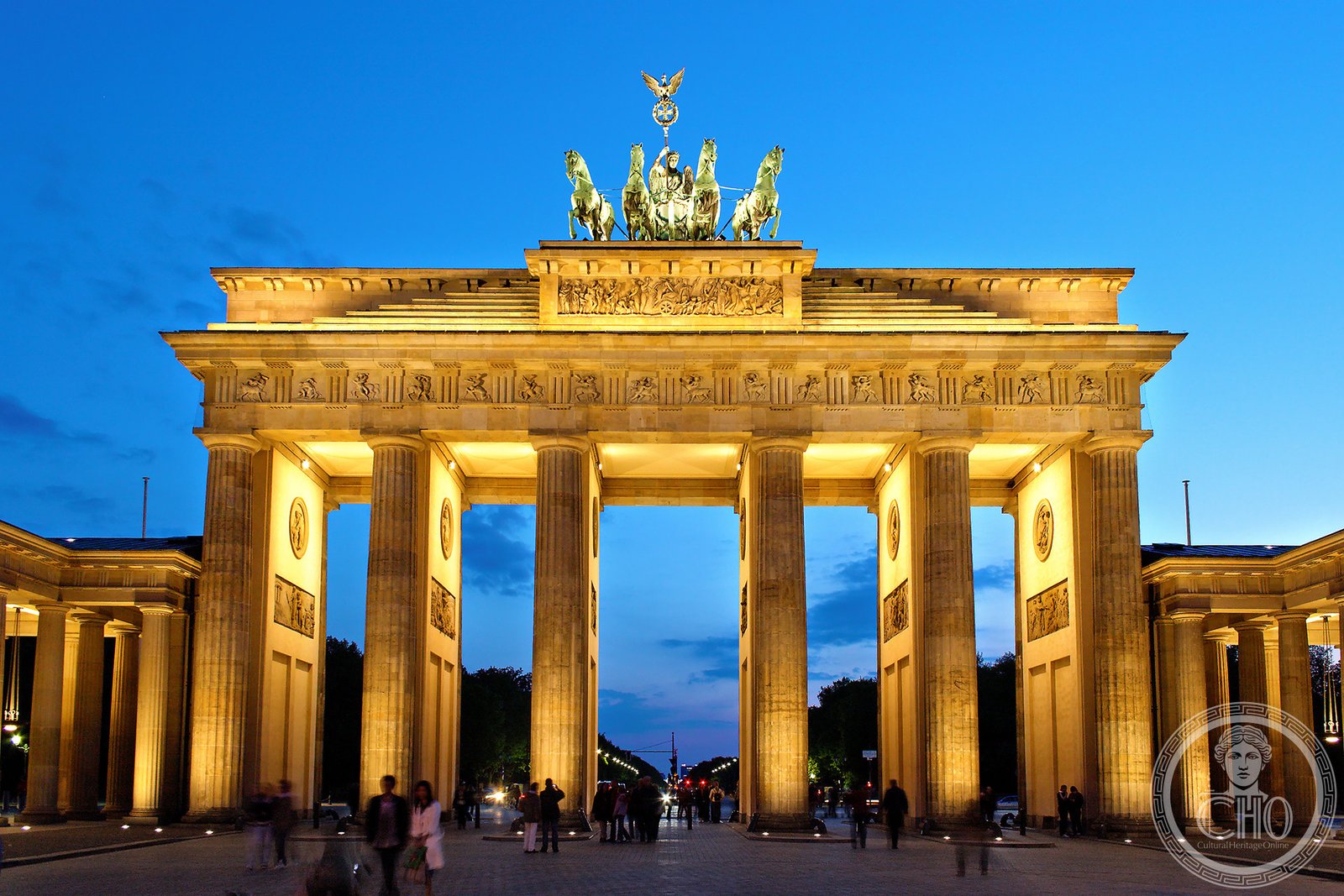
Brandenburg Gate
The Brandenburg Gate is an 18th-century neoclassical monument in Berlin and one of Germany’s best-known landmarks. Built between 1788 and 1791 by order of King Frederick William II of Prussia to designs by royal architect Carl Gotthard Langhans, it stands on the site of a former city gate that marked the beginning of the road from Berlin to Brandenburg an der Havel. The bronze quadriga crowning the gate was sculpted by Johann Gottfried Schadow.
- Type
- Triumphal arch and city gate
- Period
- 1788–1791
- Style
- Neoclassical; inspired by the Propylaea of the Athenian Acropolis
- Location
- Pariser Platz, 10117 Berlin, Germany
- Coordinates
- 52.5163° N, 13.3777° E
At a glance
- Type
- Neoclassical triumphal gate
- Period
- 1788–1791
- Style
- Neoclassical · Doric order
- Location
- Pariser Platz, Mitte district, Berlin, Germany
Overview
The Brandenburg Gate stands at the western end of Unter den Linden, once the grand ceremonial boulevard of the Prussian capital, and now faces the Tiergarten park. Originally one of eighteen city gates in the Berlin Customs Wall, it is the only one that survives. The gate has served as a backdrop for some of the most defining moments in modern European history, from Napoleon’s entry in 1806 to the fall of the Berlin Wall in 1989.
History
Architect Carl Gotthard Langhans modelled the gate on the Propylaea entrance to the Athenian Acropolis, giving Berlin’s western approach a classical grandeur befitting an emerging European power. The quadriga — a chariot drawn by four horses, driven by the goddess of victory — was added in 1793 by sculptor Johann Gottfried Schadow. Napoleon removed the sculpture to Paris in 1806; it was returned in 1814 after his defeat. During the Cold War the gate stood sealed in the no-man’s-land between East and West Berlin, becoming a powerful symbol of division until the Wall fell in November 1989.
What you see
The gate is 26 metres tall and 65.5 metres wide, formed by twelve Doric columns arranged in five passageways — the central passage was originally reserved for the royal family. The attic frieze depicts scenes of Greek mythology. On the east side facing Pariser Platz, the two flanking buildings housing guard rooms frame the formal approach. The quadriga at the top is oriented toward the city, a position that was inverted in 1814 to face outward as a symbol of Prussian victory.
Cultural significance
The Brandenburg Gate is one of the most recognised monuments in the world and the pre-eminent symbol of German reunification. Major historical speeches — including Ronald Reagan’s 1987 address “Mr Gorbachev, tear down this wall!” — were delivered in its shadow. Today it anchors the Memorial to the Murdered Jews of Europe district and draws millions of visitors every year.
Practical information
Address: Pariser Platz, 10117 Berlin. The gate itself is accessible at all times and entry is free. The Room of Silence inside the south wing (Stille Raum) is open daily for reflection. The visitor information point in the north wing has irregular hours; check local listings.
Getting there
S-Bahn: S1, S2, S25, S26 to Brandenburger Tor station (adjacent). U-Bahn: U55 to Brandenburger Tor station. Bus lines 100 and 200 stop directly in front. The gate is also a central point on Berlin’s extensive cycling network.
Sources & resources
Find it on the map
See this place and what’s around it →📷 Diventa un fotografo di Cultural Heritage Online
Condividi le tue foto dei luoghi: restano pubblicate con la tua firma come autore. Più vengono viste, più ti fai conoscere — e presto un concorso premierà le foto più apprezzate.
Accedi o registrati gratis per aggiungere una foto