
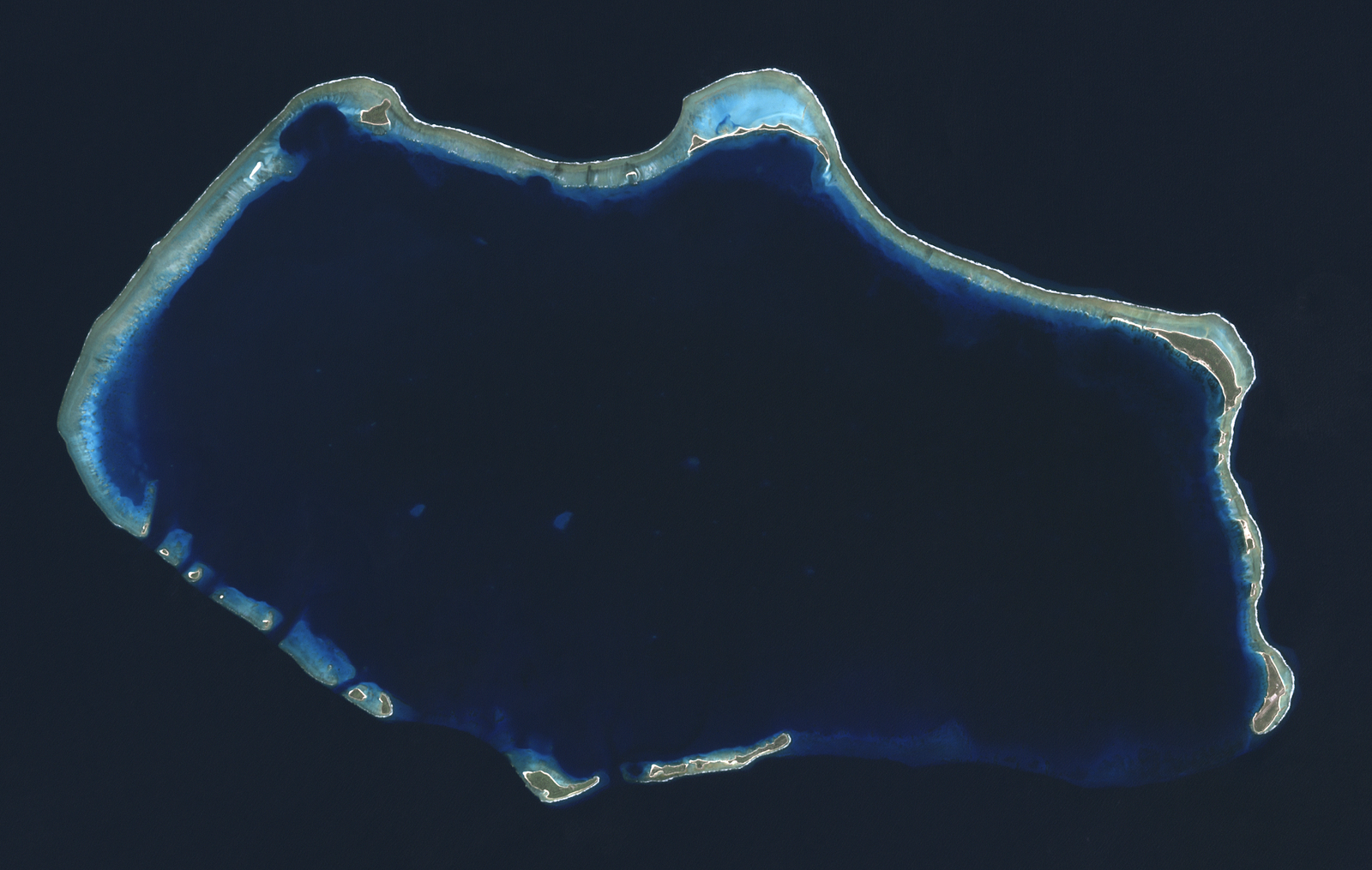
Bikini Atoll Nuclear Test Site
A coral atoll in the central Pacific Ocean where the United States conducted 23 nuclear weapons tests between 1946 and 1958, including the largest US nuclear detonation ever, displacing its entire population and leaving a lagoon full of shipwrecks that is now one of the most extraordinary dive sites on Earth. UNESCO World Heritage Site since 2010.
At a glance
Bikini Atoll is a coral reef and lagoon in the northern Marshall Islands, approximately 3,800 km southwest of Hawaii and 2,100 km east of the Philippines. Its 36 islands encircle a lagoon roughly 80 km long and 30 km wide. The atoll is uninhabited today, its 167 original Marshallese residents having been relocated in 1946 and never permanently returned, owing to persistent radioactive contamination of the soil and food chain. The lagoon contains the wrecks of 90 ships sunk during the 1946 tests, making it a destination for technical divers from around the world. UNESCO inscribed Bikini Atoll in 2010 as an outstanding example of nuclear-age Cold War heritage, specifically recognising both the tests global historical significance and the ongoing tragedy of the displaced Bikinian people.
Key facts
- Location: 11.5 N, 165.4 E, northern Marshall Islands, central Pacific Ocean
- Tests conducted: 23 nuclear weapons tests, 1946 to 1958, Operation Crossroads and Operation Castle among them
- Largest test: Castle Bravo, 1 March 1954, 15 megatons, approximately 1,000 times the yield of the Hiroshima bomb
- Target fleet: 95 decommissioned warships sunk in 1946; approx. 90 remain in the lagoon
- Original population: 167 Marshallese residents relocated 1946; Bikini Atoll remains uninhabited
- Radiation: Surface levels near natural background; soil and coconut contamination persists
- UNESCO: Inscribed 2010
- Diving: Technically accessible for divers; liveaboard expeditions operate from Majuro and Kwajalein
History
Bikini Atoll had been inhabited for millennia when US Navy Commodore Ben Wyatt visited in January 1946 and asked King Juda and the Bikinian people to relocate so that the United States could test nuclear weapons for the good of mankind and to end all world wars. The Bikinians agreed, believing the arrangement temporary. They were relocated 200 km east to Rongerik Atoll, which proved near-uninhabitable.
Operation Crossroads in July 1946 was the world first public nuclear test, watched by an international fleet of observers aboard support ships. Shot Able was an air burst over a target fleet of 95 decommissioned warships. Shot Baker was an underwater detonation that created a massive column of radioactive water. The ships were contaminated and many were subsequently sunk. The radioactive lagoon water proved impossible to decontaminate.
The most consequential test was Castle Bravo on 1 March 1954. The device yield was predicted at 6 megatons but actually produced 15 megatons, more than double the expected yield, making it the largest US nuclear test ever. A massive fallout cloud spread over inhabited atolls of the Marshall Islands, contaminating the populations of Rongelap and Utrik atolls with serious doses of radioactive fallout. The crew of the Japanese fishing vessel Lucky Dragon No. 5 was also severely contaminated. Castle Bravo triggered a global movement for nuclear test ban treaties, leading eventually to the Partial Test Ban Treaty of 1963.
The last test at Bikini was conducted in 1958. The Atomic Energy Commission declared Bikini habitable in 1968 and some Bikinians returned. But they were evacuated again in 1978 after cesium-137 levels in their blood were found to have risen alarmingly. The contamination is now judged to be at near-natural background levels in the water and on beach sand, but coconut crabs and the soil remain contaminated by long-lived isotopes.
What you see
Above the surface, Bikini Atoll is a ring of low palm-covered islands around a lagoon that appears idyllic and undisturbed. The former village site on Bikini Island preserves the concrete foundations of a church built in the 1950s and traces of the original settlement. The atoll is remote and lacks tourist facilities; reaching it requires chartered boat or liveaboard dive vessel.
Below the surface is one of the most dramatic dive sites in the world. The lagoon contains the wrecks of approximately 90 vessels including the US aircraft carrier Saratoga, one of the largest diveable wrecks on Earth at 270 metres long and resting at 40 to 60 metres depth. Also present are the Japanese battleship Nagato, from which Admiral Yamamoto commanded the attack on Pearl Harbor, the US battleship Arkansas, several submarines, and dozens of smaller vessels. Many wrecks are festooned with corals and marine life and are considered to be the most intact and spectacular military wreck dives available anywhere.
Cold War heritage
UNESCO inscribed Bikini Atoll as the first Cold War site on the World Heritage List, recognising it as outstanding testimony to the nuclear age and the Cold War that shaped the second half of the 20th century. The inscription explicitly acknowledges two aspects: the global historical significance of the nuclear tests and the human cost borne by the Bikinian people, who were displaced from their homeland and have never been able to return permanently.
The Castle Bravo test in particular had global consequences beyond the immediate contamination. The unexpectedly large yield and the contamination of inhabited islands and a Japanese fishing vessel triggered an international public awakening about the dangers of atmospheric nuclear testing, directly contributing to the political pressure that produced the 1963 Partial Test Ban Treaty, which ended atmospheric testing by the US, USSR, and UK.
Practical information
- Access: Bikini Atoll is accessible only by chartered liveaboard dive vessel; there are no commercial flights or passenger ferries
- Diving: Technical open-water certification strongly recommended; depths 30-60 m; nitrogen narcosis and decompression sickness risks at the deeper wrecks
- Operators: A small number of specialist dive operators run expeditions, typically departing from Majuro or Kwajalein in the Marshall Islands
- Safety: Surface radiation levels are near natural background; eating local coconuts or fish is discouraged
- Permits: Visits require a permit from the government of the Marshall Islands
Getting there
The Marshall Islands are served by United Airlines from Honolulu, Hawaii via the island of Majuro. Kwajalein Atoll is accessible only to US military personnel and contractors. From Majuro, the journey to Bikini Atoll by liveaboard takes approximately two to three days. There is no infrastructure on the atoll for independent visitors; all logistics must be arranged through a specialist dive operator well in advance.
Nearby
- Rongelap Atoll – contaminated in 1954 by Castle Bravo fallout; partially resettled, approximately 300 km east
- Enewetak Atoll – site of 43 additional US nuclear tests 1948-1958, also UNESCO-listed context, approximately 300 km southwest
- Majuro – capital of the Marshall Islands, gateway for logistics and permits, approx. 800 km southeast
Sources
- UNESCO World Heritage Centre – Bikini Atoll Nuclear Test Site, whc.unesco.org/en/list/1339
- Wikipedia – Bikini Atoll, en.wikipedia.org/wiki/Bikini_Atoll
- US Department of Energy – Nevada National Security Site history archives
- Richard Rhodes – The Making of the Hydrogen Bomb; Dark Sun (Simon and Schuster, 1995)
Find it on the map
See this place and what’s around it →📷 Diventa un fotografo di Cultural Heritage Online
Condividi le tue foto dei luoghi: restano pubblicate con la tua firma come autore. Più vengono viste, più ti fai conoscere — e presto un concorso premierà le foto più apprezzate.
Accedi o registrati gratis per aggiungere una foto