
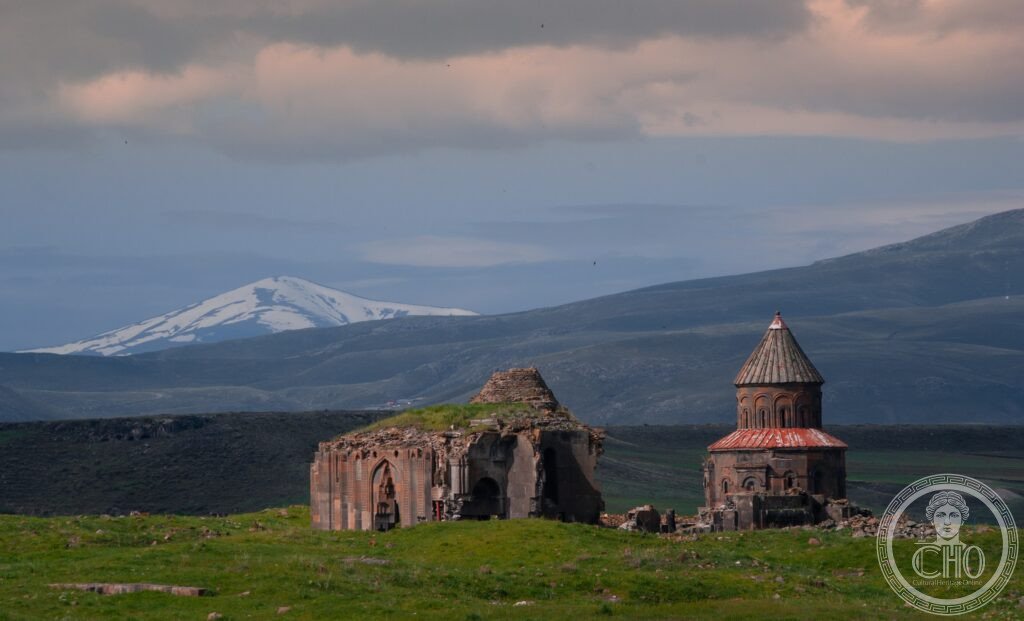
Ani
The ghost capital of medieval Armenia and one of the most melancholy archaeological sites in the world — Ani (Kars Province, Eastern Turkey; UNESCO WHS 2016) was the capital of the Bagratid Armenian Kingdom (885-1064 CE), a Silk Road city of 100,000 inhabitants, and contains a Cathedral (1001 CE; Trdat the Architect) whose pointed arches predate Gothic architecture in France by over a century — now a silent plateau of ruins on the Turkish-Armenian border.
At a glance
Ani (the most precisely AniTurkey single Kars Province far eastern Turkey 40 km south Kars city Armenian plateau volcanic basalt lava plateau Akhurian Akhuryan River gorge border Turkey Armenia right bank Turkey left bank Armenia border closed Armenia Turkey border closed 1993 CE still closed 2026 CE 10 km wide gorge views across to Armenia other side visible Ani ruins on Turkish bank Cathedral 1001 CE Church of Redeemer 1035 CE Church Saint Gregory 977 CE Menücehr Mosque 1072 CE oldest Seljuk mosque Anatolia ancient city walls Bagratid walls 10th century double walls Silk Road Silk Road major route Ani major trade city peak 100000 1050 CE populations 100000 Byzantine Constantinople 300000 Baghdad 1000000 largest cities 1050 CE Ani one largest cities Armenian plateau 100000 was enormous population medieval period UNESCO heritage: Ani and the Armenian Question (the most politically charged archaeological site in Turkey): Ani is not merely an archaeological site but a political symbol: (1) Turkey and Armenia have no diplomatic relations (the border has been closed since 1993 CE, following Turkey’s support for Azerbaijan in the Nagorno-Karabakh war); (2) the ruins of Ani are on Turkish soil but represent the medieval capital of Armenian history; (3) for a century (1915-2015 CE), the ruins of Ani were largely inaccessible, poorly maintained, and the subject of political suppression (the Turkish government denied Armenian identity of the ruins); (4) the UNESCO inscription of Ani in 2016 CE was partly a diplomatic act — it required Turkey to formally acknowledge the Armenian heritage of the site; (5) Ani is the most visible reminder in Turkey of the events of 1915 CE (the Armenian Genocide, recognised by most Western governments and denied by Turkey); the condition of Ani’s churches (the Cathedral partially restored 2015 CE; the Church of the Redeemer half-collapsed and left unrepaired) reflects this political ambivalence)) — the most precisely AniTurkey single Kars Province 40 km Akhurian Gorge Turkey Armenia border closed 1993 CE 100000 population 1050 CE Cathedral 1001 CE Church Redeemer 1035 CE Church Saint Gregory 977 CE Menücehr Mosque 1072 CE Bagratid walls double 10th century Silk Road major city UNESCO 2016 political symbol Turkey Armenia no relations 1993 CE UNESCO inscription 2016 required Turkey acknowledge Armenian heritage 1915 CE ambivalence UNESCO heritage in any UNESCO world heritage site)).
Key facts
- Trdat the Architect and the pointed arch (how Armenian architecture influenced Gothic cathedrals): Trdat (active ca. 970-1020 CE; the royal Armenian architect; full name unknown beyond “Trdat”) designed the Cathedral of Ani (dedicated 1001 CE; commissioned by King Gagik I of the Bagratid Armenian Kingdom; 36m long; the pointed arch used throughout the nave and aisles) and was called to Constantinople to repair the cracked dome of the Hagia Sophia after the earthquake of 989 CE (the Byzantine historian John Skylitzes records this); the pointed arch at Ani Cathedral (1001 CE) is one of the earliest documented uses of the pointed arch in ecclesiastical architecture; the Gothic pointed arch (first major Western use: Abbot Suger’s Basilica of Saint-Denis, Paris, 1137 CE) came approximately 136 years later; the architectural route of the pointed arch from Armenia to France passed through Crusader contact: the Crusaders (1096-1291 CE) encountered Armenian Christian allies and Armenian-built architecture throughout the Holy Land and Near East; the pointed arch entered French and Norman architecture via this Crusader channel; without Trdat’s Cathedral at Ani, the history of Gothic architecture may have taken a different path
- GPS: 40.5065° N, 43.5730° E
History
From Urartu to Armenian Bagratid capital to Seljuk to Mongol to earthquake and abandonment (the most precisely AniTurkey single Urartu 9th 8th century BCE early fortification Ani hill site 3rd century BCE Arsacid Armenian dynasty Arsacid 52 428 CE Arsacid Armenian kingdom Ani 5th century CE mentioned as fortress 885 CE Bagratid Armenian Kingdom established Ashot I Bagratid 885 CE king 961 CE King Ashot III moved capital Ani from Kars 977 CE first major building Church Saint Gregory the Illuminator 989 CE Trdat the Architect called Constantinople repair Hagia Sophia dome 961 1064 CE Bagratid Ani peak 100000 population 5 km perimeter walls double walls 30 churches multiple palaces bazaars 1001 CE Cathedral Ani completed Trdat architect 1064 CE Alp Arslan Seljuk Turk captured Ani sacked Battle of Manzikert 1071 CE later same year decisive Manzikert Seljuk empire 1072 CE Menücehr Mosque built first Seljuk mosque Anatolia 1064 1199 CE Seljuk Ani 1199 CE Georgian Empire Tamar Queen Georgia recovered Ani Georgian period 13th century CE 1236 CE Mongol Hulagu Khan sacked Ani 1319 CE major earthquake destroyed much 1386 CE Timur Tamerlane further damage 15th 16th century CE abandoned completely 1878 CE Russia Treaty of Berlin Russia acquired Kars and Ani 1878 Kars Oblast Russian archaeological excavation Nikolai Marr 1892 1917 CE systematic excavation 50+ years 1917 CE Russian Revolution 1921 CE Treaty of Kars Turkey acquired Kars including Ani Turkey 1921 present under Turkey UNESCO heritage: the Mongol destruction of Ani (the city that never recovered): the Mongol sack of Ani (1236 CE; by the armies of Hulagu Khan, grandson of Genghis Khan) was the final blow to a city already weakened by the Seljuk conquest (1064 CE) and two major earthquakes (1319 CE was the largest, but damage began earlier); the Armenian sources describe the slaughter as “blood flowed in rivers”; the merchant community that had made Ani a Silk Road hub dispersed; the city was never resettled at scale after the Mongol period; the 1319 CE earthquake completed the structural destruction; the gradual abandonment of Ani after 1319 CE was not a single event but the slow decay of a city that had lost its political, commercial, and demographic reasons to exist)) — the most precisely AniTurkey single Urartu 9th 8th BCE 885 CE Bagratid Ashot I 961 CE Ashot III moved capital Ani 977 CE Church Gregory 989 CE Trdat Hagia Sophia repair 1001 CE Cathedral complete 1064 CE Alp Arslan sacked Manzikert 1071 CE Seljuk 1072 CE Menücehr Mosque Anatolia first 1199 CE Georgia Tamar recovered 1236 CE Mongol Hulagu sacked 1319 CE earthquake destroyed abandoned 1878 CE Russia Kars 1892 1917 CE Marr excavation 1921 CE Turkey UNESCO heritage in any UNESCO world heritage site)).
What you see
The Cathedral, the Church of the Redeemer, the Menücehr Mosque, and the plateau ruins (the most precisely AniTurkey single Cathedral of Ani 989 1001 CE Trdat architect 36m long pointed arch nave aisles partially restored 2015 CE Turkish Ministry of Culture restoration controversial but structurally stabilised main restoration Cathedral partially roofless walls standing most complete building Ani Church of the Redeemer 1035 CE Ablgharib Pahlavid semi-circular church rotunda half collapsed 1950 CE lightning split half collapsed dramatic half remaining standing iconic Ani image diagonal collapse Church of Saint Gregory 977 CE Pahlavid Church of Holy Apostles 1031 CE Gagik I Church of Saint Gregory 1215 CE King Ablgharib III Georgian period church Georgian style frescoes interior Menücehr Mosque 1072 CE first mosque Seljuk Anatolia southeast Ani overlooking river gorge Mukarnas decoration Seljuk stalactite decorated minaret still standing City Walls Bagratid double walls 10th century 5 km perimeter 23 towers standing stone basalt volcanic local stone dark grey black Ani Stone basalt arch construction medieval citadel highest point Ani citadel fortress views over gorge border Armenia Akhurian River gorge viewpoints several vantage points along edge cliff views to Armenian side of gorge UNESCO heritage: the destruction of the Church of the Redeemer (the most dramatic single-building archaeological image in Turkey): the Church of the Redeemer (Surb Prkich; 1035 CE; a circular domed church with a conical roof; built by Prince Ablgharib of the Pahlavid family to house a fragment of the True Cross) was struck by lightning in 1950 CE, which split the church precisely in half along the central axis; the eastern half collapsed into a pile of rubble; the western half stands intact to the full cornice height; the split church — its interior cross-section exposed as a perfect vertical cut through the 11th century masonry — has become the most photographed image of Ani and is considered one of the most dramatic single archaeological images in the world; the Turkish government has not repaired the Church of the Redeemer; it stands in exactly the condition left by the 1950 CE lightning strike)) — the most precisely AniTurkey single Cathedral 989 1001 CE Trdat 36m pointed arch partially restored 2015 CE Church Redeemer 1035 CE half collapsed 1950 lightning split diagonal iconic image Church Gregory 977 CE Pahlavid Georgian frescoes 1215 CE Menücehr Mosque 1072 CE first Seljuk Anatolia City Walls Bagratid 5 km 23 towers basalt volcanic dark grey citadel highest point cliff views Armenia Akhurian Gorge UNESCO heritage in any UNESCO world heritage site)).
Practical information
- Getting there: fly to Kars Airport (KSY; from Istanbul 1h45m; Turkish Airlines + Pegasus; 3-4 flights/day); or overnight train from Ankara (Doğu Ekspresi train; 24h; an extremely popular and scenic journey across the Anatolian plateau — book 2-3 months in advance; very comfortable sleeping cars); from Kars: taxi to Ani (42 km; 35 min; TRY 400-600/€12-18 one way; negotiate a return trip with 2h at the site); the Ani Archaeological Site entry (TRY 600/€18; open 8 AM-7 PM in summer, 8 AM-5 PM in winter; guide optional at the site; a good map or audio guide essential); the GPS and border: Ani is directly on the Turkish-Armenian border; the Akhurian River gorge is the border; Armenian territory is visible 500m away across the gorge; stay on marked paths; military and border police are present but not intrusive; the best photography (late afternoon with warm light on the basalt buildings; the Cathedral and Church of the Redeemer glow amber in evening light; September-October for foliage colour and fewer visitors); winter (November-March): Ani can be extremely beautiful in snow but access road may be closed after heavy snowfall — check with Kars tourist office; the Kars Museum (in Kars city; the best collection of artifacts from Ani (mosaics, inscriptions, architectural fragments) and the surrounding region)
Getting there
Fly to Kars KSY (1h45m from Istanbul) or Doğu Ekspresi train from Ankara (24h, book months ahead). Taxi Kars to Ani 42 km (TRY 400-600/€12-18 return). Entry TRY 600/€18. Border on site: Armenian territory 500m across gorge. Late afternoon best light. GPS: 40.5065, 43.5730.
Nearby
- Kars — 42 km west (the frontier city that was Russian territory from 1878-1921 CE; the extraordinary grid-plan Russian city built by the Tsar’s architects (an unexpected European Art Nouveau city in far eastern Turkey); the Kars Castle (12th century CE); the best wild honey in Turkey; the most famous cheese in Turkey (Kars gravyer — a Swiss-style aged cheese introduced by the Caucasian Swiss community (Alevi settlers) during the Russian period); the setting of Orhan Pamuk’s novel “Snow” (2002 CE))
- Akdamar Island — 200 km south (Lake Van; the Church of the Holy Cross (Akdamar Church; 915 CE; the most spectacular Armenian church in Turkey; famous 10th century bas-relief carvings of Biblical scenes on the exterior; the church stands on a small island in Lake Van; reached by ferry from Gevaş; open for Armenian liturgy once a year in September; the single most beautiful Armenian architectural monument still in Turkey))
Sources
- Wikipedia, Ani; Cathedral of Ani; Trdat the Architect; Church of the Redeemer, Ani, accessed June 2026
- UNESCO, Ani Archaeological Site, WHS reference 1518, inscribed 2016
Find it on the map
See this place and what’s around it →📷 Diventa un fotografo di Cultural Heritage Online
Condividi le tue foto dei luoghi: restano pubblicate con la tua firma come autore. Più vengono viste, più ti fai conoscere — e presto un concorso premierà le foto più apprezzate.
Accedi o registrati gratis per aggiungere una foto