
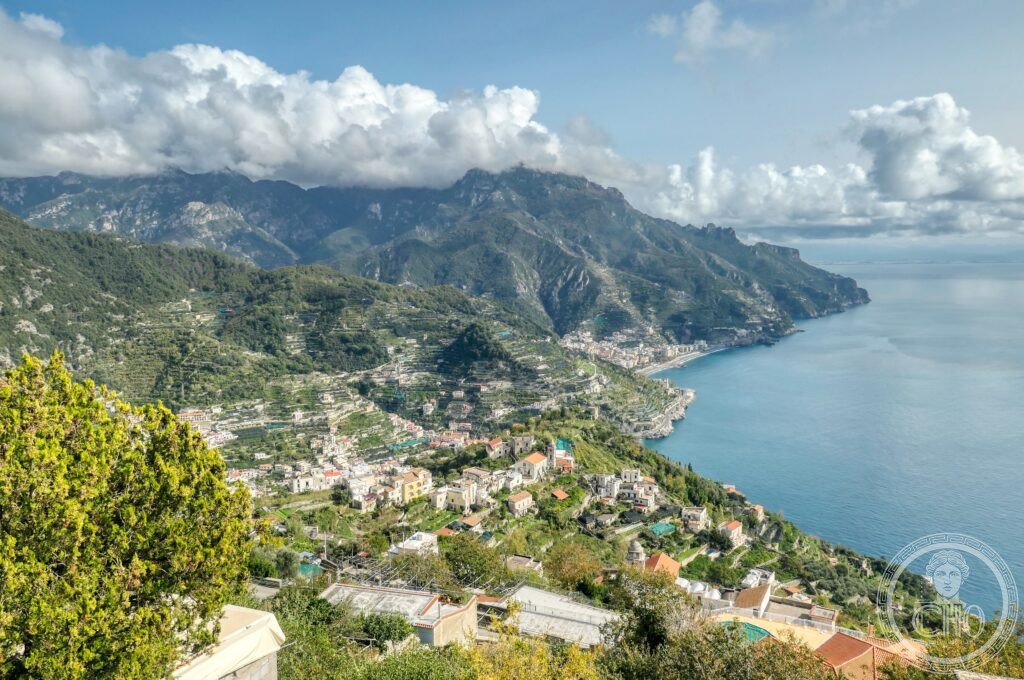
Amalfi Coast
The most spectacular Mediterranean coastal landscape and one of the most densely beautiful stretches of coastline in the world — the Amalfi Coast (Costiera Amalfitana) in Campania runs 50 km along the southern flank of the Lattari Mountains, with cliff towns stacked on terraces above the Tyrrhenian Sea, lemon groves built on impossibly steep slopes over two millennia, and a road hewn from the cliff face that is one of the most dramatic drives in Europe.
At a glance
The Amalfi Coast (Costa d’Amalfi; UNESCO WHS 1997; 12,000 hectares; the inscription describes it as “an outstanding example of a Mediterranean landscape, with exceptional cultural and natural scenic values resulting from a dramatic coastline with rugged cliffs, lemon trees and vineyards, picturesque villages and architectural works of great historical interest”) runs approximately 50 km between Positano (the western end; the most visited; the most photographed cliff town) and Vietri sul Mare (the eastern end; famous for its hand-painted ceramics); the coast road (the Strada Statale 163; cut into the cliff face in 1853; 2 lanes; the road is so narrow that buses and coaches must pull into passing bays to let each other pass; the drive from Positano to Amalfi is approximately 17 km but can take 45–90 min in summer due to traffic; the views of the cliffs and sea on both sides of the car are constant and dramatic; the road is not recommended for nervous drivers or passengers); the 13 principal towns and villages of the coast include Positano, Praiano, Furore (the fjord; a narrow ravine with a beach at the bottom), Conca dei Marini, Amalfi (the historic capital), Atrani (the smallest municipality in Italy; connected to Amalfi by a footpath), Ravello (inland, 350 m above sea level; the most culturally rich of the coast towns), Minori, Maiori, Cetara, and Vietri sul Mare.
Key facts
- Positano: the most photogenic cliff village in Italy — Positano (population approximately 3,000 year-round; approximately 2 million visitors per year; the most photographed view on the Amalfi Coast is from the boat arriving or departing, looking at the stacked pink-yellow-terracotta houses from the sea; the main beach, Spiaggia Grande, is pebble, not sand; the prices are the highest on the coast — a hotel room with sea view in August can exceed EUR 400/night; the principal street, Via Positanesi d’America (named for the emigrants who left for New York in the early 20th century and whose remittances funded many of the buildings), is a series of steps descending from the coast road to the waterfront; a taxi from Positano to the ferry dock is a 15-min walk and costs EUR 10 in a shared minivan or EUR 50–80 in a private car)
- Amalfi town and its history: the town that gave the coast its name was once the most important maritime republic in the western Mediterranean — Amalfi (population approximately 5,500; the historic centre is a tight grid of vaulted passages and staircases climbing from the seafront to the hill above; the Cathedral of Sant’Andrea, with its Byzantine-Arab-Norman campanile and the striking black-and-white striped façade and the Cloister of Paradise (13th century; a quadrangle of interlaced double arches, each filled with a view of the sky and palm trees — one of the most serene architectural spaces in southern Italy; the bronze doors of the cathedral were cast in Constantinople in 1066) was one of the four great maritime republics of medieval Italy (with Venice, Genoa, and Pisa); the Amalfitan Tables (the first comprehensive maritime law code in Europe, codified c. 1000 AD; the Tavole Amalfitane remained in force in southern Italian ports until 1570); Amalfi was destroyed by a storm and tidal wave in 1343; the Arsenale della Repubblica (the medieval shipyard; the only surviving Amalfitan Republic shipyard, partially preserved in vaulted stone chambers beneath the modern Piazza Flavio Gioia)
- Ravello and its gardens: the most elevated and culturally distinguished town on the coast — Ravello (population approximately 2,500; 350 m above Amalfi on the ridge above the coast; accessible by road from Amalfi or by a steep but beautiful footpath of 1h 30 min; cooler than the coast in summer; the Villa Rufolo (founded 1270 by the Rufolo banking family; the Arabic-Norman architecture of the tower and cloisters; the garden — terraced with bougainvillea, rosebushes, and views of the coast 350 m below — was visited by Richard Wagner in May 1880; he wrote in the Ravello guestbook: “the magic garden of Klingsor has been found”; he later used the memory of the garden in the composition of Parsifal; the Ravello Festival, the most prestigious classical music festival in southern Italy, is held in the Villa Rufolo gardens and the Villa Cimbrone gardens every summer since 1953; several conductors and musicians have been so captivated by the terrace view that they have composed or rehearsed here specifically for the view); the Villa Cimbrone (a 19th-century villa transformed into a garden by the English Lord Grimthorpe from 1904; the Terrace of Infinity — a 180° terrace above the sea with 14 white marble busts on the railing — is the most famous garden view in Italy after the Boboli Gardens)
- Heritage: UNESCO World Heritage Site, Costiera Amalfitana (Amalfi Coast), inscribed 1997
- GPS: 40.6340° N, 14.6027° E
History
The coast was settled in Greek and Roman times (Roman villas dotted the coastline; several are visible as underwater ruins); Amalfi emerged as a maritime republic in the 9th century; at its height in the 10th–11th centuries, Amalfi was one of the largest cities in Italy (approximately 50,000–70,000 inhabitants); the Amalfitan Tables (the first European maritime law code) were codified c. 1000 AD; Amalfi was sacked by the Normans of Roger II in 1131; a catastrophic storm and tidal wave in 1343 destroyed most of the lower city and the medieval port; the coast road was constructed in 1853; the coast became a fashionable destination for northern European artists, writers, and tourists from the mid-19th century (Longfellow, Wagner, Nietzsche, D.H. Lawrence, and Greta Garbo all visited; the Villa Rufolo gardens inspired Wagner’s Parsifal); UNESCO WHS 1997.
What you see
The coast is experienced primarily from the water (the ferry/hydrofoil from Salerno calling at Positano, Amalfi, Minori, and back — the best way to see the coast as a whole; approximately EUR 10–15 per hop; runs April–October), by road (the SS163; one of the most dramatic drives in Europe; best driven westbound, Amalfi to Positano, so the sea is on your left and visible), and on foot (the Sentiero degli Dei — the “Path of the Gods”; a 7 km hiking trail from Bomerano to Positano at approximately 1,300 m above sea level, with the entire length of the coast visible below; one of the most dramatic coastal walks in Europe; accessible by bus to the Bomerano trailhead from Amalfi in summer); the Cathedral of Sant’Andrea in Amalfi (the most important medieval building on the coast; the 11th-century Cloister of Paradise; the 13th-century campanile with majolica inlay); the Villa Rufolo in Ravello (the Wagner garden); the Grotta dello Smeraldo (the Emerald Grotto; a sea cave 10 km west of Amalfi, accessible by boat from the coast road; the green colour from underwater light entering through a submerged opening; less spectacular than Capri’s Blue Grotto but less crowded).
Practical information
- Getting there: the nearest airport is Naples International Airport (NAP; 60 km from Positano; 1h 30 min by private transfer; no direct public bus from the airport to the coast — the standard public route is train from Naples Centrale to Salerno (1h) then SITA bus along the coast road (1h 30 min from Salerno to Amalfi); the helicopter transfer from Naples Airport to Positano takes 15 min and costs approximately EUR 400–500 per person and is offered by several Positano hotels); from Rome: 300 km (4h by road or 2h 40 min by Frecciarossa train to Naples Centrale then transfer)
- When to go: the shoulder seasons (late April–early June; late September–October) are the best combination of weather, crowds, and price; July–August is extremely crowded (the coast road can be at a standstill for hours; Positano’s pebble beach is wall-to-wall beach chairs; accommodation prices are at their peak); November–March is off-season (cooler, quiet, some restaurants closed; but the lemon trees are yellow with fruit, the hiking trails are quiet, and the towns are lived-in rather than tourist spectacles); the Ravello Festival (classical music in the Villa Rufolo gardens; July–August; program announced March) is the best cultural event on the coast
- The Sfusato lemon: the Amalfi Coast’s most distinctive product — the Sfusato Amalfitano (IGP since 2001; a variety of lemon grown exclusively on the cliffside terraces of the Amalfi Coast; the fruit is elongated, very large (up to 1 kg), has a thick, fragrant peel with low bitterness, and almost no seeds; the peel is the primary ingredient of limoncello (the essential lemon liqueur of southern Italy; made by cold maceration of the peel in pure alcohol for 4+ weeks, then diluted with sugar syrup to approximately 30% ABV); the terraces (the terraced dry-stone lemon groves on the near-vertical cliff faces; some of the terraces date from Roman period; the lemon harvest is April–July; the terraces are criss-crossed by steep stone paths accessible only on foot; the most accessible are visible from the road at the town of Maiori)
Getting there
Naples Airport (NAP): 1h 30 min by transfer. Trains Naples–Salerno (1h) then SITA bus (1h 30 min). Ferry along the coast from Salerno. GPS: 40.6340, 14.6027.
Nearby
- Pompeii and Herculaneum — 50 km north of Positano (1h 30 min by road, or 1h by combination of SS163 to Vietri and then autostrada to Pompeii); the most important Roman archaeological sites in the world and the best preserved Roman cities on Earth — Pompeii (UNESCO WHS 1997; together with Herculaneum, Oplontis, and Stabiae; a Roman city of approximately 11,000–20,000 inhabitants buried by the eruption of Mount Vesuvius on 24 August 79 AD in a layer of volcanic ash 5–6 metres deep; the volcanic ash preserved the city in exact detail — the wall paintings, the bakeries with bread still in the ovens, the wheel ruts in the stone pavements, the stepping stones across the streets that allowed pedestrians to avoid mud and sewage while still allowing carts to pass; the plaster casts of the bodies of 1,044 individuals who died in the eruption and whose body cavities were filled with liquid plaster by the archaeologist Giuseppe Fiorelli in 1863 to reveal the exact posture and expression of death; approximately 44 hectares of the city have been excavated); Herculaneum (closer to the Vesuvius crater; buried more deeply (23 m) in superheated pyroclastic flow rather than ash; better preservation of organic materials — wooden furniture, carbonised food, papyrus scrolls; but only 20% excavated due to the modern town of Ercolano built over it)
- Capri — 30 min by hydrofoil from Positano or Amalfi; the most famous island in the Mediterranean after Santorini — Capri (the island of approximately 13 km² in the Gulf of Naples; population 13,000; the Faraglioni (three offshore rock stacks at the south-east tip of the island; the arch of the middle Faraglione is large enough to be navigated by small boats; the Blue Grotto (Grotta Azzurra; a sea cave accessible only by rowing boat at low tide; the light entering through an underwater opening is refracted blue by the water; the most famous tourist attraction in Italy after the Colosseum, with queues of rowing boats waiting their turn), the Villa Jovis (the cliff-top villa of the Emperor Tiberius; built c. 30 AD; Tiberius ruled the Roman Empire from Capri for the last decade of his life; the ruins are on the north-east tip of the island at the end of a 40-min walk), the Gardens of Augustus (a formal terrace garden above the Faraglioni; the most direct view of the rock stacks)
- Naples (Napoli) — 60 km from Positano (1h 30 min); the most gastronomically important city in Italy and the birthplace of pizza — Naples (population 3 million in the greater area; the historic centre is UNESCO WHS 1995; the most densely populated historic centre in Europe, built on streets laid out by the Greeks in the 6th century BC; the Royal Palace of Naples; the Castel Nuovo with its triumphant arch; the San Gennaro Cathedral with the ampulla of the blood of Saint Gennaro — the patron saint of Naples — which liquefies from solid state three times a year on feast days, to the relief of the Neapolitan faithful; the Quartieri Spagnoli (the Spanish Quarter; the most authentically Neapolitan neighborhood; laundry hanging between the buildings; the presepi (nativity scenes) shops on Via San Gregorio Armeno; the pizza (Da Michele or Sorbillo on Via Tribunali for the two most contested versions of the most important pizza in the world)); the National Archaeological Museum (the finest collection of Roman artefacts from Pompeii and Herculaneum in the world; the Farnese collection of ancient sculpture; the Secret Cabinet of erotic art from Pompeii)
Sources
- Wikipedia, Amalfi Coast; Positano; Ravello; Republic of Amalfi, accessed June 2026
- UNESCO, Costiera Amalfitana, WHS reference 830, inscribed 1997
- Tobias Jones, The Dark Heart of Italy, Faber and Faber, 2003
Find it on the map
See this place and what’s around it →📷 Diventa un fotografo di Cultural Heritage Online
Condividi le tue foto dei luoghi: restano pubblicate con la tua firma come autore. Più vengono viste, più ti fai conoscere — e presto un concorso premierà le foto più apprezzate.
Accedi o registrati gratis per aggiungere una foto