

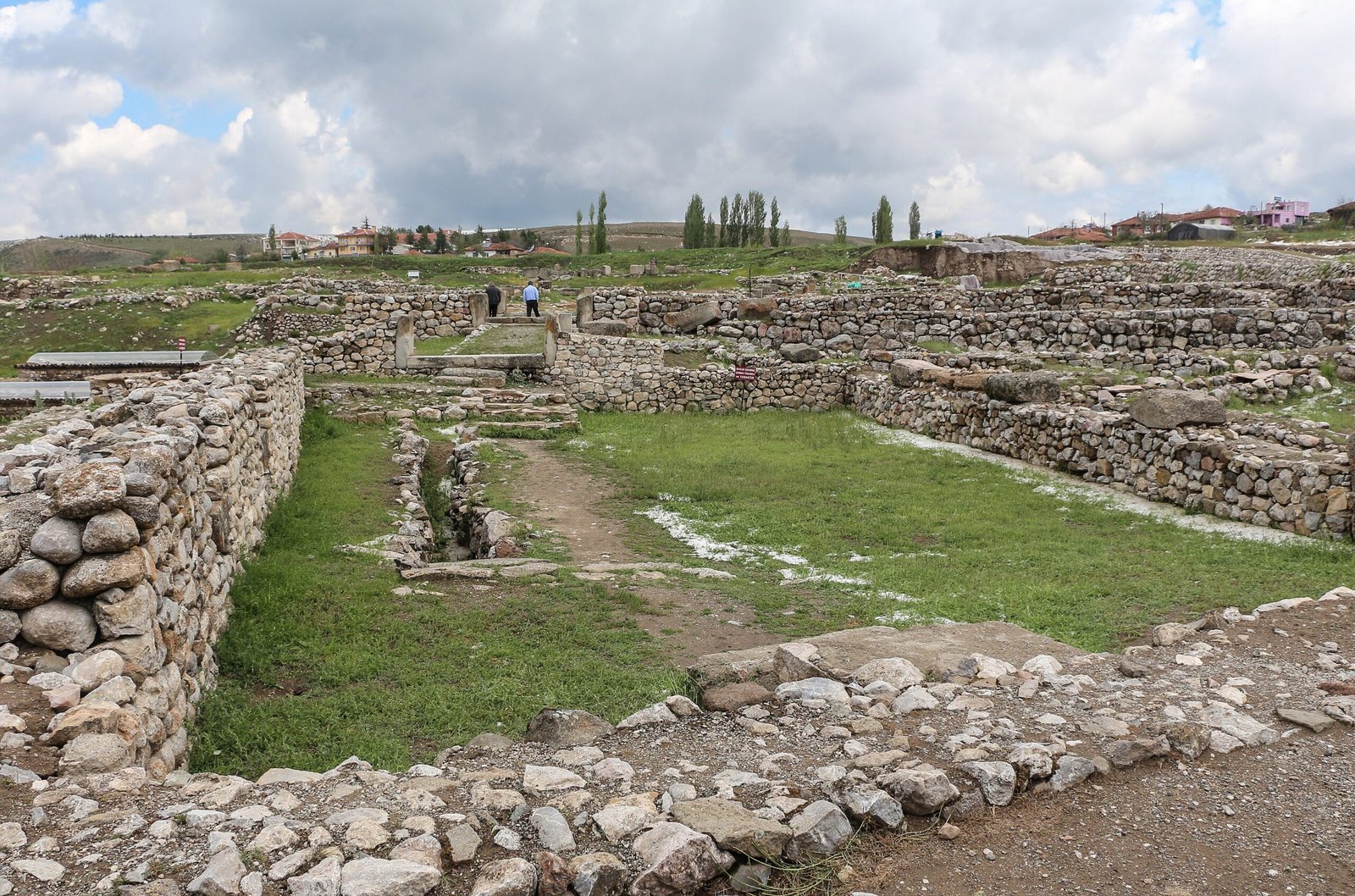
A Hittite royal ceremonial city in north-central Turkey, site of the extraordinary Bronze Age royal tombs (c. 2400–2200 BCE) containing gold sun-discs and bronze animal statuettes that represent the peak of Anatolian prehistoric metalwork — and of the well-preserved Sphinx Gate that still stands from the Hittite Empire period.
At a glance
Alacahöyük is a low tell approximately 50 kilometres north of Boğazkale (ancient Hattusa, the Hittite capital) in Çorum Province, north-central Turkey. Excavated intermittently since the 1830s and systematically since 1935, it has yielded two major sets of discoveries: the pre-Hittite royal tombs of approximately 2400–2200 BCE (Early Bronze Age), which contained the richest metalwork assemblage of prehistoric Anatolia; and Hittite-era monumental architecture (approximately 1400–1200 BCE) including the Sphinx Gate and a palace complex.
The 13 royal tombs — shaft graves covered with timber roofs and containing bronze solar disc standards, gold ornaments, and bronze animal figurines — were built approximately 400 years before the Hittites arrived in the region, by a pre-Hittite Anatolian culture whose identity and language remain debated. The finds are housed in the Museum of Anatolian Civilizations in Ankara and the Çorum Archaeological Museum.
Key facts
- Location: Near Alaca town, Çorum Province, north-central Turkey; approximately 50 km north of Boğazkale (Hattusa)
- Period of significance: Chalcolithic through Hittite Empire, c. 4000–1200 BCE; peak finds from c. 2400–2200 BCE (Early Bronze Age royal tombs) and c. 1400–1200 BCE (Hittite Empire)
- Royal tombs: 13 shaft graves, pre-Hittite Early Bronze Age, c. 2400–2200 BCE
- Key artefacts: Bronze solar disc standards; gold and electrum jewellery; bronze stag and bull statuettes with real horns and inlaid eyes; bronze ritual vessels
- Sphinx Gate: Hittite monumental gate, c. 1400–1200 BCE — two limestone sphinxes still in situ flanking the city entrance
- Excavation history: First European survey 1835–1838; systematic excavation from 1935 under Hamit Koşay (Turkish Historical Society); ongoing
- Collections: Museum of Anatolian Civilizations, Ankara; Çorum Archaeological Museum
History
The tell of Alacahöyük preserves evidence of occupation from the Chalcolithic period (c. 4000 BCE) through the early Iron Age (c. 1000 BCE), but two episodes dominate the site’s historical significance.
The first and most extraordinary is the Early Bronze Age royal tombs, dug between approximately 2400 and 2200 BCE. The 13 shaft graves — rectangular pits cut into bedrock, lined in some cases with stone, and covered with heavy timber roofing — were identified as royal by their contents: ox skeletons sacrificed above the tomb lid and left in place, alongside extraordinary metalwork assemblages that have no parallels in any other Bronze Age culture in the Near East. The solar disc standards — circular bronze discs mounted on poles, their surfaces decorated with geometric openwork designs or radiating sun patterns — are the most distinctive and puzzling objects: they appear to have served as royal or ritual standards carried in procession, but no contemporary parallel exists. Gold and electrum jewellery includes diadems, hairpins, bracelets, and dress ornaments of exceptional technical sophistication, demonstrating mastery of lost-wax casting, filigree, and granulation that would not be surpassed in Anatolia for centuries.
The people buried in these tombs were not Hittites — the Hittites did not arrive in central Anatolia until approximately 400 years later. They belonged to an Anatolian culture, possibly related to the proto-Hattian people attested in later Hittite religious texts as the original inhabitants of the Hatti land, whose language (Hattic) was preserved by the Hittites for ritual purposes after the Hattians were culturally absorbed.
The second phase of significance is the Hittite Empire period (c. 1400–1200 BCE), when Alacahöyük became a royal ceremonial centre with monumental public architecture. The Sphinx Gate — the principal entrance to the Hittite city — consists of two large limestone sphinxes (human-headed, lion-bodied) flanking the gate passage, their faces weathered but their bodies largely intact, with carved relief panels on the outer gate faces depicting processions of worshippers, musicians, and acrobats. A large palace complex adjacent to the gate preserves stone foundations and floor surfaces. The site appears to have been used for royal religious ceremonies during the Hittite period, possibly related to the Hattian religious traditions of which the Hittites were consciously the inheritors.
What you see
The archaeological site is open to visitors and well-maintained. The principal visible feature is the Sphinx Gate, standing at the southeastern entrance to the Hittite city: the two limestone sphinxes survive to approximately 2 metres in height, and the carved relief orthostat panels flanking the gate passage — showing religious processions, acrobats on a ladder, and hunting scenes — are among the best-preserved Hittite relief carvings in situ anywhere. (Note: the originals of several panels are in Ankara; some in situ examples are casts.)
The excavated areas of the Hittite palace and temple complex are accessible, with stone foundations clearly visible. The areas of the royal tomb excavations are marked and explained, though the tombs themselves are now backfilled; the ground plan of the shaft graves is indicated. An on-site museum (small but important) displays selected finds from the site, including replica solar disc standards and original Bronze Age ceramics. The full collections are in Ankara (Museum of Anatolian Civilizations) and Çorum (Archaeological Museum).
Practical information
- Open: Daily, approximately 08:30–17:30 (winter) / 08:00–19:00 (summer); confirm hours locally
- Entry: Fee applicable; included in Turkish Museum Pass (Müze Kart)
- On-site museum: Small museum within the site enclosure, included in site entry
- Facilities: Car park, small café nearby in Alaca town; limited facilities on site itself
- Best season: April–June and September–October; July–August very hot on the exposed site
- Accessibility: Mostly flat, gravel paths; partially accessible
Getting there
Alacahöyük is located approximately 2 kilometres outside the town of Alaca, in Çorum Province. By road: from Çorum city (approximately 70 km southeast, 1 hour), take the D785 road north toward Alaca; from Boğazkale/Hattusa (approximately 55 km south, 1 hour), take the road through Sungurlu. From Ankara the site is approximately 200 km (2.5 hours). No direct public transport; a taxi from Çorum or from Boğazkale is the practical option for visitors without private transport. The site is best combined with a visit to Hattusa/Boğazkale and Yazılıkaya in the same day trip from Ankara or the Çorum area.
Nearby
- Hattusa / Boğazkale (approximately 50 km south) — Hittite capital and UNESCO World Heritage Site with massive city walls, Great Temple, and royal archives
- Yazılıkaya (approximately 53 km south, adjacent to Hattusa) — Hittite open-air rock sanctuary with the most complete surviving cycle of Hittite divine relief carvings
- Çorum Archaeological Museum (approximately 70 km southeast) — important Alacahöyük collection including original royal tomb finds
- Museum of Anatolian Civilizations, Ankara (approximately 200 km southwest) — the definitive collection of Anatolian Bronze Age metalwork including Alacahöyük solar discs and tomb finds
Sources
- Koşay, Hamit Z. Alaca Höyük Kazısı: 1937–1939. Türk Tarih Kurumu, 1951.
- Drews, Robert. The Coming of the Greeks. Princeton University Press, 1988. (Background on Early Bronze Age Anatolia.)
- Bryce, Trevor. The Kingdom of the Hittites. Oxford University Press, 2005.
- Wikipedia contributors. Alacahöyük. Wikipedia, The Free Encyclopedia. Accessed June 2026.
Find it on the map
See this place and what’s around it →📷 Become a Cultural Heritage Online photographer
Share your photos of places: they stay published under your name as the author. The more they're seen, the more you get noticed — and soon a contest will reward the most appreciated photos.
Log in or sign up free to add a photo