
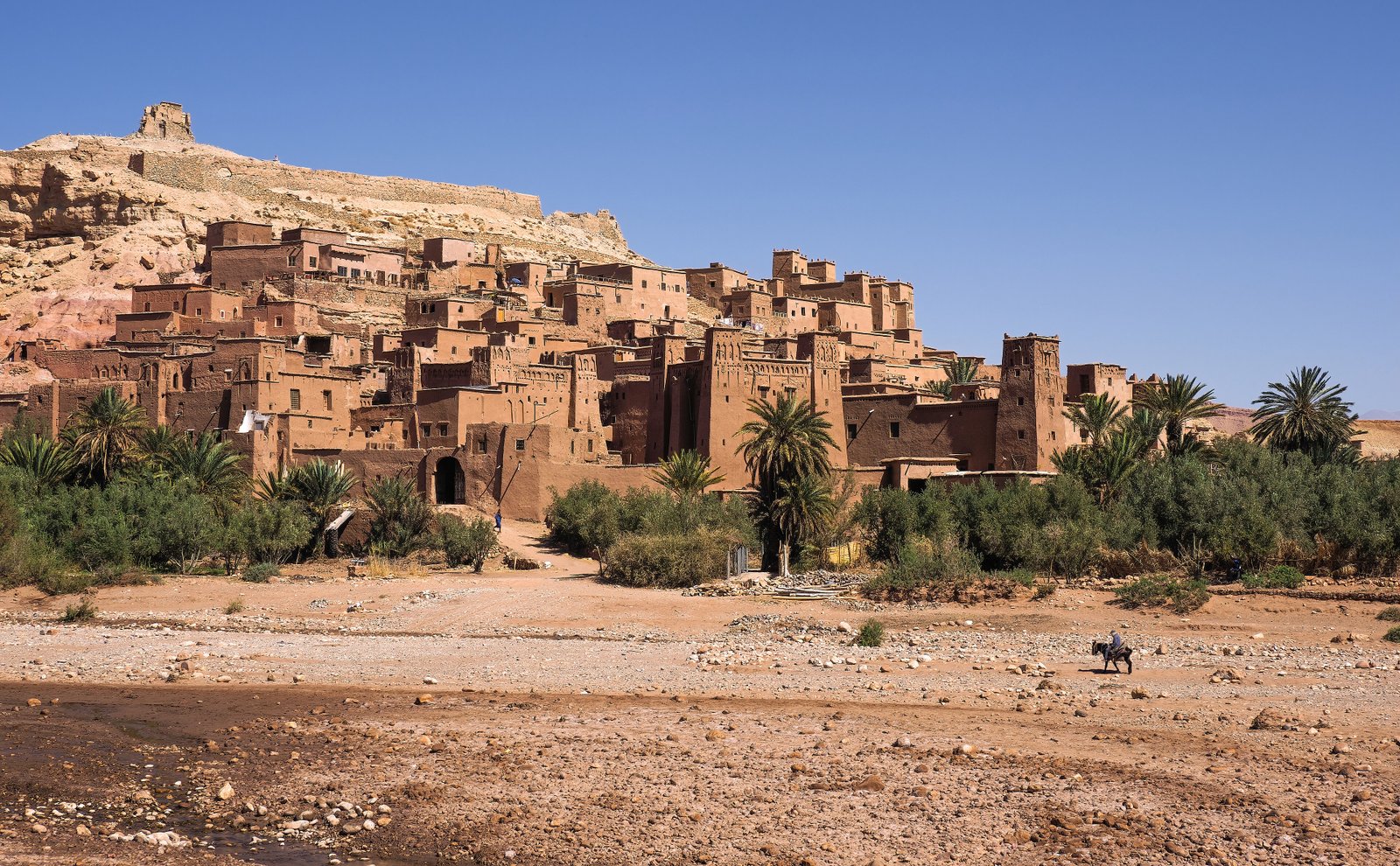
Aït Benhaddou
A fortified ksar of rammed earth and straw rising above the Ounila River, Aït Benhaddou has sheltered caravans on the trans-Saharan route for a thousand years — and stood in for Roman cities, slave ports, and desert planets for over 200 film productions.
At a glance
Aït Benhaddou is a ksar — a collective fortified village — built primarily from pisé, a mixture of rammed earth, straw, and gypsum that gives the towers their warm ochre colour. Situated on a hillside on both banks of the Ounila River in Morocco’s Drâa-Tafilalet region, the ksar was a key stop on the caravan route linking the Sahara to Marrakech. Six kasbahs with their characteristic angular towers survive largely intact. Though most residents have moved to the new village across the river, four or five families still inhabit the old side, and the community repairs the earthen walls every rainy season — an act of maintenance that has sustained the architecture for centuries. UNESCO inscribed it in 1987.
Key facts
- Period: c. 11th century AD (construction); continuously inhabited to present
- UNESCO inscription: 1987
- Film appearances: Gladiator (2000), Game of Thrones seasons 3–4 (2013–2014), Lawrence of Arabia (1962), Jesus of Nazareth (1977), The Mummy (1999), Babel (2006), Prince of Persia: The Sands of Time (2010), Kingdom of Heaven (2005); over 200 productions total
- Scale: Six kasbahs; approximately 300m × 200m footprint
- Access: Wade or take a small boat across the Ounila River; no vehicle access to the ksar interior
History
The ksar developed along the ancient caravan route connecting the oases of the Drâa Valley to the markets of Marrakech. Berber traders, Jewish merchants, and Saharan nomads all passed through or settled within its walls, leaving a layered social history legible in the different architectural styles of its towers. The pisé construction — earth mixed with straw, pebbles, and gypsum — required each generation to repair and rebuild after the winter rains, meaning that Aït Benhaddou is not a preserved ruin but a living process. The community’s seasonal maintenance work is itself the reason the ksar survives.
By the mid-20th century, the trans-Saharan trade routes had collapsed and most residents moved to the newer village across the river. The ksar might have dissolved into the landscape had it not been discovered by film and television productions beginning with David Lean’s Lawrence of Arabia in 1962. That first major film brought the site to international attention; subsequent productions followed in such numbers that a local economy built around film crews, set construction, and tourism took root. Ridley Scott’s production team for Gladiator (2000) built Roman-style streets and structures around the ksar’s exterior to serve as the garrison city of Zucchabar — one of the most ambitious physical production interventions the site has seen.
For Game of Thrones (2013–2014), the external walls and gates of the ksar became the slaver city of Yunkai in Essos, serving as the setting for Daenerys Targaryen’s siege scenes in seasons three and four. The production required minimal additional construction: the existing towers and walls provided exactly the visual language the show’s designers needed for a fictional city of antiquity. UNESCO’s inscription in 1987 recognised not only the architectural ensemble but its intangible value as a living example of Moroccan pre-Saharan earthen architecture.
What you see
Entering the ksar from the river crossing, the first sensation is fine dust — the rammed-earth walls shed a constant fine powder that coats surfaces and hangs in the air during dry months. The six kasbahs rise in stacked, irregular volumes, their corners decorated with geometric patterning formed by projecting mud-brick corbels. Inside the residential quarters, narrow passages open suddenly into small courtyards; the spatial logic is compressed and labyrinthine, designed to slow and confuse any attacker who breached the outer wall. The highest kasbah commands a full view of the Ounila Valley and the Atlas foothills beyond.
For Gladiator, Ridley Scott’s team extended the ksar’s southern face into a full Roman streetscape, with colonnaded market stalls and tiled floors laid directly on the earthen ground. The scene where Maximus is sold as a slave in the market of Zucchabar was filmed in and around these temporary structures, with the ksar’s actual towers serving as the city’s visible skyline. Today no trace of that set remains — the pisé absorbed or eroded every addition — but the kasbah walls and gate archway that framed those shots are unchanged.
Practical information
- Opening hours: Ksar accessible year-round; no fixed gate hours, donation expected on entry
- Best season: October–April (spring and autumn optimal; summer temperatures exceed 40°C)
- Duration: 1.5–2.5 hours for the ksar; half-day if combining with the surrounding landscape
- Film note: Gladiator’s Zucchabar market was built along the ksar’s southern exterior wall; Game of Thrones’ Yunkai gate scenes used the main north entrance archway
Getting there
Ouarzazate Airport (OZZ) is the nearest airfield, approximately 30km east on the N9 highway. Ouarzazate is served by domestic flights from Casablanca and Marrakech, and by charter flights from several European cities. From Ouarzazate, shared taxis and tour vehicles reach Aït Benhaddou in under 40 minutes. Marrakech (Ménara Airport, RAK) is 200km north over the Tizi n’Tichka pass — a dramatic 3.5-hour drive or bus journey.
Nearby
- Ouarzazate — Morocco’s “Ouallywood,” home to Atlas Film Studios, the world’s largest film studio complex (30km east)
- Drâa Valley — series of palm oases and kasbahs stretching south towards Zagora
- Tizi n’Tichka pass — 2260m High Atlas crossing on the route to Marrakech
Sources
- Wikipedia: en.wikipedia.org/wiki/Aït_Benhaddou
- UNESCO WHC: whc.unesco.org/en/list/444
- IMDb — Gladiator (2000): imdb.com/title/tt0172495
Find it on the map
See this place and what’s around it →Historical events at this place (3)
📷 Diventa un fotografo di Cultural Heritage Online
Condividi le tue foto dei luoghi: restano pubblicate con la tua firma come autore. Più vengono viste, più ti fai conoscere — e presto un concorso premierà le foto più apprezzate.
Accedi o registrati gratis per aggiungere una foto