

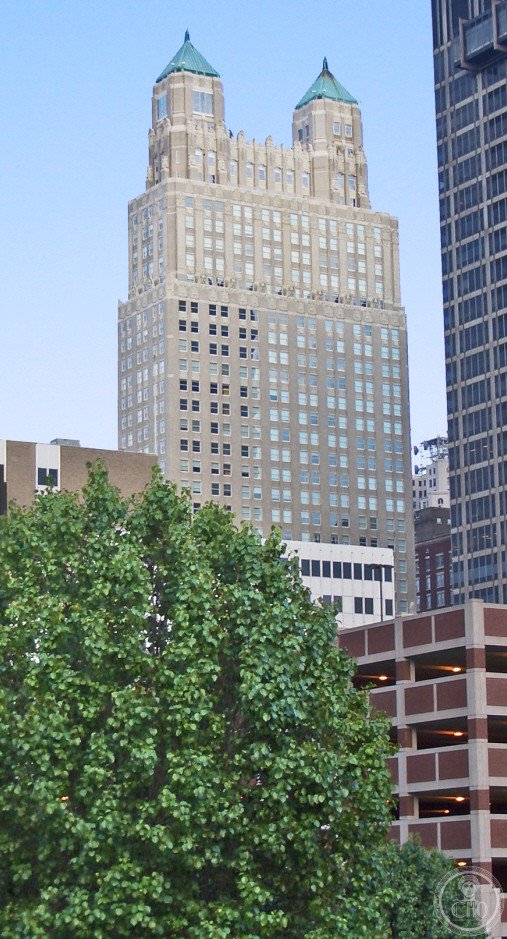

909 Walnut — the former Fidelity National Bank Building — is among Kansas City’s finest Art Deco towers, its terracotta facade and Gothic-ornamented crown a 1930 statement of institutional confidence in the year the Depression arrived.
At a glance
Completed in 1930 at 909 Walnut Street in downtown Kansas City, Missouri, the building was designed by Hoit, Price & Barnes for the Fidelity National Bank. Its 35-story terracotta tower combines the setback geometry of the American skyscraper tradition with decorative Gothic crown work that was the firm’s signature in their major Kansas City commissions of this period. The building is a contributing property of the Downtown Kansas City Historic District, recognised for its architectural quality as one of the most accomplished Art Deco towers in the city. The firm’s contemporaneous Power & Light Building, one block south, shares the same architectural vocabulary and the same architects, making the two towers a paired statement of Kansas City’s late-1920s commercial ambition.
Key facts
- Completed: 1930
- Architects: Hoit, Price & Barnes
- Style: Art Deco with Gothic ornamental crown
- Address: 909 Walnut Street, Kansas City, MO 64106
- Original client: Fidelity National Bank
- Signature feature: Terracotta-clad tower with Gothic pinnacles and vertical window piers
History
The Fidelity National Bank was among Kansas City’s most prominent financial institutions in the late 1920s. Its decision to commission a downtown skyscraper in 1928–1929 reflected the period’s unshaken confidence in urban commercial real estate — a confidence that the stock market crash of October 1929 would quickly undermine. Hoit, Price & Barnes were already working on the Power & Light Building one block south; the two commissions, both won in the same period, gave the firm an unusual opportunity to produce a cohesive block of downtown Art Deco architecture within walking distance.
909 Walnut was completed in 1930, in the first year of the Depression. The Fidelity National Bank maintained its occupancy through the difficult years that followed, and the building remained continuously occupied as a commercial office tower through the twentieth century. Its architectural quality was recognised in its individual listing on the National Register of Historic Places in 1997 (NRHP ref. 97000908).
The building’s current name — 909 Walnut — reflects its address rather than any corporate identity, a common fate for commercial towers whose original institutional tenants merged or relocated over the decades. The terracotta exterior, maintained in its original finish, gives the building an unusual architectural coherence for a ninety-year-old commercial property.
What you see
The building’s facade at 909 Walnut Street presents a vertically emphasised composition: continuous piers running the full height of the shaft, interrupted at the setback zones by decorative cornices and at the crown by the Gothic pinnacles that distinguish Hoit, Price & Barnes’ major work. The terracotta skin — a material common in American Deco construction of this period for its moulding flexibility, fire resistance, and ease of maintenance — has a warm cream tone that varies slightly in depth across the facade, giving the surface a texture that stone would not achieve.
The Gothic ornamental work at the crown is the building’s most distinctive element: buttress-like projections, pointed finials, and carved panels that quote ecclesiastical sources in a commercial context. The quotation is not ironic — for the architects and their clients in the late 1920s, Gothic verticality and ornamental richness signalled permanence, financial solidity, and civic aspiration in a register that the stripped Deco of later years explicitly rejected. Seen from Walnut Street looking north, the paired towers of 909 Walnut and the Power & Light Building — a block apart, both by Hoit, Price & Barnes, both completed within a year of each other — define the urban character of this stretch of downtown Kansas City.
Practical information
- Access: Lobby open during business hours; exterior visible at all times
- Best view: Walnut Street looking north; or from 10th Street looking south for the full tower silhouette
- Time needed: 20 minutes exterior; lobby 5–10 minutes
- GPS: 39.1033° N, 94.5818° W
- Nearest transit: Main Street MAX rapid transit; KC Streetcar on Main Street
Getting there
909 Walnut stands at the intersection of 9th and Walnut Streets in downtown Kansas City, a few minutes’ walk from the Power & Light Building and the Municipal Auditorium. Union Station is approximately a 15-minute walk south-west; Kansas City International Airport connects by taxi or shuttle in approximately 30–40 minutes.
Nearby
- Power & Light Building (1931) — Hoit, Price & Barnes’ companion tower at 14th and Baltimore, one block south
- Municipal Auditorium (1935) — PWA Deco civic complex at 301 W 13th Street
- Scarritt Building (1906) — Gothic Revival commercial building at 818 Grand Blvd, an earlier generation of Kansas City urban architecture
Sources
- National Register of Historic Places, Downtown Kansas City Historic District (contributing property) — nps.gov
- Kansas City Landmarks Commission, historic properties record — kcmo.gov
- Landmarks Heritage Preservation Commission, Hoit Price & Barnes firm files — UMKC Western Historical Manuscript Collection
- Shortridge, James R. Kansas City and How It Grew. University Press of Kansas, 2012
- Wikidata, 909 Walnut Q4645620 — wikidata.org
Find it on the map
See this place and what’s around it →📷 Become a Cultural Heritage Online photographer
Share your photos of places: they stay published under your name as the author. The more they're seen, the more you get noticed — and soon a contest will reward the most appreciated photos.
Log in or sign up free to add a photoIs this page about you?
This page is read by travellers and heritage enthusiasts who find it on Google. Tell us how you are connected to this place and we will take it from there.