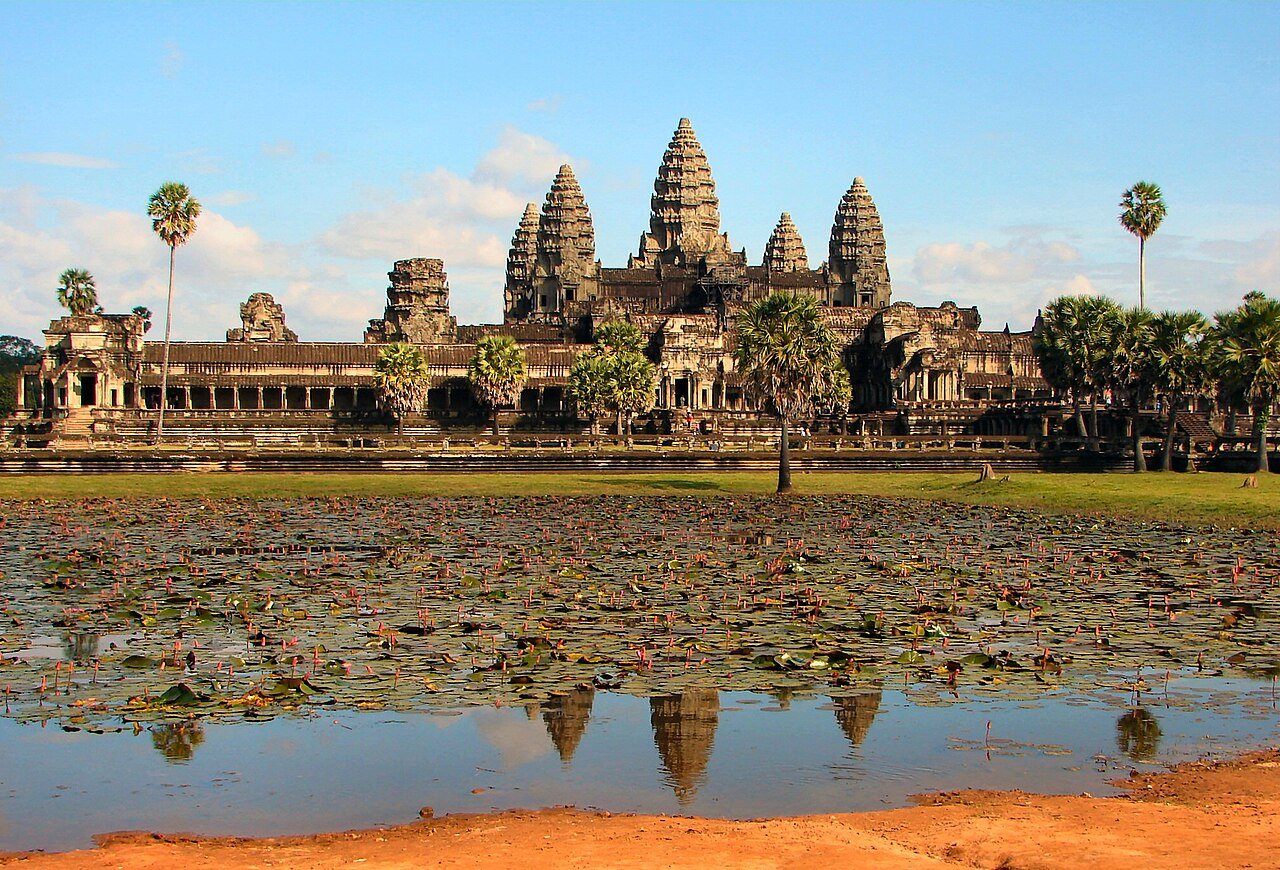
Southeast Asia is home to 50 UNESCO World Heritage Sites across nine countries, spanning volcanic temple complexes and ancient trading towns to some of the most biodiverse rainforests on earth. The region stretches from the limestone karsts of northern Vietnam to the coral atolls of the Sulu Sea, and its World Heritage list reflects that breadth — Neolithic burial grounds sit alongside Baroque colonial churches, and rice terraces cultivated for two thousand years share designation with caves that hold the fossil record of early human settlement. From Cultural Heritage Online.
The shape of Southeast Asia’s World Heritage list
UNESCO began inscribing Southeast Asian sites in 1991, when Indonesia’s Borobudur Temple Compounds, Prambanan Temple Compounds, Komodo National Park, and Ujung Kulon National Park all received designation in a single session — alongside Thailand’s Historic City of Ayutthaya and the Thungyai-Huai Kha Khaeng Wildlife Sanctuaries. That inaugural cohort established a pattern still visible in the list today: the region’s nominations balance monumental Hindu-Buddhist architecture against landscapes of exceptional ecological value.
The list has grown steadily since. The most recent additions came in 2025, when Cambodia’s Cambodian Memorial Sites, Malaysia’s Forest Research Institute Malaysia Forest Park Selangor, and Vietnam’s Yen Tu-Vinh Nghiem-Con Son complex each received inscription. Of the roughly 50 inscribed properties, the majority are cultural sites; natural and mixed designations account for roughly a third, concentrated in the Malay Archipelago, the Mekong uplands, and the Philippine seascape.
Countries with the most inscriptions
Indonesia leads the region with 10 World Heritage Sites — a reflection of its extraordinary geographic and cultural range across more than 17,000 islands. The portfolio runs from Sangiran Early Man Site on Java, one of the most significant paleoanthropological discoveries of the twentieth century, to the Cultural Landscape of Bali Province, inscribed in 2012 for its subak irrigation system rooted in ninth-century Balinese Hinduism. The 2023 inscription of the Cosmological Axis of Yogyakarta brought another urban cultural landscape into the list.
Vietnam ranks second with nine properties, including the 2025 addition of the Yen Tu-Vinh Nghiem-Con Son complex — a serial nomination linking Buddhist pilgrimage sites associated with the Trúc Lâm school, founded in the thirteenth century under the Trần dynasty. Thailand and Malaysia each hold six sites, while the Philippines also counts six, ranging from the sixteenth-century Baroque Churches of the Philippines to the marine biodiversity of Tubbataha Reefs Natural Park. Cambodia, with five inscriptions including three in the last decade, has among the fastest-growing portfolios in the region.
Cross-border and serial sites
The most significant transnational property in Southeast Asia links Vietnam and Laos through contiguous karst ecosystems. Phong Nha-Kẻ Bàng National Park in Vietnam was first inscribed in 2003; its Lao counterpart, Hin Nam No National Park, was added in 2025, formally creating a cross-border serial property that protects one of the largest continuous blocks of limestone forest in Southeast Asia. The caves within this system — among them Son Doòng, the largest known cave passage in the world by volume — represent both geological and biological significance of the highest order.
Serial nominations within single countries have also shaped the region’s list. Vietnam’s inscription of Hạ Long Bay originally covered the bay itself, later extended to include the Cát Bà Archipelago. Thailand’s 1991 inscription of the Historic Town of Sukhothai and Associated Historic Towns grouped three linked archaeological parks under a single designation. The Philippines’ Baroque Churches nomination consolidated four colonial-era churches across Luzon and Panay built between 1587 and the eighteenth century. This serial approach allows nominations to articulate cultural or ecological systems rather than single monuments in isolation.
Natural and mixed-criteria sites
Southeast Asia’s natural World Heritage Sites are concentrated in two ecological zones: the Sundaland biodiversity hotspot of Borneo and Sumatra, and the archipelagic marine environments of the Philippines and Indonesia. Kinabalu Park in Malaysian Borneo is among the most botanically diverse places on earth, hosting over 5,000 vascular plant species. Komodo National Park, the only site in the region designated partly for a living reptile species, protects the Komodo dragon and the marine ecosystems surrounding the Lesser Sunda Islands. Gunung Mulu National Park in Sarawak contains the world’s largest natural chamber by area — Sarawak Chamber — and a cave system of exceptional scale.
The region’s sole mixed site — satisfying both cultural and natural criteria — is Tràng An Landscape Complex in Vietnam’s Ninh Bình province, inscribed in 2014. The site combines a karst landscape with archaeological evidence of human occupation spanning more than 30,000 years, alongside Buddhist sanctuaries and pagodas integrated into the topography. Indonesia’s Tropical Rainforest Heritage of Sumatra, a serial property covering Gunung Leuser, Kerinci Seblat, and Bukit Barisan Selatan national parks, remains on the List of World Heritage in Danger due to encroachment, illegal logging, and road construction through core zones.
Explore Southeast Asia’s UNESCO heritage
CHO publishes country-level guides to every UNESCO-inscribed nation in the region, each with GPS-located site cards, sourced editorial histories, and itinerary-ready content. Browse by country below.
- Indonesia (10 sites)
- Vietnam (8 sites)
- Cambodia (3 sites)
- Thailand (6 sites)
- Philippines (6 sites)
- Malaysia (4 sites)
- Myanmar (2 sites)
- Laos (3 sites)
- Singapore (1 site)
Every site in this list is pinpointed on CHO’s interactive heritage map, with GPS coordinates and sourced editorial history. See our guide to UNESCO World Heritage criteria, and our piece on cultural travel beyond mass tourism.
Frequently Asked Questions
How many UNESCO World Heritage Sites does Southeast Asia have?
Southeast Asia has 50 UNESCO World Heritage Sites inscribed across nine countries: Indonesia, Vietnam, Thailand, Malaysia, the Philippines, Cambodia, Laos, Myanmar, and Singapore. The first inscriptions in the region were made in 1991; the most recent additions were announced in 2025.
Which country in Southeast Asia has the most UNESCO World Heritage Sites?
Indonesia holds the most UNESCO World Heritage Sites in Southeast Asia with 10 inscribed properties. These range from the ninth-century Buddhist monument of Borobudur on Java to Lorentz National Park in Papua, the largest protected area in the Asia-Pacific region. Vietnam ranks second with nine sites.
Are there any UNESCO World Heritage Sites that cross international borders in Southeast Asia?
Yes. The Phong Nha-Kẻ Bàng and Hin Nam No national parks in Vietnam and Laos respectively were formally linked as a transnational serial property in 2025, protecting a continuous karst forest system. The designation is one of the few cross-border World Heritage properties in Southeast Asia.
What makes Southeast Asia’s World Heritage Sites distinctive compared to other regions?
Southeast Asia combines two exceptional inheritance streams — Hindu-Buddhist monumental architecture spanning the first to fifteenth centuries, and some of the world’s most biodiverse tropical ecosystems — in a geographically compact area. Several sites, including Angkor in Cambodia and the Rice Terraces of the Philippine Cordilleras, also document living cultural traditions that have continued without interruption for over a millennium.
Sources used in this article
- UNESCO — List of World Heritage Sites in Southeast Asia.
- CHO magazine — What is a World Heritage Site?
- CHO — Interactive map of heritage sites.
Sources
- S1 — Tarling, Nicholas, ed. The Cambridge History of Southeast Asia. Cambridge University Press, 1992. ISBN 978-0-521-35505-6.
- S2 — Higham, Charles. The Civilization of Angkor. University of California Press, 2001. ISBN 978-0-520-23442-0.
Spotted an error? Write to editorial@culturalheritageonline.com and we correct it the same day.