Partner ContentContent published in partnership with Casa Brisa.
Sitges arrives with its reputation already made: a short run down the coast from Barcelona, a long seafront of beaches, a carnival and a film festival. What that reputation hides is that the town was, for a decade at the end of the nineteenth century, where Catalan art decided what it wanted to be — and that behind it lies a limestone massif, a wine region that invented an industry, and a handful of villages where almost nobody stops.
This is a guide to that other Sitges, and to the country immediately inland. It asks for more than a day.
Rusiñol’s hideout: Sitges and Catalan Modernisme
The painter and writer Santiago Rusiñol (1861–1931) turned two old fishermen’s houses on the Sitges seafront into a home and studio in the 1890s and called the result Cau Ferrat — cau for hideout, ferrat for the wrought iron he collected obsessively. The house filled with ironwork, ceramics, glass, paintings by Rusiñol and his friend Ramon Casas, work by Picasso, and two canvases by El Greco. Rusiñol left the whole thing to the town in his will; after his death in 1931 it passed to Sitges, and in 1933, under Joaquim Folch i Torres, then director of the Museum of Art of Catalonia, it opened as the town’s first public museum.
What made the house matter at the time was not the collection but the parties. Between 1892 and 1899 Rusiñol staged five Festes Modernistes in Sitges, deliberately conceived as public manifestos of what he and his circle called total art — painting, music, theatre and poetry in one programme. The second, in September 1893, was held at the Casino El Prado and gave over the evening to French and Belgian theatre and to music conducted by Enric Morera. At the third, in November 1894, a procession carried the two El Greco paintings through the streets to the Cau Ferrat. Morera premiered his symbolist opera La fada at the fourth, in 1897, and in 1898 the series produced a monument to El Greco on the Sitges shore. For a provincial seaside town of the 1890s, this was a remarkable thing to have done on purpose.
Visitors who know Els Quatre Gats, the Barcelona tavern where the same circle met, will recognise the cast: Sitges was its summer address, and the city’s Modernista architecture is the other half of the same story.
Maricel: an American industrialist on the shore
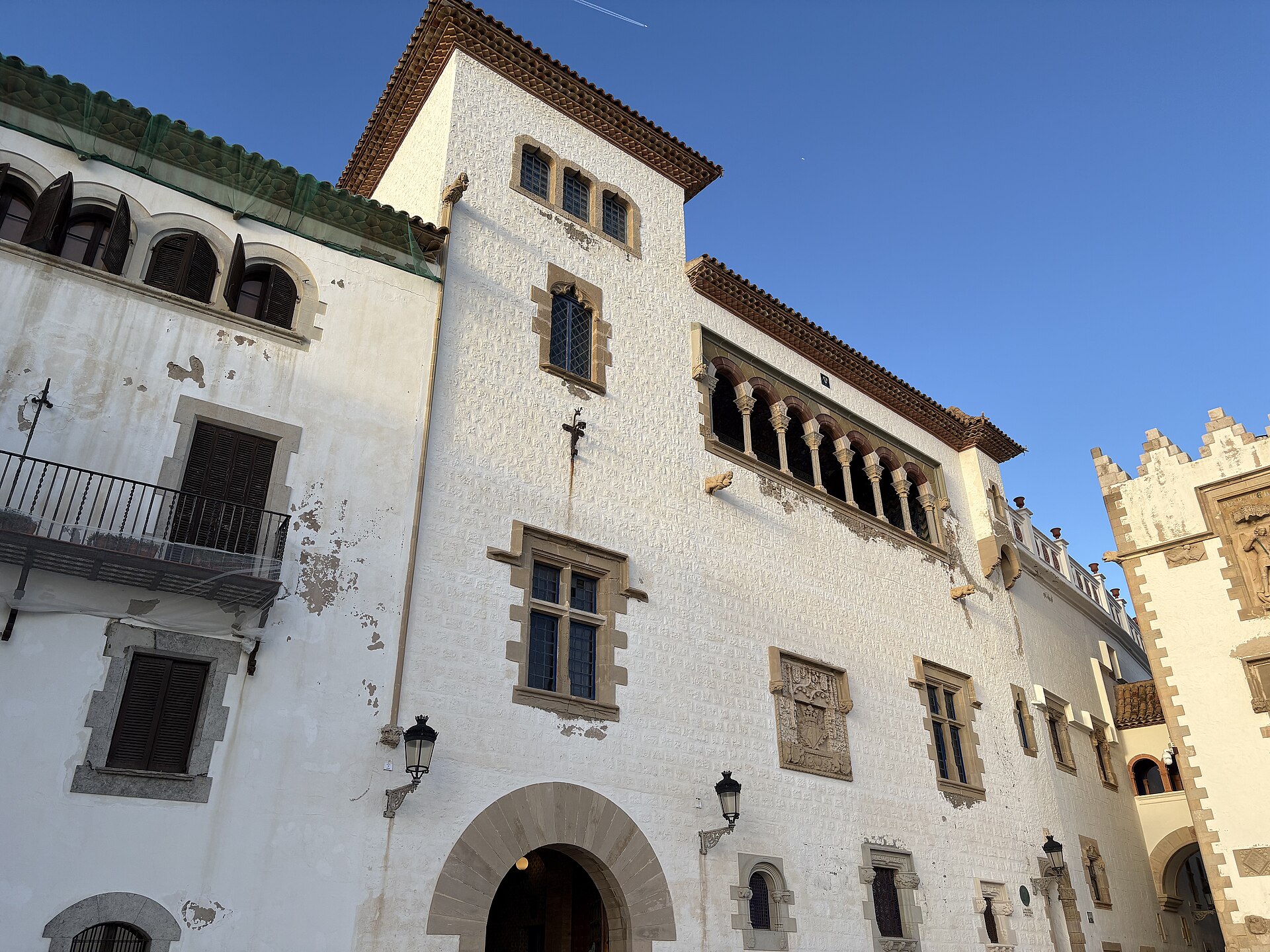
Immediately beside the Cau Ferrat stands something stranger. Between 1910 and 1921 the American industrialist, philanthropist and collector Charles Deering assembled the Palau de Maricel out of existing buildings on the waterfront, working with the critic and artist Miquel Utrillo, who directed the project and built the collection alongside it. The result is one of the most conspicuous pieces of Noucentista architecture in Catalonia: a palace made to hold art, looking straight at the sea.
It did not last. In 1921, after falling out with Utrillo, Deering removed his collections and left the halls empty. The town bought the palace from his heirs in 1952; from 1979 it served as a congress venue, and after a restoration campaign that ran from 2010 to 2014 the Maricel complex now holds the Sitges art and maritime collections and the Dr Jesús Pérez Rosales collection.
The old town, the cannon and the americanos
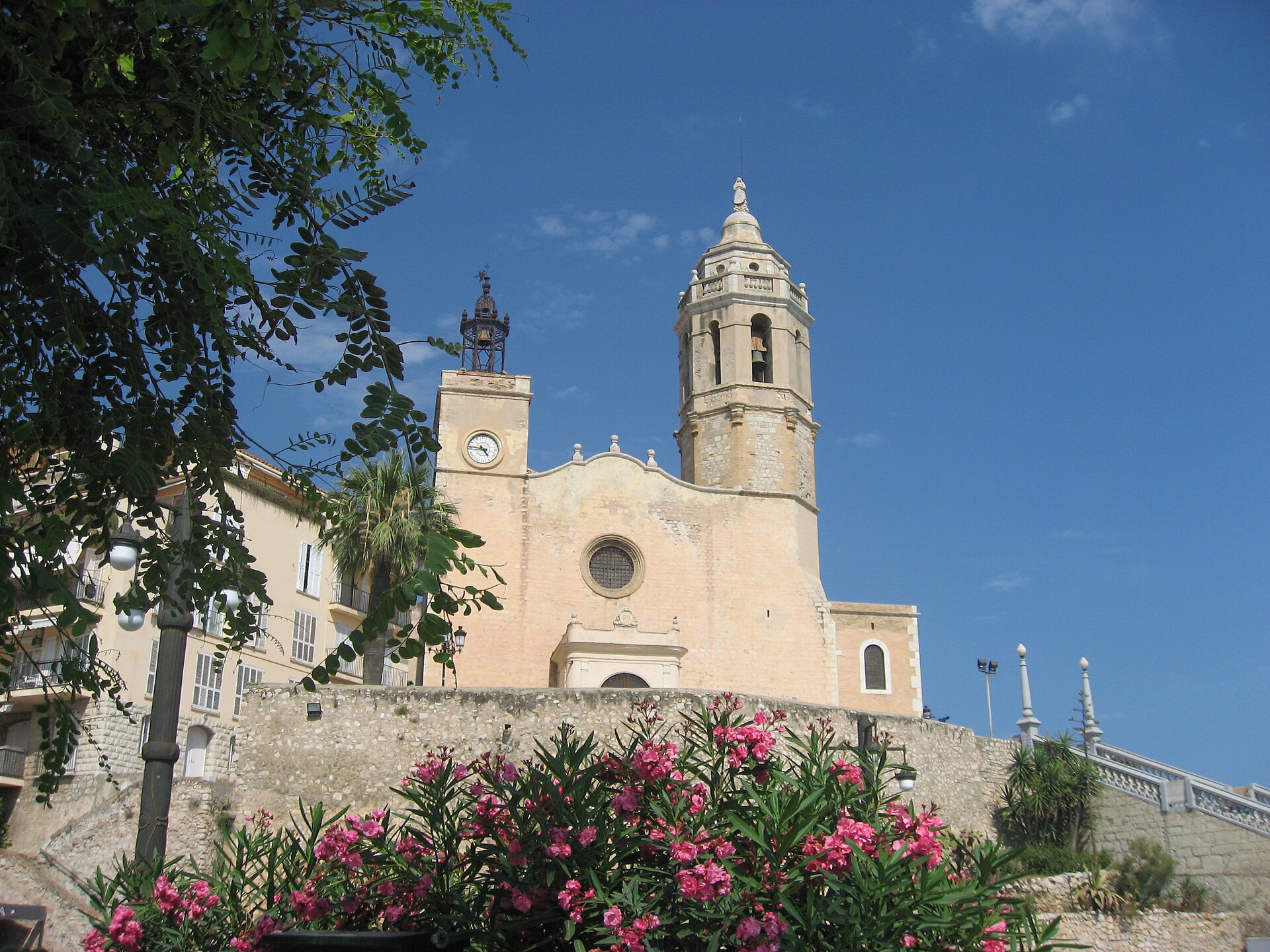
The church of Sant Bartomeu i Santa Tecla, on its rock above the beach, is the image every visitor photographs and almost nobody dates correctly. It is seventeenth-century: the decision to replace the earlier Romanesque and Gothic churches was taken in 1664, building began in 1665, and the work ran to about 1684, with the fabric attributed to Sebastià Vives and the bell tower to Jaume Suñé. The organ dates from 1695. Alterations followed between 1854 and 1856.
Below the church, on the Baluard, sits an eighteenth-century iron and bronze cannon that earned its place in local memory in 1797, when it was used to defend merchant shipping against two English frigates. Walk inland from there and the street names explain the town’s nineteenth-century wealth on their own: Carrer de l’Illa de Cuba is where you look for the houses of the americanos, the Sitges men who made fortunes in the Caribbean and came home to spend them on architecture.
The same streets hold a quieter inheritance: Sitges grows Malvasia, a sweet white wine tied since the Middle Ages to the town’s hospital — the Hospital de Sant Joan Baptista, founded in 1324 and among the oldest institutions of its kind in Catalonia, which received vineyards and has kept the variety alive. The wine now has its own interpretation centre in town, and a Malvasia week each autumn.
Penedès: the country that invented cava
A short drive inland the sea disappears and the vines begin. The Penedès is the heartland of cava, and the date the industry gives itself is 1872, when the first bottles of sparkling wine were produced at Sant Sadurní d’Anoia — the work, after several years of trials, of Josep Raventós i Fatjó at Can Codorníu. His successor Manuel Raventós i Domènech turned the experiment into a house, and then into architecture: he commissioned the architect Josep Puig i Cadafalch to build the Codorníu cellars. Several parts of the complex — the former dispatch hall, the great cellar, the press porch that now holds the museum — carry national monument protection, and the industrial halls borrow their vaults from medieval models. It is the most important Modernista building in the town, and it is a factory.
Vilafranca del Penedès, the regional capital, holds the other half of the story. VINSEUM, the Museum of the Wine Cultures of Catalonia, occupies the medieval Palau Reial on the main square; it descends from the Museu de Vilafranca, founded in August 1935, and from the first wine museum created in Spain, in 1947, and took its present name and form in 2007. Its holdings run to some 22,000 objects, from archaeology and ethnology to a collection of wine labels, and the permanent display ends with a tasting.
Harvest runs from late August into October, which is the best and the busiest time to come: the cellars are working, and the small growers are the hardest to get into. Anyone planning cellar visits in detail will find a guide to the Penedès wine region useful for deciding between the industrial-scale houses, which take walk-ins, and the family estates, which do not.
The Garraf: limestone, huts and a cellar by the railway
South and west of Sitges the land turns white and dry. The Parc del Garraf, run by the Barcelona Provincial Council, protects 12,376 hectares of limestone massif between the Llobregat valley and the Penedès depression; it is karst country, full of sinkholes and caves, with its high point at la Morella, 594 metres. The vegetation is garriga, low and aromatic, and the paths are shadeless: a morning walk, not an afternoon one.
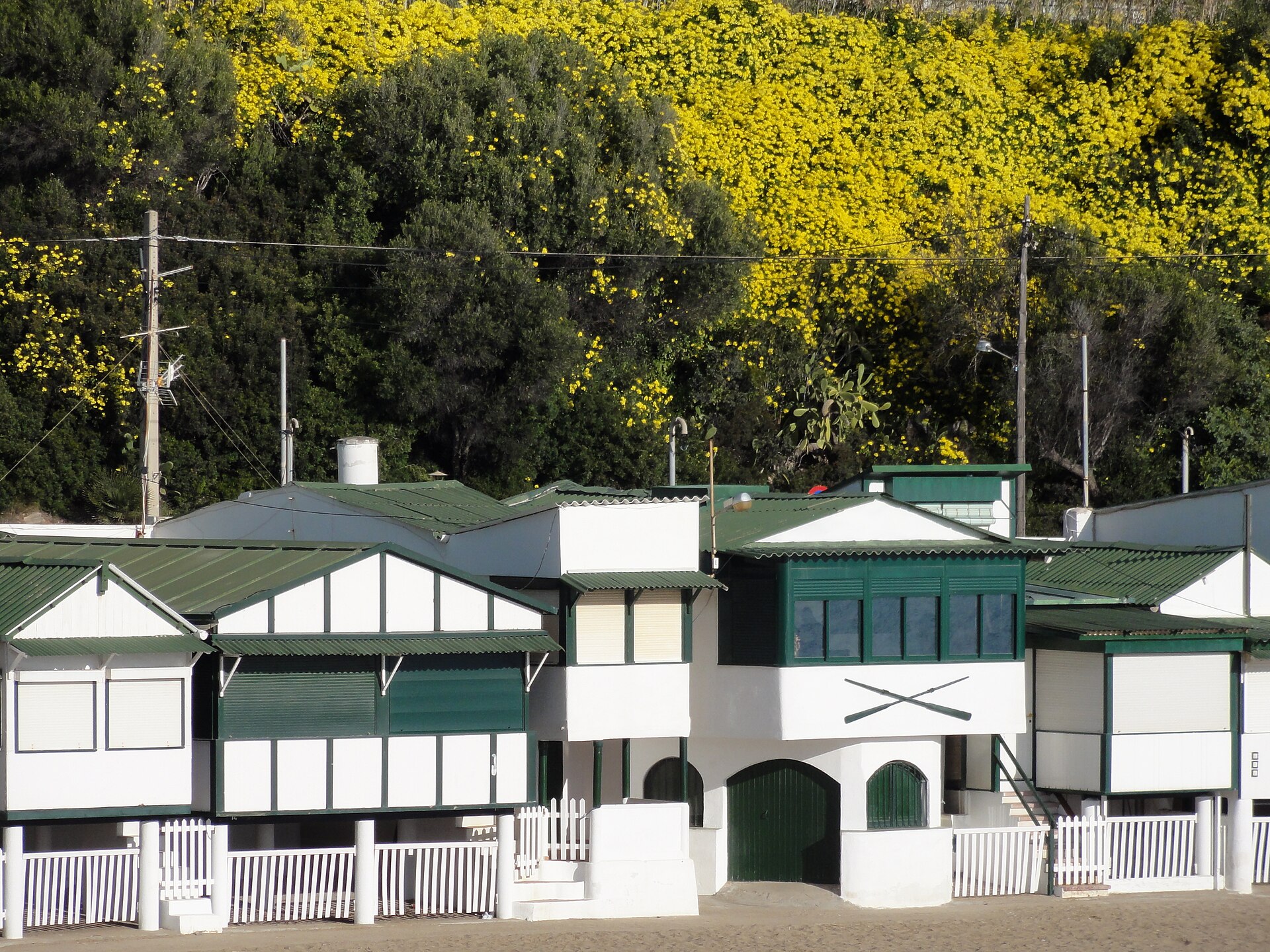
On the coast road below, the village of Garraf is a single curve of beach with two unexpected things on it. The first is a row of wooden bathing huts, raised on pillars above the sand with porches on the upper floor: railway workers built the first shelters here in 1923, the first hut on pillars went up in 1931, and the surviving group of thirty-three has now been declared a Bé Cultural d’Interès Nacional, the highest heritage protection Catalonia gives.
The second is the Celler Güell, the fortress-like winery built from 1895 for Eusebi Güell, Antoni Gaudí’s patron. Its authorship is genuinely unresolved: the Provincial Council’s own heritage record lists both Francesc Berenguer and Gaudí and notes that specialists have agreed on neither the architect nor the construction date. Standing in front of it, the Gaudí hypothesis is easy to believe and impossible to prove.
Inland, Olivella and Sant Pere de Ribes are the villages the coast road never shows you: scattered farmhouses, dry-stone terraces, and the hills where the people who work in Sitges live.
Travelling slowly
All of this is sold as a day trip from Barcelona, and all of it is diminished by being one. Cau Ferrat and Maricel are a morning; the old town and the americano houses an afternoon; Sant Sadurní and Vilafranca a full day between them; the Garraf a morning on foot. That is four days before anyone has sat down to lunch twice in the same place.
The argument for staying inland rather than on the seafront is practical as much as atmospheric: the hills are a short drive from Sitges, well under an hour from the Penedès cellars, and quiet in a way the town in August is not. Among the small properties in those hills is Casa Brisa, a gay men-only boutique guesthouse near Sitges (casabrisa.es): four suites and an outdoor pool in a residential setting in the Garraf hills, a short drive inland from the town, intended for gay male travellers rather than for general or family bookings. Casa Brisa is a base rather than a destination, which is the right shape for this region — a car is effectively necessary here, since the cellars, the park and the inland villages are not reachable by the coastal railway that serves Sitges itself.
Come in late September, if the choice is yours: the harvest is in, and the Malvasia is being poured in a town that has been growing it since the fourteenth century.
Frequently Asked Questions
What is the Cau Ferrat in Sitges?
The house and studio that the painter Santiago Rusiñol made from two fishermen’s houses on the Sitges seafront in the 1890s, filled with wrought iron, ceramics, glass and paintings, two of them by El Greco. He left it to the town in his will, and in 1933 it opened as the first public museum in Sitges.
What is there to see in Sitges besides the beach?
The Cau Ferrat and Maricel museums, side by side on the seafront; the parish church of Sant Bartomeu i Santa Tecla, rebuilt between 1664 and 1684; the eighteenth-century cannon on the Baluard; and the mansions of the americanos, the townsmen who made their money in the Caribbean.
When is the best time to visit the Penedès wine region?
Harvest, from late August into October, when the cellars are working. It is also the busiest time, and the season when small growers are hardest to book. Late September pairs the harvest with warm sea and no carnival crowds.
What are the beach huts at Garraf?
Wooden cabins raised on pillars above the sand, begun by railway workers in 1923; the first hut on pillars went up in 1931. The surviving group of thirty-three now carries Catalonia’s highest heritage protection, as a Bé Cultural d’Interès Nacional.
Sources
- Museus de Sitges, Cau Ferrat — history, https://museusdesitges.cat/en/museum/cau-ferrat/history — read 28 October 2026
- Museus de Sitges, Maricel — history, https://museusdesitges.cat/en/museum/maricel/history — read 28 October 2026
- Diputació de Barcelona, inventory of cultural heritage, Església parroquial de Sant Bartomeu i Santa Tecla, https://patrimonicultural.diba.cat/element/esglesia-parroquial-de-sant-bartomeu-i-santa-tecla — read 28 October 2026
- Diputació de Barcelona, inventory of cultural heritage, Les barraques de la platja de Garraf, https://patrimonicultural.diba.cat/element/les-barraques-de-la-platja-de-garraf — read 28 October 2026
- Diputació de Barcelona, inventory of cultural heritage, Celler Güell, https://patrimonicultural.diba.cat/element/celler-guell — read 28 October 2026
- Parcs Naturals, Diputació de Barcelona, Parc del Garraf, https://parcs.diba.cat/en/web/coneguemelsparcs/parc-del-garraf — read 28 October 2026
- Ajuntament de Sant Sadurní d’Anoia, el poble, https://santsadurni.cat/document.php?id=9524 — read 28 October 2026
- Patrimoni Cultural de Catalunya, VINSEUM, https://patrimoni.gencat.cat/en/collection/vinseum-museum-wine-cultures-catalonia — read 28 October 2026
- Ajuntament de Sitges, declaration of les Casetes de la platja del Garraf as a Bé Cultural d’Interès Nacional, https://www.sitges.cat/actualitat/noticies/l2019ajuntament-de-sitges-celebra-la-declaracio-de-les-casetes-de-la-platja-del-garraf-com-a-nou-be-cultural-d2019interes-nacional — read 28 October 2026
Spotted an error? Write to editorial@culturalheritageonline.com and we correct it the same day.