Taxila (Greek: “Τάξιλα” — transcription of the ancient name, from the Sanskrit/Pali “Takshashila” — “City of Cut Stone” or “Rock of Taksha”, from “taksha” = a mythical king’s name or the act of cutting/hewing + “shila” = rock/stone), inscribed by UNESCO in 1980, is one of the most archaeologically significant sites in Asia — a complex of multiple ancient city sites and Buddhist religious monuments distributed across the Taxila Valley in the Punjab Province of modern Pakistan (approximately 32 km northwest of Rawalpindi and approximately 35 km from Islamabad, at the strategic junction of the ancient Silk Road trade routes connecting Central Asia, the Indian subcontinent, and the Iranian plateau) that spans approximately 1,000 years of continuous urban civilisation from approximately the 5th century BCE to the 5th century CE, during which Taxila was successively under Achaemenid Persian rule (approximately 516–326 BCE, when it was part of the satrapy of Gandhara and Sindhu), Macedonian Greek rule (326–316 BCE, when Alexander the Great’s campaign through the Indus region made Taxila one of the first Indian cities to receive a Greek garrison — the Macedonian commander Ambhi/Omphis, the local ruler who submitted to Alexander at the Taxila valley, provided elephants and troops for Alexander’s subsequent Punjab campaign), Mauryan Indian rule (approximately 320–185 BCE — Taxila was the eastern headquarters of the Mauryan Empire under Chandragupta Maurya, Bindusara, and Ashoka, and the Emperor Ashoka’s own inscriptions identify him as having governed as viceroy at Taxila before his accession as emperor), Greek successor rule under the Indo-Greek kingdom (approximately 185–90 BCE, when the Bactrian Greek successor states ruled the Taxila region and produced the characteristically Hellenistic-Indian “Gandharan” art style that fused Greek figural artistic conventions with Indian Buddhist iconographic themes), and later Scythian/Parthian/Kushan rule (approximately 90 BCE–375 CE, during which Taxila was one of the most cosmopolitan cities of the ancient Silk Road, with documented communities of Zoroastrian Persians, Greek settlers, Buddhist monks, and Jain merchants coexisting in the valley’s multiple urban and monastic settlements).
Taxila’s archaeological sites and the Gandharan Buddhist circuit Bhir Mound · Sirkap · Sirsukh · Dharmarajika Stupa · Jaulian Monastery · Islamabad — 0 to 35 km
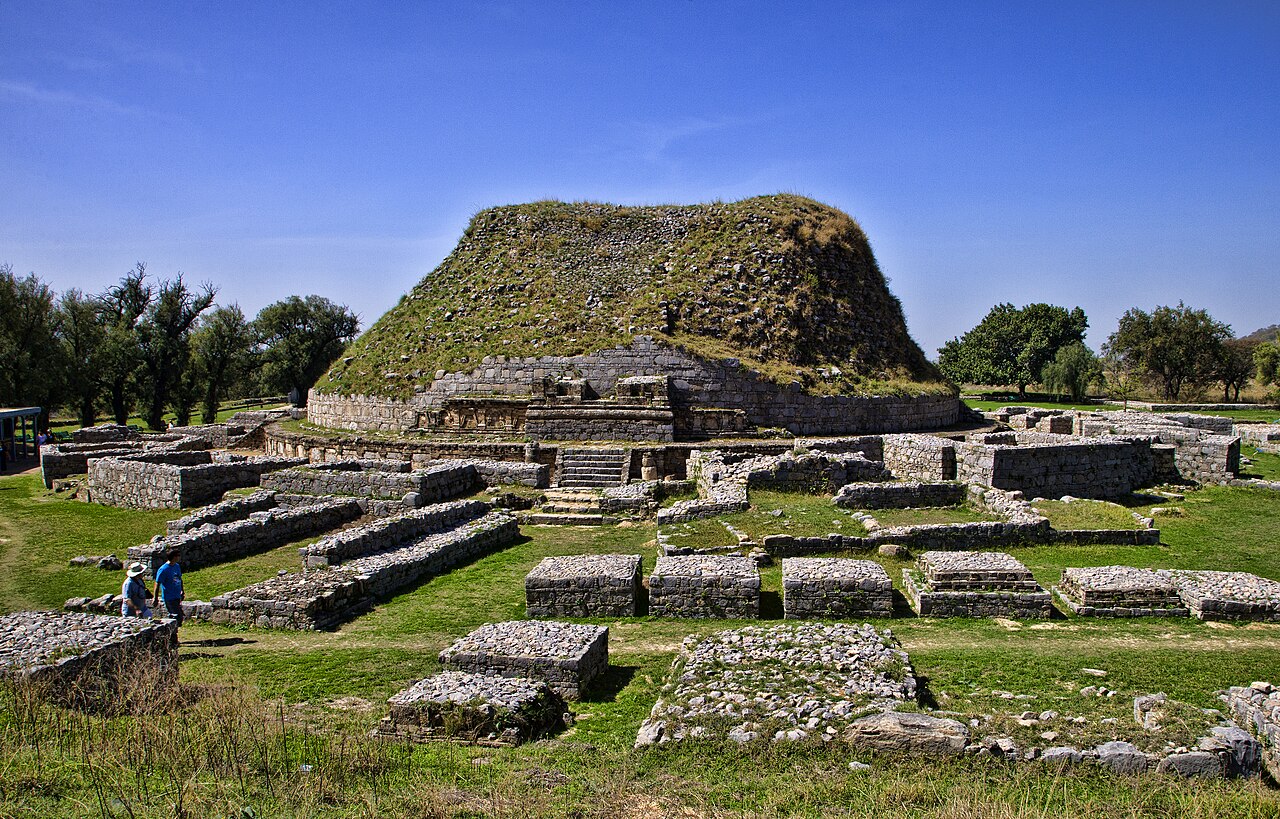
The Taxila archaeological complex encompasses three distinct ancient city sites (each representing a different historical period and urban form) and numerous Buddhist religious monuments (stupas and monasteries), spread across approximately 30 km² of the valley: the Bhir Mound (the earliest city, the “Takshashila” of pre-Macedonian and Mauryan times, an irregular unplanned urban mound covering approximately 1 km × 0.5 km whose stratigraphic excavations by the British archaeologist Sir John Marshall in 1913–34 CE revealed building phases from approximately 5th century BCE through the 2nd century BCE, with a characteristic absence of the right-angle street grid of the later planned cities — suggesting an organic “bazaar city” growth pattern typical of pre-Greek South Asian urbanism); the city of Sirkap (the “Greek city”, a planned urban settlement covering approximately 1 km × 0.5 km laid out in the Hippodamian Greek grid plan [named after the Greek urban planner Hippodamos of Miletus, who theorised the orthogonal city grid in the 5th century BCE] with right-angle streets and standardised city blocks, built approximately 185 BCE by the Bactrian Greek ruler Demetrios I and subsequently occupied and expanded by subsequent Indo-Greek, Scythian, and Parthian rulers — the characteristic architectural remains of Sirkap include the “Apsidal Temple” with its Ionic column capitals, the sun-dial stupa with Hellenistic architectural decoration, and the exceptional variety of coin finds [Sirkap has produced coins of dozens of Greek, Scythian, Parthian, and Indian rulers — one of the largest concentrations of ancient coinage from a single site in Asia]); and the city of Sirsukh (the Kushan city, built approximately 2nd century CE, covering approximately 1.6 km × 1.4 km within a rectangular walled perimeter — only a small area has been excavated, and the interior urban plan remains largely undetermined). The Buddhist religious monuments of the Taxila valley — the Dharmarajika Stupa complex (the largest stupa complex in the valley, originally built by Ashoka approximately 261–232 BCE around a relic deposit placed directly by the emperor, subsequently enlarged by successive rulers through the Kushan period, and surrounded by a subsidiary stupa and votive stupa field of approximately 50 individual subsidiary stupas), the Jaulian Monastery (the best-preserved Buddhist monastery complex in the valley, dated approximately 2nd–5th century CE, with the main courtyard’s rows of votive stupas decorated with Gandharan-style plaster sculpture of Buddha figures and devotional scenes) — are the finest surviving examples of Gandharan Buddhist architecture and art in their original landscape context.
Practical information
Taxila is approximately 35 km northwest of Islamabad/Rawalpindi and is easily accessible as a day trip from both cities. The Taxila Museum (at the entrance to the site area, open Tuesday–Sunday 09:00–17:00, closed Monday) contains the finest collection of Gandharan Buddhist sculpture in Pakistan — the stone and stucco reliefs and free-standing statues from the Taxila sites (including important examples of the “Greek Buddha” figural type — the earliest Buddha figures in the Gandharan tradition show the Buddha in the robes of a Hellenistic philosopher, with wavy hair in the Apollo style rather than the later Indian top-knot/ushnisha — a visual fusion of Greek artistic convention and Indian religious iconography that is one of the most discussed cross-cultural artistic syntheses in world art history) are exhibited in the museum before visiting the outdoor sites. The archaeological sites are spread across a 15 km radius from the museum — the standard circuit visits Dharmarajika Stupa, Sirkap, and Jaulian in a half-day tour (hiring a taxi or joining a guide at the museum entrance is the most efficient approach — the distances between sites make walking impractical). The site is open daily during daylight; entrance fee at each major monument. Best visiting months: October–March (the Punjab summer is very hot; the Taxila sites are all outdoor and exposed).
Frequently Asked Questions
What is Gandharan art and why is it historically significant?
Gandharan art (named after the ancient region of Gandhara — roughly corresponding to the Peshawar valley and the Taxila valley of modern Pakistan, and the adjacent Kabul valley of eastern Afghanistan, which was the centre of the Kushan Empire’s Buddhist cultural florescence from approximately the 1st to 5th centuries CE) is one of the most important cross-cultural artistic phenomena of the ancient world — a visual tradition that combined Greek/Hellenistic artistic conventions (naturalistic figural representation in stone and stucco, the use of classical drapery folds, portrait-style physiognomy with idealized European features, classical architectural ornament including Corinthian capitals and acanthus scrolls) with Indian Buddhist iconographic themes and religious narrative programs, producing the first large-scale figural representations of the Buddha and the first extensive narrative cycles of the Buddha’s life story in visual art. The historical significance of Gandharan art rests on two claims: (1) it produced the first known representation of the Buddha in human form — before approximately the 1st century CE, the Buddhist artistic tradition represented the Buddha’s presence through symbols (the Bodhi tree for the enlightenment, the wheel for the first sermon, a pair of footprints for the Buddha’s passage) rather than by depicting the Buddha’s body; the earliest human Buddha figures appear simultaneously in the Gandharan tradition (in stone relief sculpture at sites including Taxila, Butkara Stupa in Swat, and the Peshawar sites) and in the Mathura tradition (in red sandstone at Mathura in Uttar Pradesh, India) approximately the 1st century CE, and the debate about which tradition produced the first human Buddha figure has been extensively discussed in art-historical scholarship without definitive resolution; (2) the Gandharan figural style, particularly the treatment of the Buddha’s body in the dhyana (meditation) seated posture with the loose robes of a Hellenistic philosopher (the prototype of the most widely reproduced image in human history — the seated meditating Buddha) became the canonical visual form of the Buddha that was transmitted along the Silk Road to Central Asia (Khotan, Dunhuang, Kucha), China (the Yungang and Longmen rock-cut cave complexes), Korea (the gilt-bronze seated Buddhas of the Three Kingdoms period), and Japan (the Nara-period bronze Buddha sculpture tradition), making the Greek-influenced Gandharan figural type the remote ancestor of all East Asian Buddhist sculpture. The transmission route ran through the Kushan Empire’s trade network: the Kushan rulers (a Central Asian nomadic dynasty that established imperial control over the Taxila-Peshawar-Kabul corridor from approximately 30 CE to 375 CE) patronised both the Gandharan Buddhist artistic tradition and the Silk Road trade in Chinese silk, Roman glass, and Indian spices, and the movement of Buddhist monks, merchants, and their artistic products through the Kushan domains carried the Gandharan visual convention of the human Buddha into the Central Asian oasis cities from which Chinese pilgrims (Faxian approximately 400 CE, Xuanzang approximately 630 CE) brought it back to China.
How did Taxila function as an ancient centre of learning and what educational legacy does it have?
Taxila (Takshashila) is described in the ancient Sanskrit, Pali Buddhist, and Greek literary sources as one of the primary centres of higher learning in the ancient world — a city where students from across the Indian subcontinent and from foreign countries came to study medicine, law, military science, philosophy, and the arts under renowned teachers, in a pattern of concentrated intellectual activity that prefigures the later university traditions of Nalanda (Bihar, approximately 5th century CE) and the medieval European universities. The Pali Buddhist Jataka stories (approximately 3rd century BCE–5th century CE compilation, attributed to the period of the historical Buddha approximately 500 BCE) repeatedly describe the brilliant young hero of the tale going to “Takshashila” to study under the master-teacher, a formula that implies that Taxila’s reputation as an intellectual centre was already established by the Mauryan period. The most famous specific historical-legendary connection is the claim (in later Sanskrit biographical tradition) that Chanakya (also known as Kautilya or Vishnugupta — the author of the “Arthashastra”, the Sanskrit treatise on statecraft and economic policy that is considered the first systematic work of political science in any tradition and which describes methods of taxation, espionage, foreign policy, and war with a clarity and ruthlessness that led some 20th-century scholars to compare Chanakya to Machiavelli) studied at and taught at Taxila, and that it was at Taxila that he met the young Chandragupta Maurya (the future founder of the Mauryan Empire) and recognised him as the future ruler of India — making Taxila the birthplace of both the Arthashastra intellectual tradition and the Mauryan imperial project. The Greek sources mention Taxila as one of the cities where Alexander encountered Indian philosophical teachers (the “Gymnosophists” — “naked philosophers”, the Greek term for Indian ascetic philosophers who debated Alexander’s generals on questions of politics and the nature of the good life) and as the seat of the local ruler Ambhi/Taxiles (from whose name the city’s Greek name “Taxila” was apparently derived by the Greek historical tradition). The modern legacy of Taxila as an educational centre is the name “University of Taxila” adopted by a Pakistani university established in 2012 CE in the Taxila area — reflecting the ancient reputation for learning that the city still carries in Pakistani cultural consciousness.
EXCERPT: Taxila, Pakistan, UNESCO-inscribed 1980, is 1,000 years of layered urban civilisation in one valley — the Bhir Mound (5th century BCE Mauryan city), Sirkap (the Greek grid-plan city of 185 BCE), Jaulian Monastery (Kushan Buddhist complex, 2nd–5th century CE), and Dharmarajika Stupa built by Ashoka around a personal relic deposit, the origin of the “Greek Buddha” figural type that became the ancestral form of all East Asian Buddhist sculpture.
META: UNESCO World Heritage Sites near Taxila Pakistan: Fort and Shalamar Gardens Lahore 260 km southeast (UNESCO 1981), Rohtas Fort 200 km southeast (UNESCO 1997), Mohenjo-daro 580 km south (UNESCO 1980) — Taxila Pakistan UNESCO 1980, Gandharan art Greek Buddha, Indus Silk Road Kushan Empire, Dharmarajika Stupa Ashoka, Alexander Great Ambhi Takshashila, Jaulian Monastery Gandhara sculpture.
Sources
- S1 — UNESCO World Heritage Centre — Taxila (Ref. 139) — https://web.archive.org/web/20230601000000/https://whc.unesco.org/en/list/139/
- S2 — UNESCO World Heritage Centre — Statement of Outstanding Universal Value (Ref. 139) — https://whc.unesco.org/en/list/139/
Spotted an error? Write to editorial@culturalheritageonline.com and we correct it the same day.