In Italy, guiding is a regulated profession, and the rules that say who may guide have changed twice in thirty years: once to define the profession, once to make the licence national. This is the framework, in the terms the law uses, with the part that usually gets lost: what the law does not decide.
1. Who is a tourist guide
The definition comes from the 1983 tourism law, article 11: a tourist guide is anyone who professionally accompanies individuals or groups on visits to works of art, museums, galleries and archaeological sites, explaining the historical, artistic, monumental, landscape and natural features.
Two words carry the weight. "Professionally" separates the guide from the enthusiast who explains a church to a friend. "Accompanies" separates the guide from the audio guide or the sign: the profession is a person, in a place, with a group .
2. From the local licence to the national one
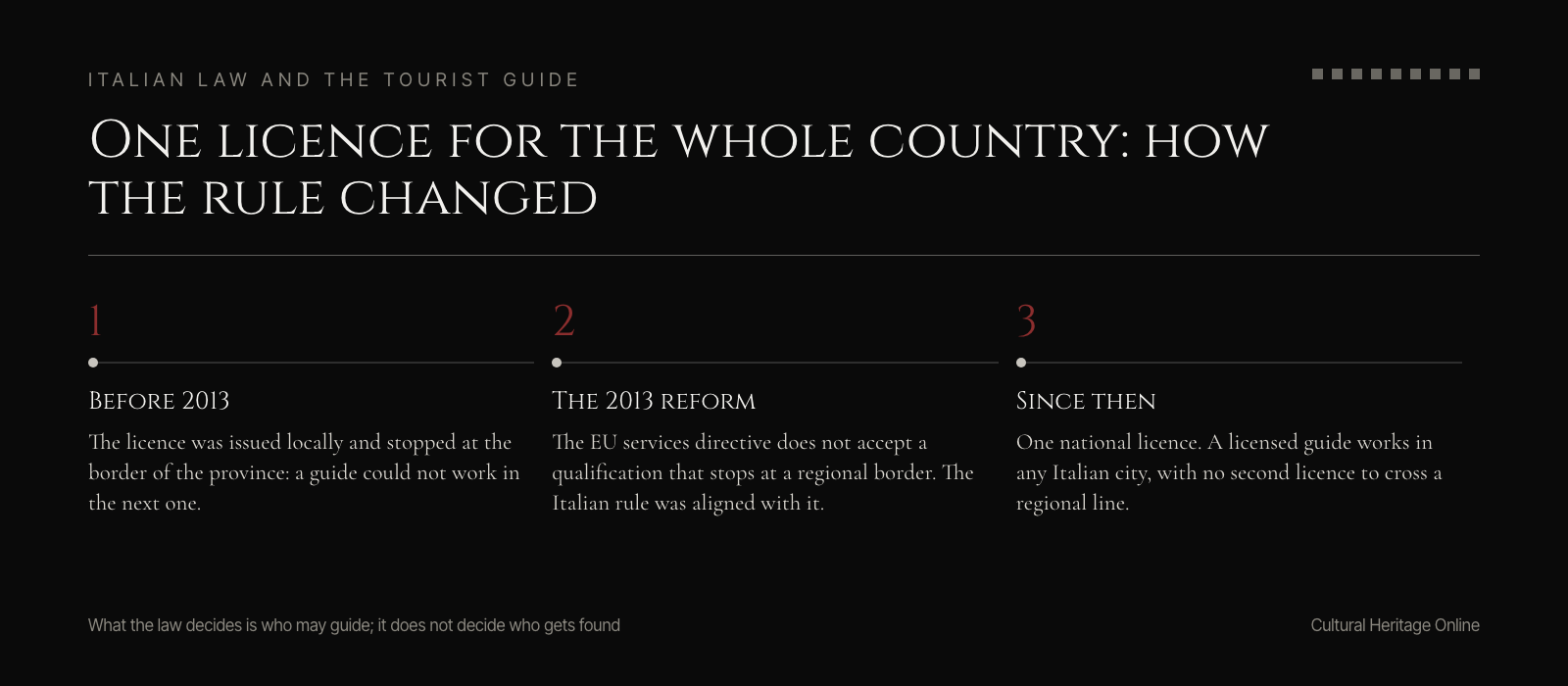
For a long time, a guide could work only where the licence had been issued: a guide from one province could not guide in the next. The change came with the 2013 reform, which made the licence valid across the whole country.
The reason was European, not Italian: the services directive does not accept a professional qualification that stops at a regional border. The reform aligned the Italian rule with it, and the national licence has been the framework since.
The practical effect is simple: a licensed guide can now work in any Italian city, and does not need a second licence to cross a regional line.
3. Guides from other EU countries
A guide legally established in another member state can provide services in Italy on a temporary or occasional basis, without a new Italian authorisation. The qualification is the one acquired at home.
The detail that matters in practice is the word "temporary": the rule is built for a season, a conference, a series of visits, not for moving the business to Italy. A guide who wants to work here permanently follows the establishment route, not the temporary one.
4. The specialised sites
The law also allows a stricter requirement for sites of particular historical, artistic or archaeological importance: there, a specific additional qualification can be required, identified by the ministry with the regions.
It is the part of the framework that changes most often, and the part a guide should check before accepting a assignment at a major museum or archaeological park.
5. What the law does not say
The law says who may guide, not how a guide finds clients. It does not say how a visitor discovers a guide, how a tour is sold, or how a price is published.
That is the part a guide has to build: a page that says who you are and what you guide, a route that shows where you go, a way to be found by someone who is planning a trip. A licence opens the door; it does not put a sign on it.
6. What a guide needs online
Three things, in order of usefulness:
- a page with your name, your languages, your specialisms and the places you guide;
- one or more routes, with the stops and the duration, so a visitor can see what a walk with you looks like;
- a way to be contacted or booked, without a form that asks for a phone call.
Operator PRO, at 99 dollars a year, gives the operator page, the itineraries and the route with the GPX file .
Build the page and the routes that make the licence visible: Operator PRO, 99 dollars a year,: /pro-operatori/