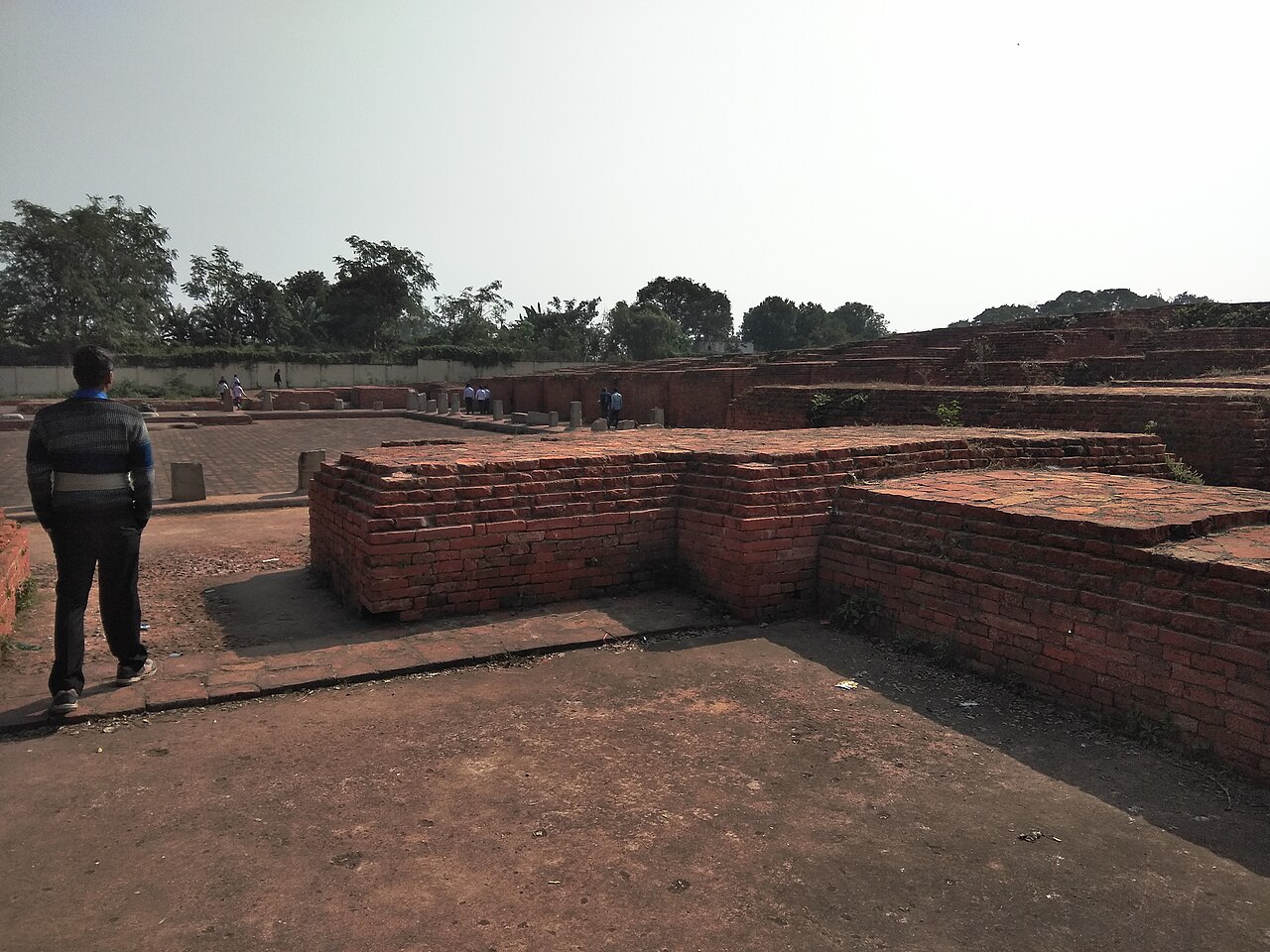
The Archaeological Site of Nalanda Mahavihara (नालंदा महाविहार), inscribed by UNESCO in 2016, is the ruins of the greatest Buddhist university in the ancient world — a monastic-university complex at Nalanda, approximately 90 km southeast of Patna in Bihar, India, that operated for approximately 700 years (the precise founding date is debated but the institution’s major development began approximately 5th century CE under Gupta patronage, and it was destroyed in 1193 CE by the Khilji general Bakhtiyar Khilji). At its height (approximately 7th–8th centuries CE), Nalanda Mahavihara (the “Great Monastery of Nalanda”, combining mahavihara, great monastery, with the university functions of an adhyayana pitha, institute of advanced learning) housed approximately 8,000–10,000 students and 2,000 teachers, drew scholars from across Asia (China, Korea, Japan, Java, Sumatra, Tibet, Mongolia, Central Asia, Sri Lanka), offered structured courses in Buddhist philosophy (both Theravada and Mahayana traditions), logic, Sanskrit grammar, medicine, astronomy, and mathematics, and maintained a library of approximately 9 million manuscripts in three multi-story buildings (the Dharmaganja library complex, the most extensive manuscript collection in the ancient world, burned for approximately three months after the Khilji destruction in 1193 CE — “the smoke was said to have been visible for miles”, according to the account of the Tibetan historian Taranatha). The Nalanda UNESCO inscription encompasses an excavated area of approximately 12 hectares of the site’s estimated 100+ hectares (the full extent of the ancient complex has not been fully excavated), including 11 monasteries (viharas) and 6 brick temples arranged in a planned layout, the ruins standing to approximately 3–5 m in height and covering an area approximately 500 m × 180 m.
Nalanda’s excavated monastery complex and the Bihar Buddhist heritage triangle Monastery ruins · Nalanda Museum · Bodh Gaya · Rajgir — 0 to 90 km
The Nalanda excavated complex (managed by the Archaeological Survey of India, with excavations conducted by Alexander Cunningham in 1861–1862 CE and systematically by the ASI from 1915 to 1937 CE — the primary excavated area represents approximately 10% of the total Nalanda complex as identified by geomagnetic surveys) reveals the spatial organisation of a planned monastic-university campus: the 11 monasteries (numbered 1–11 in the excavation sequence) are arranged along the western side of the complex, facing eastward onto a row of temples. Each monastery (vihar) follows a standard plan — a quadrangular court approximately 30 m × 30 m surrounded by two storeys of cells (approximately 20–30 small rooms on each storey, each approximately 3 m × 3 m, for individual monks), with a central court open to the sky (similar to the layout of Oxford and Cambridge medieval colleges, which developed independently in the 12th–14th centuries CE) and a small shrine at the back of the court. The central court of each monastery would have been the teaching space — the written Chinese accounts of Xuanzang (the Chinese Buddhist monk who studied at Nalanda approximately 635–642 CE and whose diary “Great Tang Records on the Western Regions” is the most detailed historical description of Nalanda at its height) describe lectures held in the open courts with hundreds of students seated around a senior teacher, and smaller tutorial sessions in the individual cells. The brick temples (stupas and shrine buildings on the eastern side of the complex) are raised on high terraced platforms in a style that shows the influence of the Gupta architectural tradition but with specific Nalanda elaborations in terracotta plaque decoration (the Nalanda style of moulded terracotta plaques depicting Buddhist narratives and decorative motifs was extremely influential across Southeast Asia — the temples of Srivijaya in Java and Sumatra, and the Mon temples of Myanmar/Burma, directly incorporate the Nalanda terracotta tradition). The Nalanda Museum (at the entrance to the excavated area, established 1917 CE) contains the most important Buddhist sculptural finds from the Nalanda excavations: a 5th-century CE Buddha image in black stone (one of the finest examples of Gupta-period Buddhist sculpture), numerous bronzes of Buddhist deities in the late Pala style (8th–12th century CE, the Pala dynasty of Bengal and Bihar who were the last major royal patrons of Nalanda before its destruction), and terracotta panels from the temple walls.
Bodh Gaya (UNESCO 2002, approximately 88 km southwest of Nalanda by road via Gaya, the site of the Buddha’s enlightenment — see separate CHO article) and Rajgir (approximately 15 km south of Nalanda — a major site of the Buddha’s ministry, the location of the First Buddhist Council in the Saptaparni Cave approximately 486 BCE, also significant for Jainism as Mahavira’s contemporary teaching site) together with Nalanda form the Bihar Buddhist Heritage Triangle — the three corners of the geographical area where the historical Buddha taught, where the early Buddhist community organised itself after his death, and where Buddhist intellectual culture reached its institutional peak in the Nalanda University. The Bihar government has invested significantly in infrastructure connecting the three sites for pilgrimage tourism. The Nalanda Ruins and the Rajgir Griddhakuta (Vulture’s Peak, the hilltop from which the Buddha delivered many of the most important Mahayana sutras, including the Heart Sutra and the Lotus Sutra) can be visited in a single day excursion from Bodh Gaya with a hired car. The modern Nalanda University (re-established 2014 CE as an international university near the ruins of the ancient Nalanda, in an attempt to revive the spirit of the ancient institution — the new university campus is approximately 2.5 km from the archaeological ruins) is a separate institution without physical connection to the UNESCO site but of symbolic importance as a statement of contemporary Asian intellectual aspiration.
Practical information
Nalanda is accessible from Patna (90 km north, approximately 2 hours by road) or from Gaya/Bodh Gaya (88 km southwest, approximately 2 hours by road). Rajgir (15 km south of Nalanda) is a convenient base for visiting both Nalanda and Rajgir in a single day. The excavated site (ASI-managed) is open daily 09:00–17:00. Admission fee (foreign visitors): standard ASI monument fee. The Nalanda Museum (at the entrance to the site) is part of the same admission. The ruins are partially shaded by trees but the site is largely open — carry water and sun protection. Visiting time: 2–3 hours for the excavated ruins and museum in detail; a shorter 1.5-hour visit covers the essential monasteries and temple ruins. Photography is permitted throughout. The modern Nalanda University campus (2.5 km from the ruins, established 2014 CE in a contemporary campus designed by Vastu Shilpa Consultants) can be visited by arrangement with the university’s visitor services office. The best combination itinerary for international visitors is: arrive Gaya/Bodh Gaya from Delhi or Patna by train; spend 2 days at Bodh Gaya (Mahabodhi Temple, full-moon ritual if timing allows); then day 3 car excursion to Nalanda and Rajgir; return to Gaya/Patna for onward travel to Varanasi/Sarnath. Best visiting season: October–February (temperatures 15–28°C, dry and pleasant; Bihar’s summer April–June reaches 42°C and is physically demanding for outdoor monument visits).
Frequently Asked Questions
What was the Nalanda Mahavihara and why was it the greatest university of the ancient world?
Nalanda Mahavihara was a residential monastic university — combining the functions of a Buddhist monastery (providing living quarters, daily worship practice, and monastic discipline for resident monks) with those of an advanced academic institution (offering structured courses in Buddhist philosophy, logic, grammar, medicine, astronomy, and mathematics taught by recognised masters to students who had been selected through entrance examination). The “greatest university” designation rests on several specific comparisons: in terms of student numbers (approximately 8,000–10,000 students at peak, compared to the approximately 3,000 students at the University of Bologna, the oldest European university, founded approximately 1088 CE — at a time when Nalanda was already approximately 600 years old), in terms of international reach (students travelled from across Asia — the Chinese pilgrims Xuanzang, I Ching, and others left detailed accounts of the journey to Nalanda, which was considered the supreme center of Buddhist learning in Asia), and in terms of institutional longevity (approximately 700 years of continuous operation, from the Gupta period to the Khilji conquest, compared to the Oxford University’s approximately 900 years of operation from its 12th-century CE founding to the present). The specific academic curriculum at Nalanda (documented through Xuanzang’s diary “Great Tang Records on the Western Regions”, approximately 646 CE) included: Buddhist philosophy in both Theravada and Mahayana traditions (including the foundational texts of Madhyamaka (Nagarjuna’s philosophy of emptiness), Yogacara (Vasubandhu’s mind-only school), and Pramana (Dignaga and Dharmakirti’s Buddhist logic and epistemology — the specific branch of Buddhist philosophy that had the most systematic engagement with non-Buddhist philosophical traditions including the Nyaya and Vaisheshika schools of Hindu philosophy and the philosophy of the Jains)); Sanskrit grammar and literature (both the Paninian grammatical tradition and literary Sanskrit); Ayurvedic medicine (the traditional Indian medical system based on Charaka Samhita and Sushruta Samhita texts); and astronomy (including the Aryabhatiya, the foundational text of Indian mathematical astronomy composed by Aryabhata approximately 499 CE — Aryabhata is believed to have been associated with Nalanda). The influence of Nalanda on Asian intellectual history extends beyond the specific texts and teachings: the institutional model of the residential monastic-university (a community of scholars living together in purpose-built residences with a library, teaching spaces, and a supportive institutional administration) was carried to Tibet (where the Nalanda model directly influenced the establishment of Tibetan Buddhist universities like Sakya Monastery, 1073 CE), to Southeast Asia (where the Srivijaya Empire of Sumatra and Java, 7th–12th centuries CE, maintained close educational ties with Nalanda), and to Mongolia, Korea, and Japan through the networks of scholars who studied at Nalanda and returned to their home countries carrying manuscripts and institutional knowledge.
Who was Xuanzang and why is his account of Nalanda so important?
Xuanzang (Chinese: 玄奘, approximately 602–664 CE, also transliterated Hsüan-tsang) was a Chinese Buddhist monk from the Tang dynasty who made a 17-year journey from China to India (approximately 627–645 CE), travelling overland through Central Asia and returning via the sea route through Indonesia — a journey now called the “Buddhist Silk Road” pilgrimage and the basis for the 16th-century Chinese novel Journey to the West (which transmutes Xuanzang’s historical journey into a mythological narrative). Xuanzang’s time at Nalanda (approximately 635–642 CE) was the most significant period of his Indian journey — he was admitted to study under the abbot Shilabhadra (the greatest Buddhist scholar of the period, then approximately 100 years old, who had been in residence at Nalanda for approximately 50 years), participated in the academic life of the institution, studied Sanskrit grammar, Mahayana philosophy, and Buddhist logic, and collected approximately 657 Sanskrit Buddhist texts to bring back to China. His diary “Da Tang Xiyuji” (大唐西域记, “Great Tang Records on the Western Regions”, dictated to his disciple Bianji approximately 646 CE, one year after Xuanzang’s return to China) is the most detailed and reliable historical account of India in the 7th century CE — the text describes the geography, Buddhist sites, political conditions, and populations of the regions Xuanzang traveled through, and is used by modern historians and archaeologists as the primary external documentary source for reconstructing the historical geography of 7th-century India, confirming the location of sites and providing dimensions and descriptions of monuments that either no longer survive or survive in heavily altered form. His specific description of Nalanda (approximately 20 pages in the full text) covers: the physical layout of the eight monasteries and nine major temples he observed (a larger complex than the 11 monasteries currently excavated, suggesting that much of the ancient complex remains unexcavated); the daily routine of the 8,000 students and 2,000 teachers; the competitive admission examination (applicants were questioned at the gate by the dharmasvamin, the institutional gatekeeper, and only those who could answer difficult questions in Buddhist logic were admitted — Xuanzang himself says he was initially stumped and had to revisit before being admitted); the library’s three buildings housing the manuscript collection; and the daily schedule of lectures, debates, and ritual observances. Xuanzang’s translations of the Sanskrit texts he brought back to China (approximately 1,335 scrolls, translated with a team of assistants at the Great Wild Goose Pagoda in Xi’an, 645–664 CE) introduced Mahayana Buddhist philosophy, logic, and scripture to East Asia in a new wave of transmission that significantly shaped Chinese, Korean, and Japanese Buddhist theology. He remains one of the most important intellectual figures in the history of Buddhism.
EXCERPT: Nalanda Mahavihara, UNESCO-inscribed in 2016, is the ruins of the greatest Buddhist university of the ancient world — 11 brick monastery quadrangles housing 10,000 students, 9 million manuscripts destroyed in 1193 CE, Chinese pilgrim Xuanzang’s 7th-century account of entrance examinations and daily lectures in open courtyards — 88 km from Bodh Gaya (UNESCO 2002) in Bihar’s Buddhist heritage triangle.
META: UNESCO World Heritage Sites near Nalanda Mahavihara Bihar India: Mahabodhi Temple Bodh Gaya 88 km southwest (UNESCO 2002), Buddhist Monuments at Sanchi 500 km west (UNESCO 1989), Khajuraho Group of Monuments 550 km west (UNESCO 1986) — Bihar Buddhist heritage triangle Bodh Gaya-Rajgir-Nalanda, the sacred geography of Buddhism’s founding and intellectual development.
Sources
- S1 — UNESCO World Heritage Centre — Archaeological Site of Nalanda Mahavihara at Nalanda, Bihar (Ref. 1502) — https://web.archive.org/web/20230601000000/https://whc.unesco.org/en/list/1502/
- S2 — UNESCO World Heritage Centre — Statement of Outstanding Universal Value (Ref. 1502) — https://whc.unesco.org/en/list/1502/
Spotted an error? Write to editorial@culturalheritageonline.com and we correct it the same day.