


Curated Itinerary
Silk Roads: the Chang’an–Tianshan Corridor
East to west along the Chang’an–Tianshan Corridor: Xi’an’s palaces and pagodas, the Gansu grottoes, the oasis ruins of Turpan and the caravan towns of the Chu Valley.
Take this route into Google Maps
From Giant Wild Goose Pagoda
to Suyab,
in the order we curated them.
Google Maps takes 11 points in one route: this one uses 11 of the 13 stops, spaced along the way. The full list is below.
These places are spread over thousands of kilometres, and Google will not always join them into one route. It opens with the stops loaded in our order: from there pick two that are close to each other, choose how you travel, and add places of your own. For a single leg, the directions on each stop's own page work better.
This itinerary follows the Chang’an–Tianshan Corridor of the Silk Roads, inscribed by UNESCO in 2014 across China, Kazakhstan and Kyrgyzstan. It runs east to west, the direction the silk itself travelled: from the imperial palaces and pagodas of Xi’an, through the Buddhist grotto sites of Gansu, to the earthen oasis cities of Turpan and the caravan towns of the Chu Valley.
The thirteen stops divide into four natural clusters — Xi’an, the Hexi Corridor, the Tarim oases, and the Central Asian valleys — and most travellers will treat each cluster as its own journey. Rail links the Chinese stages; Bishkek and Almaty anchor the western ones. What connects them is the listing itself: a single World Heritage property built out of distance, where each stop marks roughly what a caravan could reach before resting.
Allow two to three weeks to see the corridor properly, or take it cluster by cluster over several trips. Either way, start at the Giant Wild Goose Pagoda: the scriptures it was built to hold are the best argument that this road carried more than trade.
Read the full story of this route in the CHO Magazine →
Get this route — explore at your own pace
The walk and the notes are open to everyone, right here. To take the route with you — the GPX and KML tracks for your phone — you need a CHO account, and a free one is enough. We do not sell these routes: we build them ourselves and give them to the people who read us.
Create a free accountAlready have one? Log in.
This route was built with the tools we give operators.
Guides, associations and cultural operators build their own routes here: pick the stops from the archive, add your notes, and the map, the GPX and the printable version come out on their own. Your programme gets a permanent page, your events go on the city pages people read while planning — and if you sell your route as a road-book or a virtual tour, you receive 80% of the price net of tax.
See how an operator account worksBefore you go
A word from your host
This is the longest route on CHO and nobody does it in one go. Treat each cluster as its own trip and let the trains do the work in China. The moment it clicks is standing at Burana Tower, five thousand kilometres from Xi'an, recognising the same road.
Getting around
High-speed rail connects Xi'an, Tianshui and Turpan; the Kyrgyz and Kazakh sites are day trips from Bishkek and Almaty by road. Check current visa and border-crossing requirements for all three countries before booking.
Step by step

Giant Wild Goose Pagoda
A monumental brick Buddhist pagoda built in 652 to house texts brought from India by the monk-scholar Xuanzang. Now a UNESCO World Heritage Site.

Small Wild Goose Pagoda
A significant Buddhist pagoda in Xi'an, China, the Small Wild Goose Pagoda stands as a monument to the city's role as the ancient capital Chang'an…

Daming Palace
The imperial palace complex of Tang dynasty emperors, Daming Palace served as the seat of power in Chang'an for over 220 years and is now a UNESCO World…

Weiyang Palace
The grandest imperial palace ever built, Weiyang Palace served as the administrative heart of Chang'an for over eight centuries before its destruction…

Famen Temple
A Buddhist temple in Shaanxi province regarded as the ancestor of pagoda temples in Guanzhong, located 120 kilometers west of Xi'an.

Maijishan Grottoes – Virtual Tour 360°
Carved into a freestanding sandstone cliff near Tianshui, the Maijishan Grottoes hold roughly 7,200 Buddhist sculptures and about 1,000 square metres of…

Bingling Temple
A millennium-long sanctuary of Buddhist grottoes carved into the Yellow River canyon, Bingling Temple unites Central Asian and Chinese sculptural…

Jiaohe ruins
Jiaohe, capital of the Tocharian kingdom of Jushi, crowns a dramatic leaf-shaped plateau above two river valleys near Turpan—a natural fortress and vital…
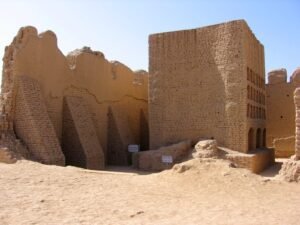
Gaochang / Khara-Khoja — The Great Mudbrick Capital of the Silk Road
The largest mudbrick city ruins in the world by area — the capital of the Turfan oasis kingdom, a cosmopolitan Silk Road city where Buddhist monasteries…

Kizil Caves
West of the ancient oasis city of Kucha, 236 rock-cut Buddhist caves line a river cliff — among the earliest surviving Buddhist grottoes in China, painted…

Talgar
Talgar is an administrative center in Almaty Region, southeastern Kazakhstan, located 25 kilometers east of Almaty and serving as the hub for Talgar District.

Burana Tower (Balasagun) – Virtual Tour 360°
A weathered brick minaret rising from the Chuy Valley steppe, Burana Tower is the last upstanding monument of Balasagun, once capital of the Karakhanid…

Suyab
A prosperous Silk Road settlement in Kyrgyzstan's Chu valley, Suyab connected Tang-era China with Central Asian markets before fading into archaeological…
Download for tour navigation
🔒 The walk and the notes are open to everyone on this page. The files to take with you — the stop list as a PDF, and the GPX and KML tracks for your phone — come with a CHO account, and the free one includes them.
Walk it with the navigator on
These places are spread over thousands of kilometres, and Google will not always join them into one route. It opens with the stops loaded in our order: from there pick two that are close to each other, choose how you travel, and add places of your own. For a single leg, the directions on each stop's own page work better.