
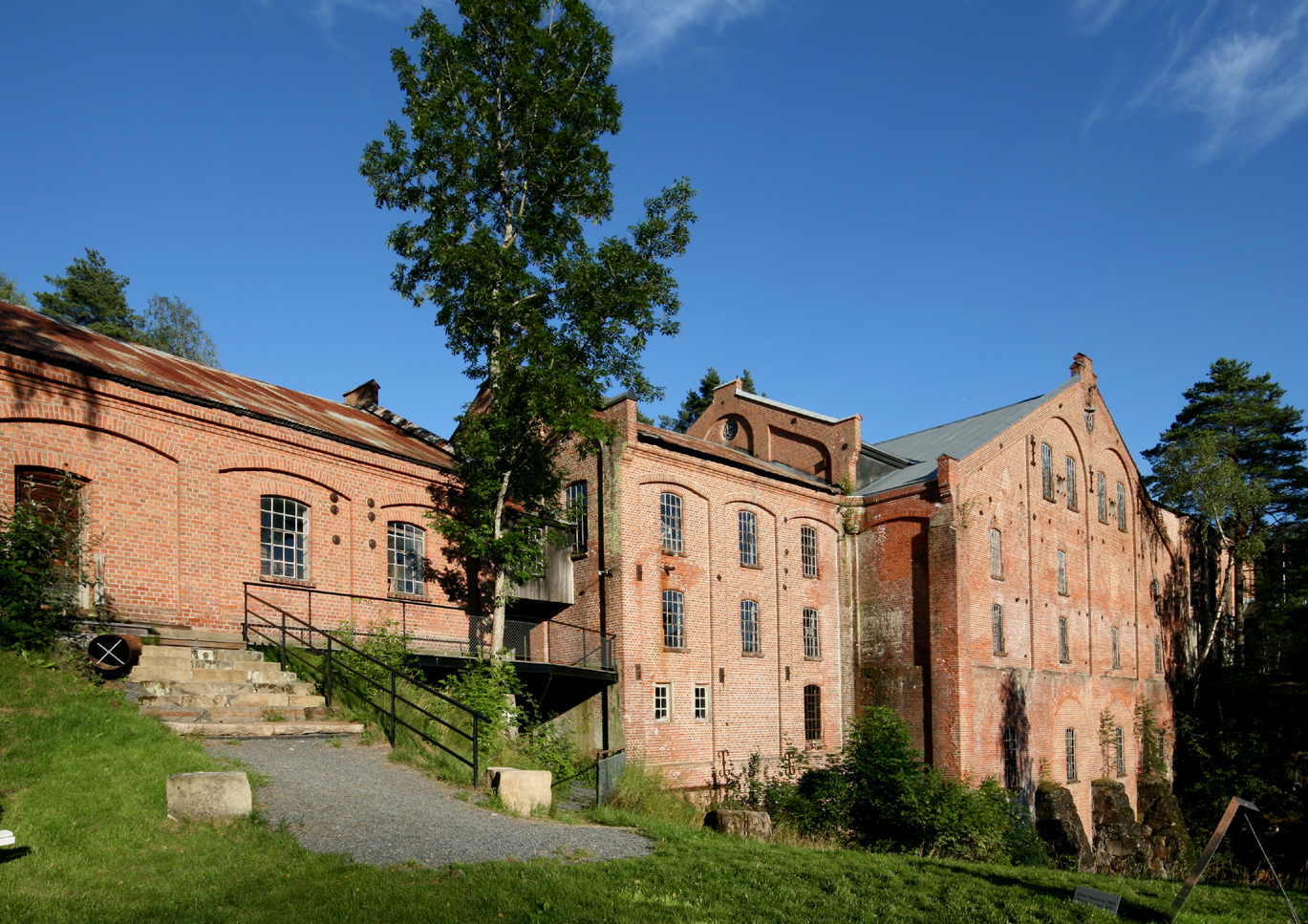
The Kistefos Museum is a combined industrial heritage site and contemporary art museum set on the banks of the river Randselva in Jevnaker, Innlandet county, Norway. At its core stands the former Kistefos wood pulp mill, founded in 1889 and powered by the Hønefossen waterfall. The site today encompasses the preserved mill buildings, a growing outdoor sculpture park, and the striking The Twist gallery building by the Danish architecture firm Bjarke Ingels Group (BIG), opened in 2019.
At a glance
- Type
- Industrial heritage museum and contemporary art museum with sculpture park
- Period
- Mill founded 1889; museum established 1996; The Twist gallery opened 2019
- Style
- Industrial vernacular (mill); contemporary parametric architecture (The Twist, BIG)
- Location
- Jevnaker, Innlandet county, Norway (approx. 60 km north of Oslo)
- Coordinates
- 60.2223° N, 10.3669° E
Overview
Kistefos occupies a uniquely scenic position where industrial history and cutting-edge contemporary art converge. The preserved pulp mill — operational until 1955 — provides a tangible record of the industrial revolution in rural Norway, while the sculpture park and The Twist gallery represent some of the most ambitious recent investment in contemporary art infrastructure in Scandinavia. Owned and operated by the Kistefos Foundation, established by businessman and collector Christen Sveaas, the site has become an internationally recognised destination for art and architecture tourism.
History
The Kistefos mill was established in 1889 by Christen Anker, exploiting the powerful Hønefossen waterfall on the Randselva river to drive mechanical wood-pulp production. The mill became one of the key industrial enterprises in the region during the late nineteenth and early twentieth centuries, employing many workers from Jevnaker and surrounding communities. After closing in 1955, the site lay dormant until Christen Sveaas — a descendant of the founding family — began transforming it into a museum in the 1990s. The Kistefos sculpture park opened with major international works, and The Twist gallery, bridging the river with an audacious twisted form, was inaugurated in 2019 to international critical acclaim.
What you see
The original mill building retains much of its Victorian industrial machinery, including the enormous turbines and paper-making equipment that once drove production. Around it, more than fifty large-scale sculptures by internationally renowned artists — among them Yayoi Kusama, Anish Kapoor, and Tony Cragg — are distributed along a riverside walking trail through woodland and meadow. The Twist gallery straddles the Randselva river, its twisted rectangular volume rotating 90 degrees from one bank to the other; inside, it hosts temporary exhibitions of contemporary painting and sculpture. The entire site rewards leisurely exploration on foot.
Cultural significance
Kistefos represents one of the most successful examples in Norway of adaptive reuse of an industrial heritage site as a living cultural venue. The Twist gallery has received widespread architectural recognition as a bold statement about the relationship between art, architecture, and landscape. Together, the industrial mill and the contemporary art programme offer a compelling dialogue between Norway’s industrial past and its creative present, drawing visitors from across Europe and beyond.
Practical information
- Address
- Samsmoveien 41, 3520 Jevnaker, Norway
- Opening hours
- Open seasonally (typically May–October); check kistefos.com for current hours
- Admission
- Ticketed; combined entry to mill, sculpture park, and The Twist gallery
- Website
- kistefos.com
Getting there
From Oslo, take the E16 motorway northbound towards Hønefoss and follow signs to Jevnaker; total driving time approximately 60 minutes. Regional buses connect Oslo (Nationaltheatret/Lysaker) to Jevnaker; alight at the Jevnaker centre stop and follow the riverside path to the museum (approximately 1 km). There is ample parking on site for those arriving by car.
Sources & resources
Find it on the map
See this place and what’s around it →📷 Become a Cultural Heritage Online photographer
Share your photos of places: they stay published under your name as the author. The more they're seen, the more you get noticed — and soon a contest will reward the most appreciated photos.
Log in or sign up free to add a photo