

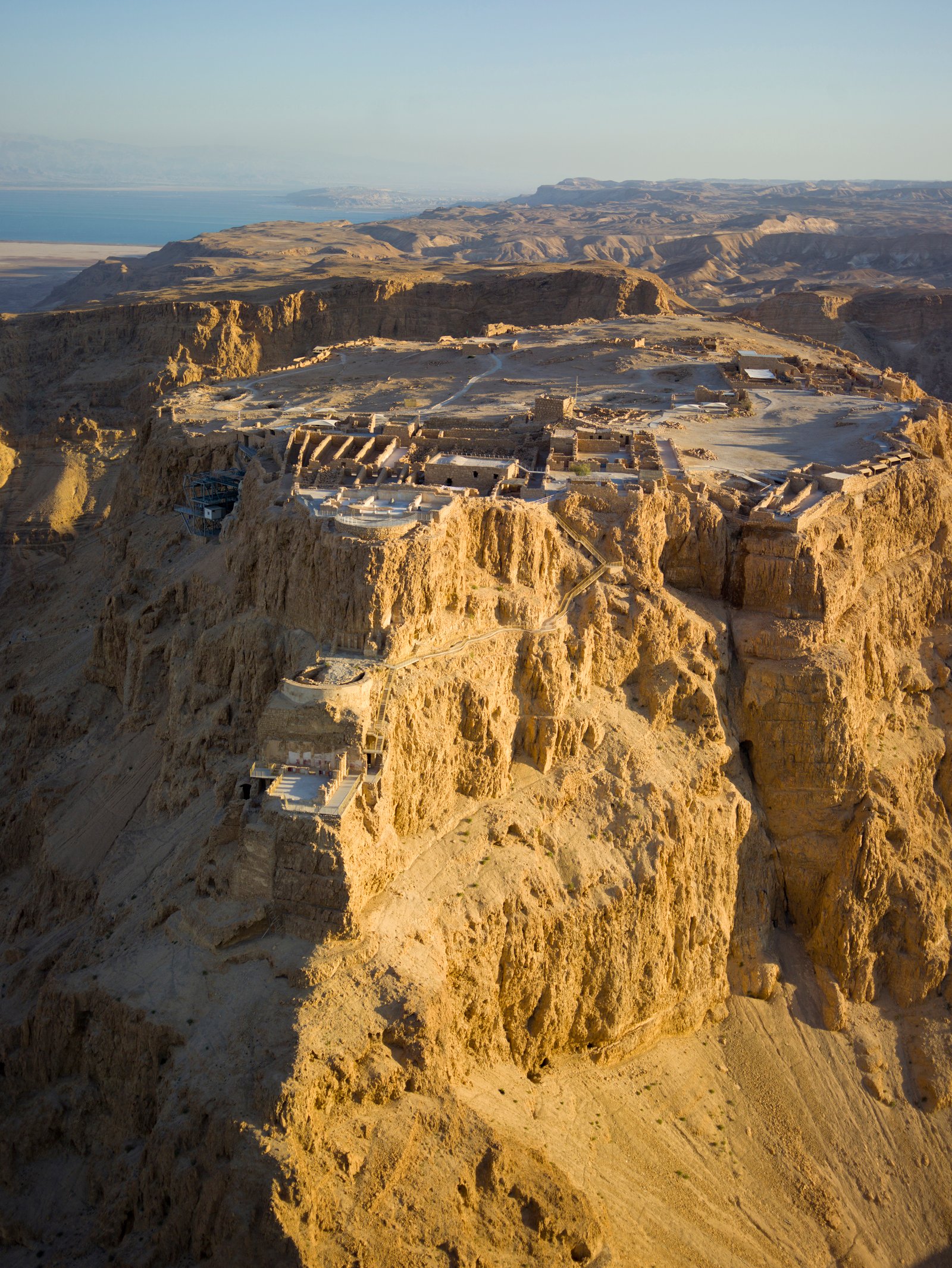
Masada is a mountain-top fortress complex in the Judaean Desert, overlooking the western shore of the Dead Sea in southeastern Israel. Built atop a natural plateau rising over 400 metres above the surrounding terrain, the fort was constructed in the first century BC and later reinforced by Herod the Great. It is best known for the Siege of Masada in 73 CE, during which Jewish rebels held out against Roman legions before the garrison’s mass suicide — an event that became a defining symbol of Jewish resistance and national identity.
- Type
- Ancient mountain fortress and UNESCO World Heritage Site
- Period
- First fortified c. 100 BC; major construction under Herod the Great, 37–31 BC
- Style
- Herodian palatial and defensive architecture
- Location
- Masada National Park, Dead Sea region, Southern District, Israel
- Coordinates
- 31.3158° N, 35.3379° E
Overview
Masada stands approximately 20 km east of modern Arad, isolated on a rhomb-shaped plateau above the arid landscape of the Judaean Desert. The site was first fortified by the Hasmonean king Alexander Jannaeus and later transformed by Herod the Great into a luxurious royal retreat and impregnable fortress. Declared a UNESCO World Heritage Site in 2001, Masada today draws over a million visitors annually and is one of Israel’s most visited archaeological parks.
History
Herod the Great carried out extensive building works at Masada between 37 and 31 BC, constructing a three-tiered hanging palace on the northern cliff, a large bathhouse, storerooms, and a casemate wall encircling the plateau. After Herod’s death the fortress passed to Roman governors before being seized in 66 CE by the Sicarii, a group of Jewish rebels, at the start of the First Jewish–Roman War. Following the fall of Jerusalem in 70 CE, some 960 rebels and their families took refuge at Masada; the Roman governor Lucius Flavius Silva besieged it in 73 CE, and when the Romans finally breached the walls they found the defenders had died in a collective act of suicide rather than surrender.
What you see
The plateau preserves the remains of Herod’s northern palace, with its three descending terraces carved into the cliff face and decorated with frescoes and mosaic floors. A large Byzantine church from the 5th or 6th century CE, a Roman-style bathhouse with hypocaust heating, storerooms, an ancient synagogue, and a ritual bath (mikveh) are also clearly visible. The surrounding desert reveals the outline of eight Roman siege camps and a ramp built by Roman soldiers — among the best-preserved examples of Roman siege architecture in the world.
Cultural significance
Masada holds profound symbolic importance in Israeli culture: the phrase “Masada shall not fall again” encapsulates the determination of a people to resist subjugation, and Israeli military units historically held swearing-in ceremonies on the summit. As a UNESCO World Heritage Site, it is also recognised as an exceptional example of Herodian architecture and a vivid record of the Jewish–Roman conflict in the 1st century CE.
Practical information
- Address
- Masada National Park, Dead Sea Region, Israel
- Access
- Cable car from the eastern side; Snake Path hiking trail (45–90 min) from the eastern side; Roman Ramp path from the western side
Getting there
Masada is located roughly 90 km south of Jerusalem via Route 90 along the Dead Sea shore. Bus services run from the central bus stations of Jerusalem and Beer-Sheva to the Masada junction; a cable car provides quick access to the summit. Many visitors combine a trip to Masada with a stop at the Dead Sea beaches nearby.
Sources & resources
Find it on the map
See this place and what’s around it →📷 Become a Cultural Heritage Online photographer
Share your photos of places: they stay published under your name as the author. The more they're seen, the more you get noticed — and soon a contest will reward the most appreciated photos.
Log in or sign up free to add a photoIs this page about you?
This page is read by travellers and heritage enthusiasts who find it on Google. Tell us how you are connected to this place and we will take it from there.