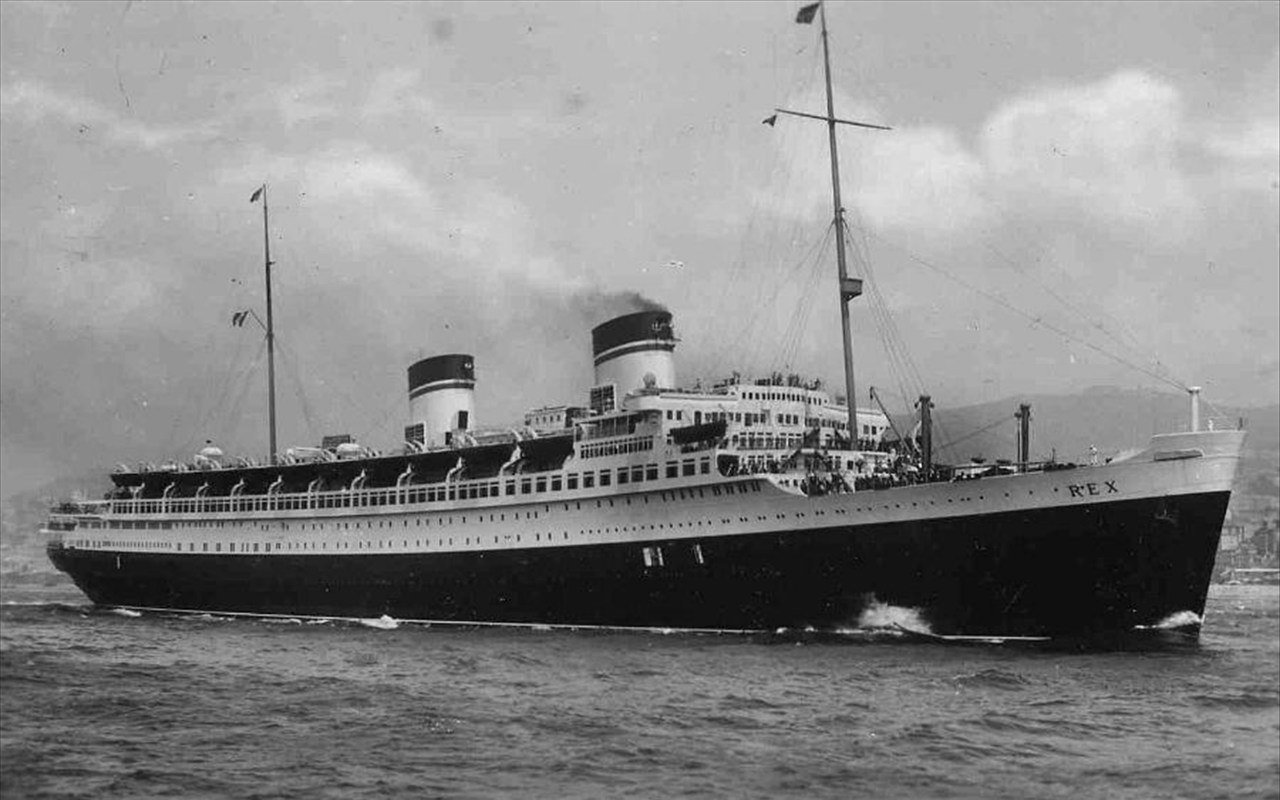
Italy’s interwar decade at sea produced two opposite legacies. One was the fastest ocean liner in the world, the Rex — Blue Riband holder of 1933, bombed to a wreck in 1944, alive now only in photographs and in a scene of Fellini’s Amarcord. The other was a deliberately old-fashioned sailing ship, the Amerigo Vespucci — launched in 1931 at Castellammare di Stabia and still at sea today as the Italian Navy’s training ship. Speed died young; tradition is in her tenth decade. Together they are the two poles of what the era built on water.
The context, stated plainly
Both ships were products of the fascist years and of the state’s appetite for prestige: the regime pushed the superliners as floating national showcases, and Fellini’s famous line about the Rex — “the greatest thing the regime ever built” — is spoken in Amarcord precisely as satire of that worship. The record crossing was real engineering; its uses were propaganda; the ship’s end came in a war the same regime chose. All three facts belong together.
The Rex: four days and thirteen hours
The Rex came out of the Ansaldo yard at Sestri Ponente, Genoa — launched on 1 August 1931, away on a troubled maiden voyage to New York on 27 September 1932 that included repairs at Gibraltar. The redemption came in August 1933: westbound from Gibraltar to the Ambrose light in four days and thirteen hours, at an average of 28.92 knots, taking the Blue Riband from Germany’s Bremen. Italy held the Atlantic record until the French Normandie took it in 1935. With her running mate Conte di Savoia, the Rex gave the Genoa–New York run its brief golden age.
The war ended it. Laid up, the Rex was caught near Koper on 8 September 1944 by RAF aircraft: struck by 59 rockets and cannon fire, burning and listing, she capsized in shallow water after a second attack. The wreck was scavenged for scrap through the 1950s. Nothing of the fastest liner Italy ever built survives above water; her memory does, most durably in the night-time apparition Fellini staged for the townspeople of Amarcord in 1973.
The Vespucci: launched 1931, still at sea
The other ship took the opposite bet. At the historic naval yard of Castellammare di Stabia, to a design by Francesco Rotundi, Italy launched on 22 February 1931 a full-rigged steel sailing ship for the training of naval officers — the Amerigo Vespucci, sister to the Cristoforo Colombo of 1928 (later ceded to the USSR as war reparations). A hundred metres overall, twenty-six canvas sails, a black-and-white hull out of the age of gun decks: she was archaic on purpose, built on the conviction that seamanship is learned under sail.
The conviction held. The Vespucci has trained every generation of Italian naval officers since, crossed the world’s oceans, completed a 36-port world tour in 2023–2025, and carries the compliment the USS Independence signalled to her in 1962 — “You are the most beautiful ship in the world” — as an unofficial motto. She is the rare interwar artefact that needs no heritage protection: she is simply still in commission.
What survives, and where
Of the Rex: photographs, newsreels, relics in maritime collections, and a place in film history. Of the Vespucci: the ship herself, home-ported at La Spezia and regularly visitable at her port calls, and the working shipyard at Castellammare di Stabia where she was built — still launching ships under Fincantieri, within sight of the town’s seafront. The yard and the ship together hold this chapter of the story; the liner’s chapter closed in shallow water off the Istrian coast in 1944.
Places of this story in the archive
- Castellammare di Stabia Shipyard and the Amerigo Vespucci — where the ship still at sea was launched
- Idroscalo di Orbetello — the aviation twin of the same decade
Sources
- English Wikipedia, “SS Rex” — yard and dates, Blue Riband figures, loss of the record to the Normandie, the sinking of 8 September 1944, scrapping, Amarcord.
- English Wikipedia, “Italian training ship Amerigo Vespucci” — yard, designer, dates, sister ship, service, world tour, the 1962 signal.