Fifty-three sites across five regions sit on UNESCO’s List of World Heritage in Danger — a formal mechanism, established under Article 11.4 of the 1972 World Heritage Convention, designed to mobilise emergency funding and international pressure when outstanding universal value is under acute threat. The list spans medieval citadels shattered by artillery, rainforests hollowed by illegal logging, and ancient cities slowly consumed by rising groundwater. It is not a list of failures. It is a tool. From Cultural Heritage Online.
What the List of World Heritage in Danger means
The danger list was created so that the international community could act before a site is lost, not after. Inscription triggers UNESCO emergency allocations from the World Heritage Fund, opens access to technical missions and conservation advisors, and — crucially — generates the kind of diplomatic visibility that can redirect national policy. The first sites entered the list in 1979, and the mechanism has been used ever since to push governments toward decisions they might otherwise defer.
Of the 53 sites currently listed, 39 are cultural and 14 are natural. The split matters: cultural sites overwhelmingly face human-made crises — armed conflict, unchecked urban expansion, governance breakdown — while natural sites more often contend with poaching, invasive species, and the accelerating pressure of climate change. Both categories share one diagnostic: the Outstanding Universal Value for which they were originally inscribed is now genuinely at risk.
Armed conflict: the greatest threat
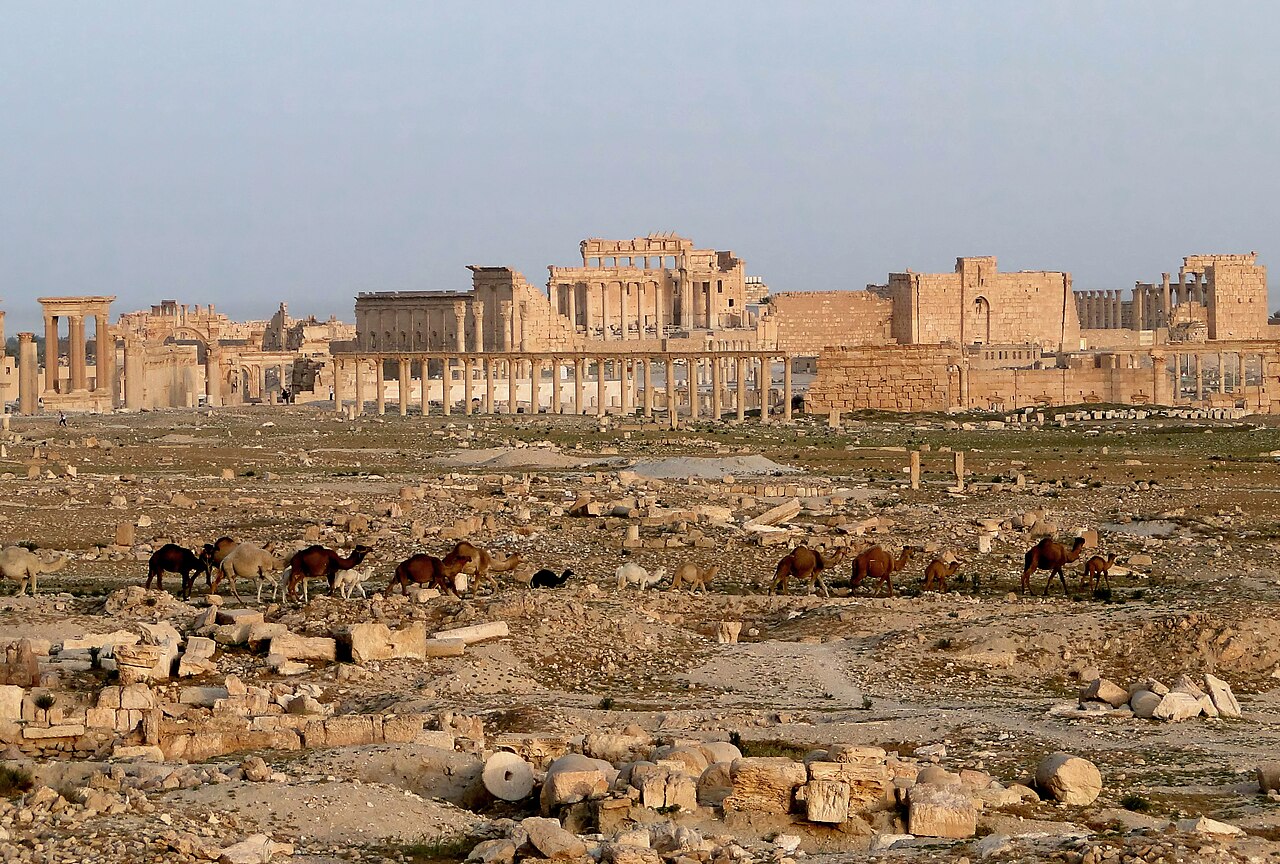
The Arab States region accounts for 22 of the 53 sites on the danger list — 41 percent of the total — and the driver is largely war. Syria alone has all six of its UNESCO World Heritage Sites inscribed on the danger list: the Ancient City of Damascus, the Ancient City of Aleppo, the Ancient City of Bosra, Crac des Chevaliers and Qal’at Salah El-Din, the Ancient Villages of Northern Syria, and the Site of Palmyra. All six sustained damage during the civil war that began in 2013. Palmyra, where the Temple of Bel and the Arch of Triumph were deliberately demolished by the Islamic State in 2015, became the war’s most photographed act of cultural destruction.
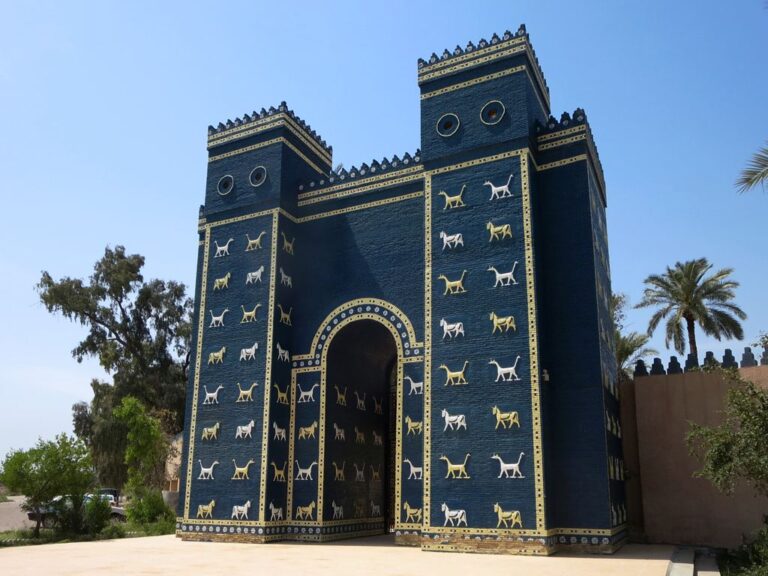
Recent additions to the list track active conflicts with near-real-time precision. Saint Hilarion Monastery and Tell Umm Amer in Gaza (Palestine) was added in 2024 as the site sustained damage from the ongoing war. The Landmarks of the Ancient Kingdom of Saba in Yemen entered the list in 2023 alongside the Rachid Karami International Fair in Lebanon, the latter threatened not by bombs but by the country’s financial collapse and years of deferred maintenance after the 2020 Beirut port explosion. Iraq and Libya each have multiple listings; the pattern across the region is consistent: when state authority fractures, heritage protection fractures with it.
Natural parks under pressure
Africa contributes 12 sites to the danger list, the majority of them protected natural areas. The Democratic Republic of the Congo has several national parks listed, including Virunga, Garamba, Kahuzi-Biéga, and Salonga — an almost complete inventory of the country’s UNESCO natural sites. The threats are overlapping: illegal artisanal mining, militia activity that prevents ranger access, bushmeat poaching, and agricultural encroachment at park boundaries. These are not simple conservation failures; they are symptoms of state fragility in post-conflict landscapes where park management competes with survival economics.
In the Asia-Pacific region, six sites carry danger status. Climate change registers most visibly here: coral bleaching, sea-level rise, and intensifying storm cycles affect island and coastal sites in ways that no fence or patrol can address. The category of “natural site” increasingly blurs with the category of “climate casualty,” and the danger list is becoming one of the few international mechanisms capable of naming that connection formally.
Development and governance failures
Not every threat arrives with artillery or a storm surge. Some sites erode through incremental decisions — a highway approved through a buffer zone, a dam approved upstream, a legal framework that exempts state infrastructure from heritage impact assessment. Europe and North America holds seven sites on the danger list, including two Ukrainian sites — the Historic Centre of Odesa and the Ancient City of Tauric Chersonese — inscribed or endangered as the Russo-Ukrainian War expanded. Latin America and the Caribbean accounts for six listings, including sites in Venezuela and Peru where governance failures and illegal mining have put both cultural monuments and natural landscapes at sustained risk.
The underlying pattern across development-driven cases is the same: the formal designation exists, the management plan may exist, but the political will to enforce either against economic or infrastructure pressure does not. Inscription on the danger list is one of the few levers the international community holds. It rarely blocks a decision outright, but it raises the reputational cost of proceeding.
Recovery: sites that left the danger list
The most-cited recovery is the Belize Barrier Reef Reserve System. Inscribed on the danger list in 2009 over fears that offshore oil drilling and mangrove removal would destroy the reef ecosystem, it was removed in 2018 after the Belizean government imposed a moratorium on offshore drilling and strengthened protections for mangroves. The case is often used to demonstrate that the danger list can actually work — that the combination of international pressure, technical assistance, and domestic political will can reverse a trajectory. Yellowstone, Galapagos, and Angkor have all passed through the list and emerged.
The 2025 cycle brought three more removals: Abu Mena in Egypt, the Old Town of Ghadamès in Libya, and the Rainforests of the Atsinanana in Madagascar. The Tombs of Buganda Kings at Kasubi in Uganda, destroyed by fire in 2010, was delisted in 2023 after reconstruction was completed. These exits are not declarations that threats have permanently vanished; they signal that conservation status has improved enough to manage the risk without emergency-level intervention. These sites sit alongside thousands of others on CHO’s interactive heritage map, with GPS coordinates and sourced editorial history. See our complete guide to UNESCO Sites in Danger and our explainer on UNESCO criteria.
Frequently Asked Questions
How many UNESCO World Heritage Sites are currently on the danger list?
As of mid-2026, 53 sites are inscribed on the UNESCO List of World Heritage in Danger. Of these, 39 are cultural sites and 14 are natural sites. The number changes each year as the World Heritage Committee meets to review the conservation status of listed properties.
What is the UNESCO List of World Heritage in Danger?
The List of World Heritage in Danger is a formal mechanism established under Article 11.4 of the 1972 World Heritage Convention. It identifies sites whose Outstanding Universal Value is threatened by conflict, natural disaster, development pressure, or governance failure. Inscription triggers UNESCO emergency funding and technical assistance, and raises international diplomatic pressure on the responsible state party.
Which country has the most UNESCO sites on the danger list?
Syria leads with six sites, representing its entire UNESCO World Heritage inventory. All six — including the ancient cities of Damascus, Aleppo, and Palmyra — were placed on the danger list following damage sustained during the Syrian Civil War, which began in 2013. The Democratic Republic of the Congo also has multiple listings, concentrated among its national parks.
Can a site be removed from the danger list once added?
Yes. The Belize Barrier Reef Reserve System was removed in 2018 after the government banned offshore oil drilling; the Tombs of Buganda Kings at Kasubi was removed in 2023 following reconstruction after a fire. In 2025, Abu Mena (Egypt), the Old Town of Ghadamès (Libya), and the Rainforests of the Atsinanana (Madagascar) were all delisted after conservation conditions improved sufficiently.
Sources used in this article
- UNESCO — UNESCO World Heritage — in Danger.
- Wikipedia — List of World Heritage in Danger.
- CHO magazine — What is a World Heritage Site?
- CHO — Interactive map of heritage sites.
Sources
- S1 — Rössler, Mechtild, and Ingunn Kvisterøy, eds. The World Heritage Convention: Past, Present and Future. UNESCO Publishing, 2012. ISBN 978-92-3-001075-1.
- S2 — Smith, Laurajane. Uses of Heritage. Routledge, 2006. ISBN 978-0-415-37662-4.
Spotted an error? Write to editorial@culturalheritageonline.com and we correct it the same day.