
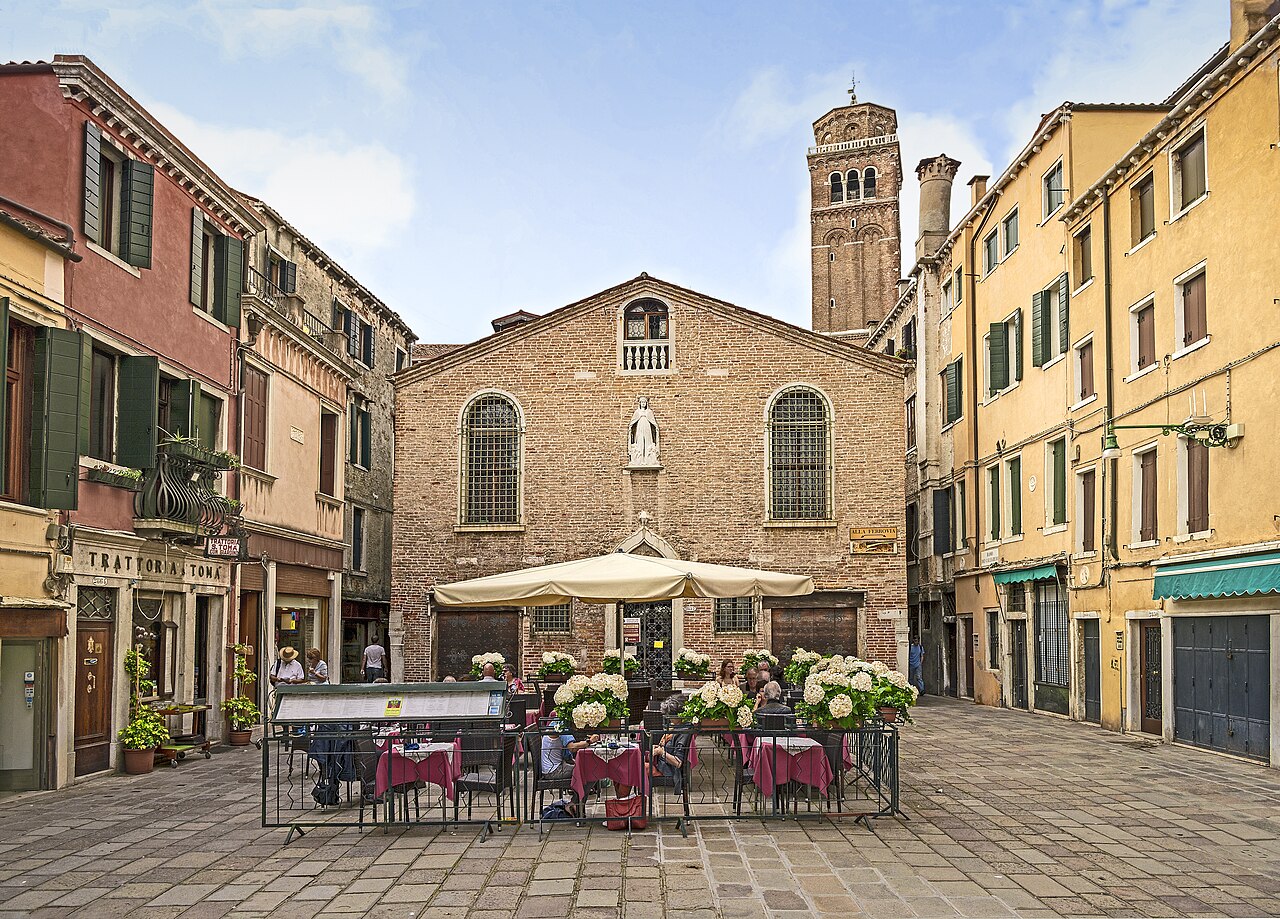
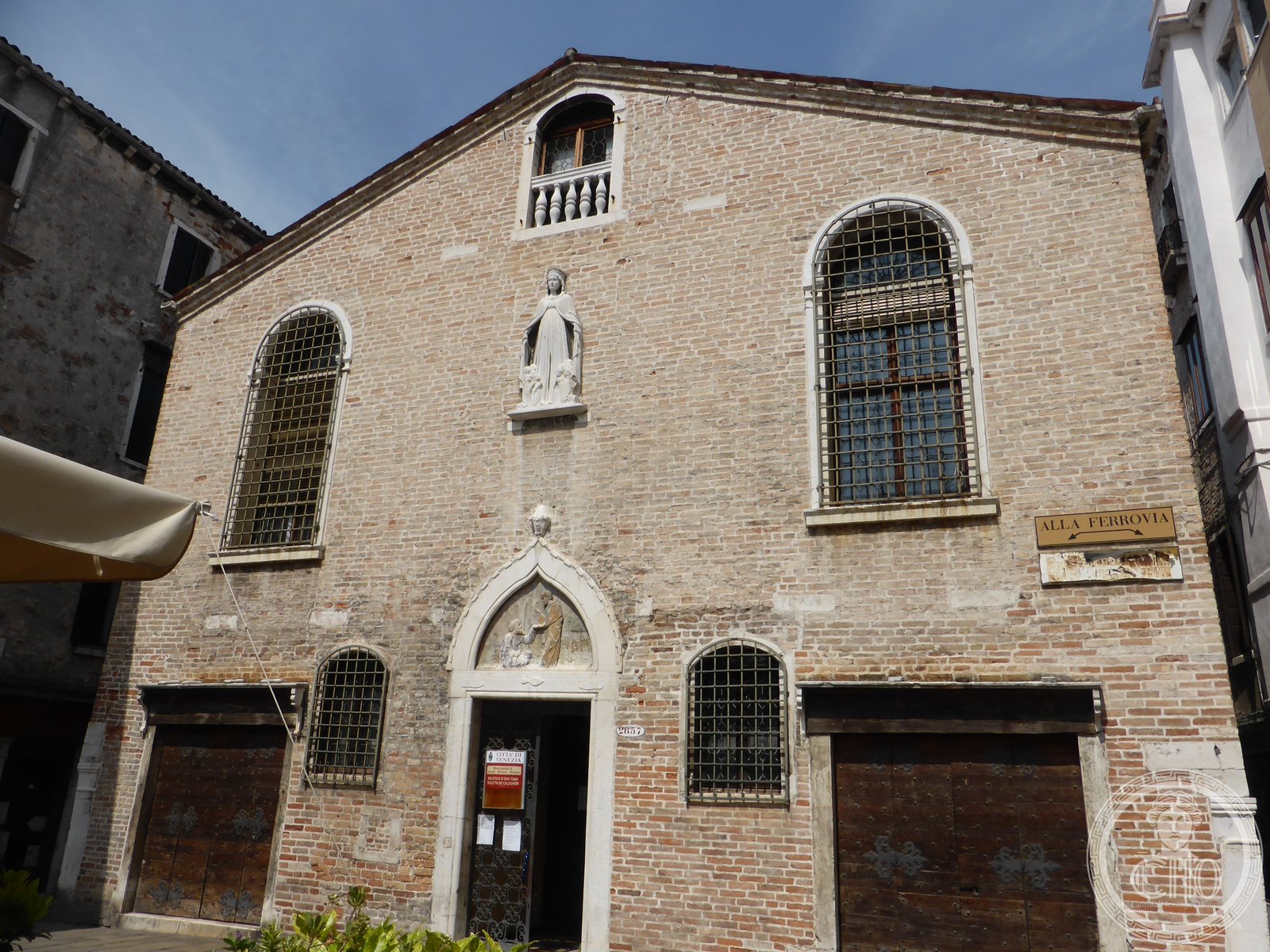
The Municipal Library of San Tomà occupies the Scoletta dei Calegheri, a small 15th-century confraternity hall in the San Polo sestiere of Venice, originally built as the meeting house of the Cobbler’s Guild (Calegheri, i.e. shoemakers). One of the most intimate examples of a Venetian scuola minore surviving with its original fabric, the building features a carved stone relief of St Mark healing the cobbler Anianus above its portal — a rare and expressive piece of early Renaissance Venetian sculpture — and now serves the neighbourhood as a public lending library.
At a glance
- Type
- Scuola minore (guild confraternity hall) / municipal public library
- Period
- 15th century (original construction); modifications 17th–18th century
- Style
- Early Venetian Renaissance; guild vernacular
- Location
- Campo San Tomà, San Polo, Venice, Italy
- Coordinates
- Approximately 45.4360° N, 12.3240° E (Campo San Tomà, San Polo)
Overview
Venice was once home to hundreds of scuole — lay confraternities that combined religious devotion, mutual aid, and professional solidarity. The Scuola dei Calegheri (Shoemakers’ Confraternity) was one of the oldest and most important of the trade-based scuole minori, holding the patronage of St Mark in his role as patron of cobblers. The building stands on the south side of the Campo San Tomà, one of the most characterful squares in the San Polo sestiere, and its modest exterior belies its art-historical significance. The relief above the door, attributed to Pietro Lombardo or his circle, is among the finest small-scale sculptures in the city.
History
The Cobbler’s Guild of Venice is documented as early as the 11th century, and the confraternity dedicated to their patron saint operated continuously until the suppression of the Venetian Republic in 1797 by Napoleon. The current building dates to the 15th century, when the guild was prosperous enough to commission a proper seat with an oratory on the upper floor. After the Napoleonic suppression, the building passed through various civic uses before being adapted as a neighbourhood lending library by the Municipality of Venice. The relief above the portal — showing St Mark healing Anianus by restoring his severed hand — has been attributed by scholars to Pietro Lombardo’s workshop and dated to around 1478.
What you see
The building’s modest two-storey facade is distinguished by the large carved relief above the main entrance, depicting St Mark tending to the cobbler Anianus in a lively narrative composition with detailed figure work typical of early Venetian Renaissance sculpture. The ground floor reading room of the current library preserves the spatial character of the original scuola hall, with stone floors and plain plastered walls. The Campo San Tomà itself, framed by the Romanesque-Gothic church of San Tomà opposite and several historic palazzi, is one of the quieter and more authentic Venetian squares away from the main tourist routes.
Cultural significance
The Scoletta dei Calegheri is a microcosm of Venetian civic culture — the intersection of trade organisation, lay piety, and artistic patronage that characterised the Republic at its height. Its continued use as a public library maintains the scuola’s original function as a community institution, giving a living purpose to a building that in many other cities would have been museified or left vacant. The portal relief is a treasured example of early Renaissance figurative sculpture in a non-aristocratic, guild context.
Practical information
- Address
- Campo San Tomà, San Polo, Venice, Italy
- Entry
- Free entry as a public library
Getting there
Campo San Tomà is in the heart of the San Polo sestiere, roughly midway between the Rialto and the Frari church. The nearest vaporetto stop is San Tomà (Line 1), a 3-minute walk. On foot from the Rialto, cross the Rialto Bridge and follow the main route through San Polo market toward Campo San Polo, then continue south to Campo San Tomà — approximately 10 minutes. The campo is also signed from the Frari basilica, which is one minute away.
Sources & resources
Gallery
Find it on the map
See this place and what’s around it →
📷 Become a Cultural Heritage Online photographer
Share your photos of places: they stay published under your name as the author. The more they're seen, the more you get noticed — and soon a contest will reward the most appreciated photos.
Log in or sign up free to add a photo