
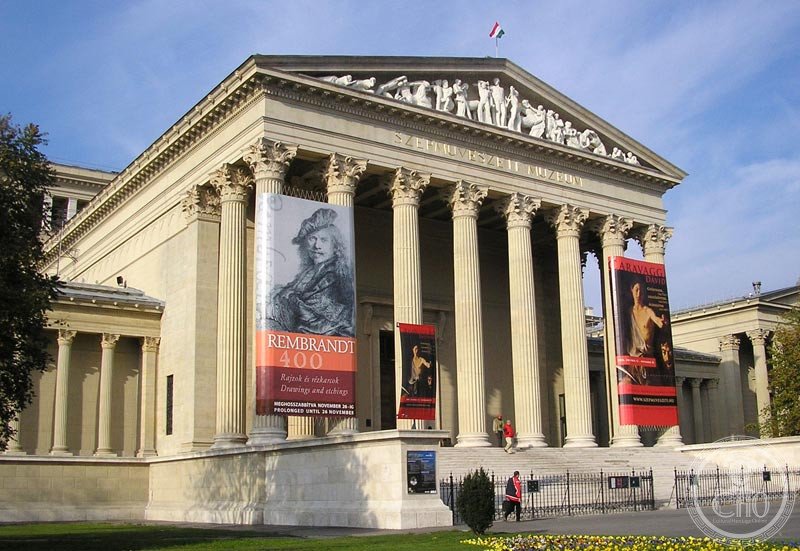
The Hungarian National Museum is the country’s pre-eminent institution for the history, art, and archaeology of Hungary, founded in 1802 when Count Ferenc Széchényi donated his private library and collections to the Hungarian nation. Housed since 1847 in a monumental Neoclassical building designed by Mihály Pollack on Múzeum körút in central Pest, the museum’s permanent collections span prehistoric Hungary through the Communist era, including the coronation regalia of the medieval Hungarian kingdom.
At a glance
- Type
- National history, art, and archaeology museum
- Period
- Founded 1802; building constructed 1837–1847
- Style
- Neoclassical; architect Mihály Pollack
- Location
- Múzeum körút 14–16, Budapest VIII, Hungary · 47.4912° N, 19.0603° E
Overview
The Hungarian National Museum was founded in 1802 and is the national museum for the history, art, and archaeology of Hungary, including areas not within Hungary’s modern borders such as Transylvania; it is separate from the collection of international art held in the Hungarian National Gallery. The museum’s encyclopaedic collections cover the full arc of human habitation in the Carpathian Basin from the Palaeolithic through the 20th century, with particular strengths in medieval archaeology, numismatics, and the applied arts of the Hungarian nobility. A separate institution, the Hungarian National Gallery, holds the country’s collection of fine art.
History
Count Ferenc Széchényi’s 1802 donation of his personal library, coin collection, and document archive to the nation is considered the founding act of the museum; the Hungarian Diet formalised the institution the same year. The current Neoclassical building was purpose-built between 1837 and 1847 to designs by Mihály Pollack, one of the leading architects of Hungary’s Reform Era, and is considered one of his masterworks. The building’s steps became a symbolic site on 15 March 1848, when the poet Sándor Petőfi is said to have read his “National Song” there, marking the outbreak of the Hungarian Revolution of 1848–49 — an event commemorated every year on Hungary’s national holiday. The collections survived the Second World War and have been continuously expanded and reorganised since 1990.
What you see
The permanent exhibition occupies the museum’s two main floors and presents Hungarian history from the earliest stone tools found in the Carpathian Basin through the occupation period after 1945. Highlights include the jewelled sword and mantle of Saint Stephen, Hungary’s first king; the Seuso Treasure, a spectacular late-Roman silver hoard; and a comprehensive display of medieval Hungarian goldsmithing and ceramics. The Lapidarium in the basement preserves carved stone architectural elements from demolished medieval buildings. The grand columned entrance hall and the painted ceremonial staircase are architectural attractions in their own right.
Cultural significance
As Hungary’s oldest and largest national museum, the institution embodies the country’s sense of historical continuity and cultural identity, particularly the memory of the medieval Kingdom of Hungary that preceded centuries of Ottoman and Habsburg rule. Its founding in 1802, during the Hungarian national awakening, made it a symbol of the aspirations that would culminate in the revolutionary year of 1848, and the building’s steps remain a politically charged public space to this day.
Practical information
- Address
- Múzeum körút 14–16, 1088 Budapest
- Admission
- Paid entry; reductions available for EU citizens and students
- Website
- hnm.hu
Getting there
The museum is on Múzeum körút in Budapest’s VIII district. The nearest metro stop is Kálvin tér, served by lines M3 (blue) and M4 (green), approximately 5 minutes on foot. Trams 47 and 49 stop directly on Múzeum körút. The museum is also easily walkable — approximately 15 minutes — from the Great Synagogue on Dohány Street and from the historic inner city around Deák Ferenc Square.
Sources & resources
Find it on the map
See this place and what’s around it →📷 Become a Cultural Heritage Online photographer
Share your photos of places: they stay published under your name as the author. The more they're seen, the more you get noticed — and soon a contest will reward the most appreciated photos.
Log in or sign up free to add a photo