There is a particular silence in an antiques market at opening time, when the dew is still on the trestle tables. It is the hour when the past surfaces. Among yellowed books and worm-eaten frames, what caught the eye was a roll of thick, rough paper that smelled unmistakably of time. Unrolled with the care owed to an archaeological find, it gave up a series of original posters — dramatic colours, lines cut like blades — each carrying a nervous, essential, unmistakable signature: Sironi. Eleven sheets, now digitized, that lead straight into the entrails of early twentieth-century Italy.
The restless master
Mario Sironi (1885–1961) was a painter, an illustrator of genius, and one of the most tormented minds of his century. Formed in Rome alongside Umberto Boccioni and Gino Severini, he passed through Futurism at his own solemn pace: where Marinetti’s movement sang the joy of speed, Sironi’s Futurism was dark from the start, fixed on silent industrial suburbs and factory chimneys standing like black obelisks. The First World War marked his psyche and left him a legacy of depression. In Milan in the Twenties he became the pillar of the Novecento Italiano movement gathered around the critic Margherita Sarfatti, forging a language at once archaic and modern, drawn from Giotto and Masaccio and re-cast in industrial key. He also bound himself to Fascism more closely than any artist of his rank, believing in an art of the State with a social and educating function. In that project the poster was central. For years he drew for newspapers, most famously Mussolini’s Il Popolo d’Italia, and he treated the street poster as the modern fresco: art that left the bourgeois salon to argue with the crowd.
L’Ambrosiano: the metropolis and the news
A conspicuous part of the find advertises L’Ambrosiano, the Milanese daily founded by the Futurist publisher Umberto Notari, whose first issue appeared on 7 December 1922. For this modern paper of a modern city, Sironi drew the day itself, edition by edition.
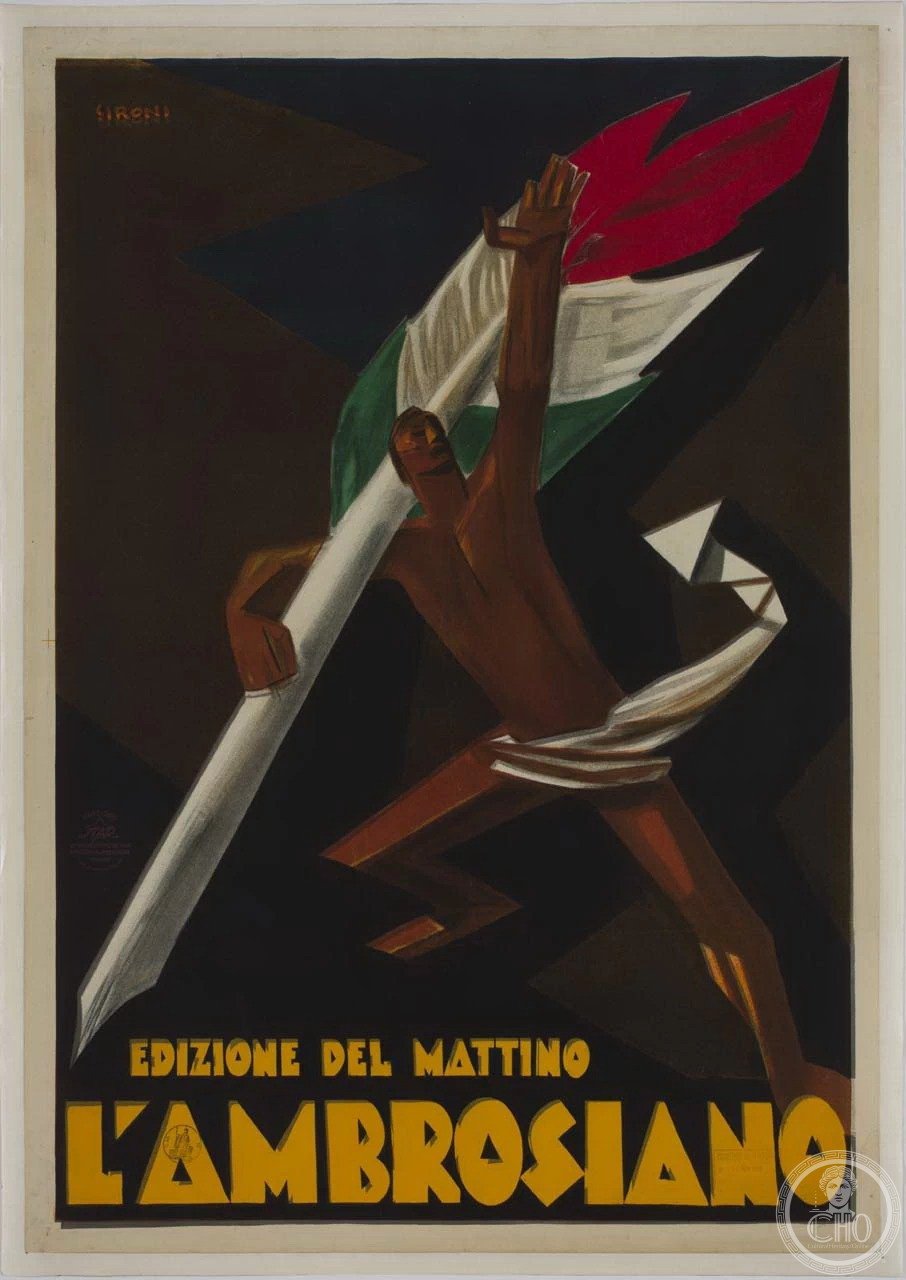
For the morning edition, a colossal male figure strides toward the viewer carrying an enormous tricolour, its red flaming like a torch against a dark ground broken by sharp abstract geometry. The step is classical, the vigour modern: the morning paper as bearer of light and civic reveille.
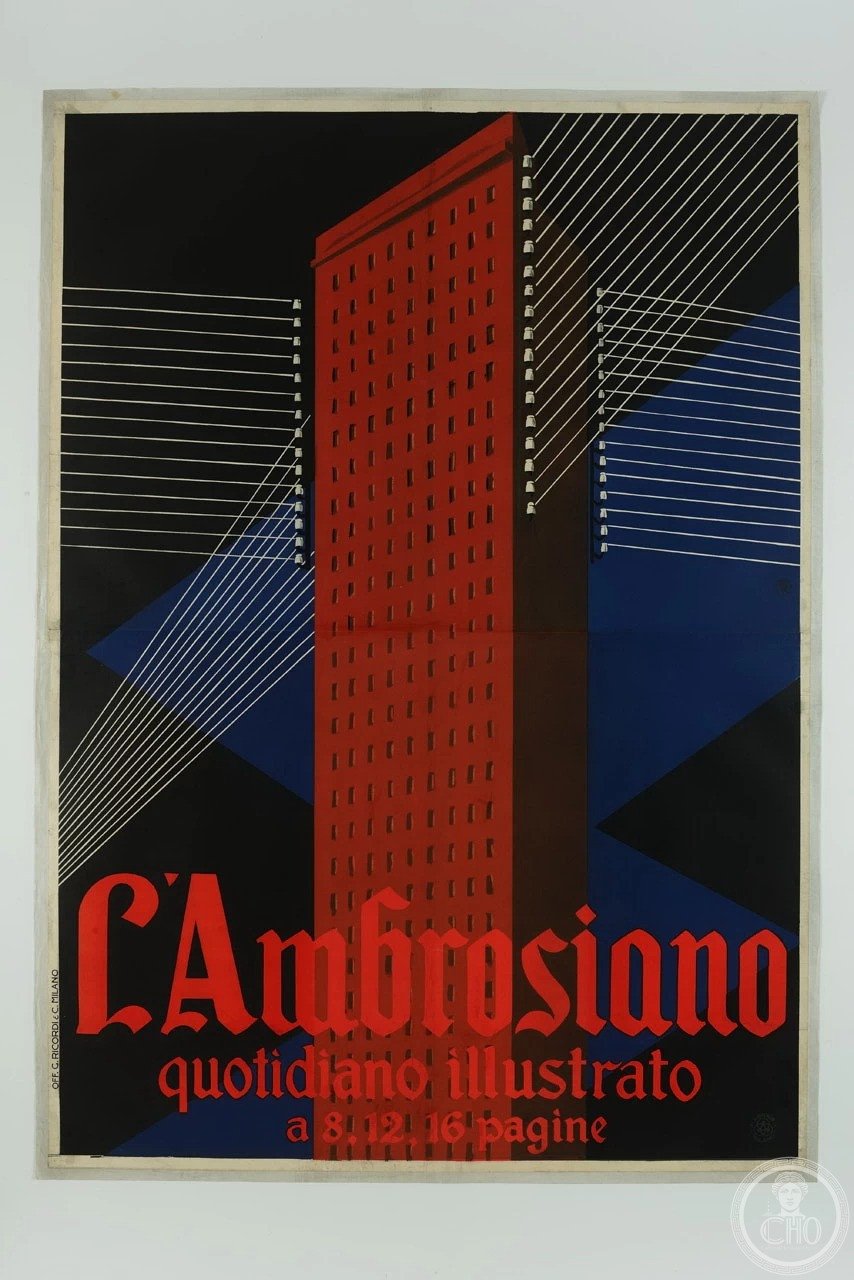
For the illustrated daily he abandons the figure altogether. A brick-red skyscraper rises like a blind monolith pierced by geometric windows, sheaves of telegraph wires radiating diagonally through the dark. It is a totem of the city that climbs, with the newspaper as the artery running information through it.
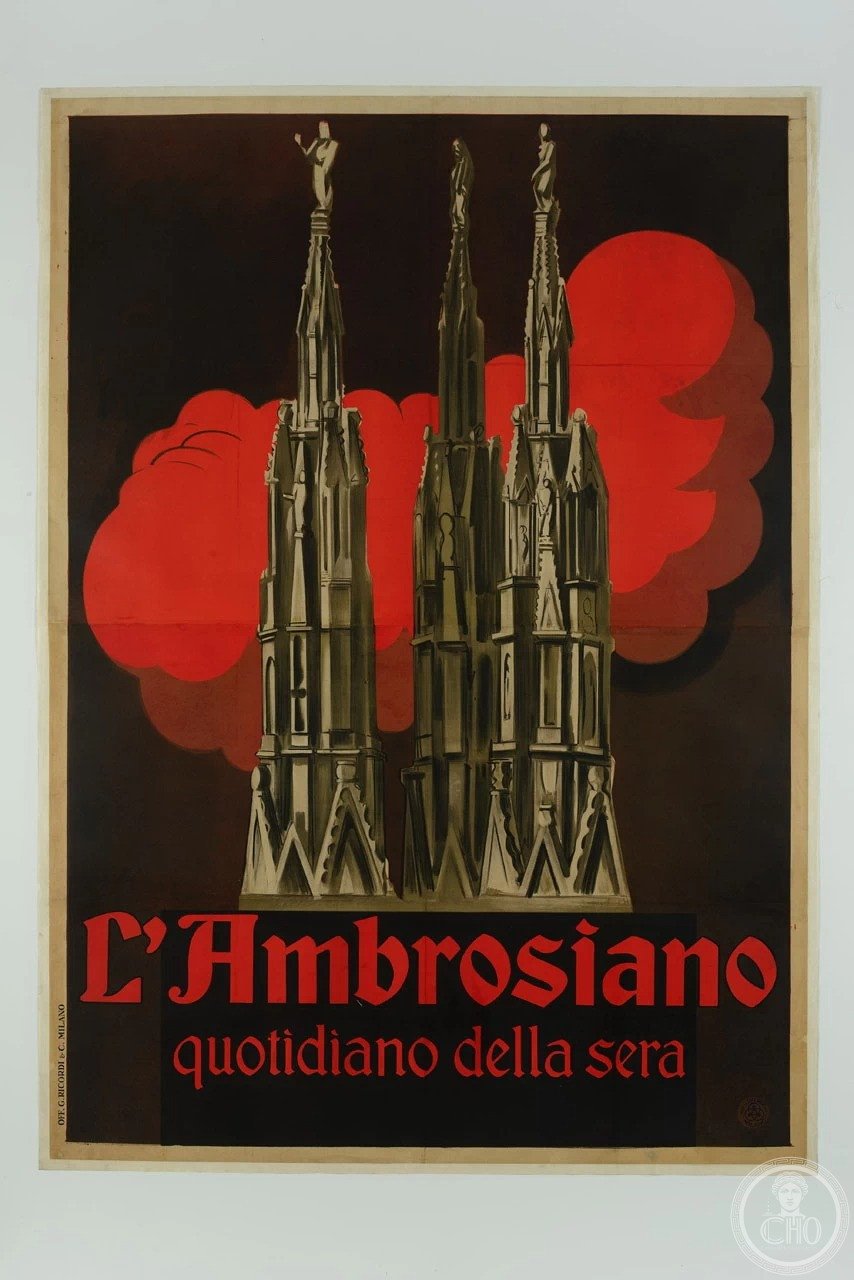
The evening edition gets the opposite symbol: the spires of the Duomo, severe and stylized, against an enormous dense red cloud — sunset over the industrial city, or the smoke of its factories. Sacred and profane fused in one image of a city ending its working day.
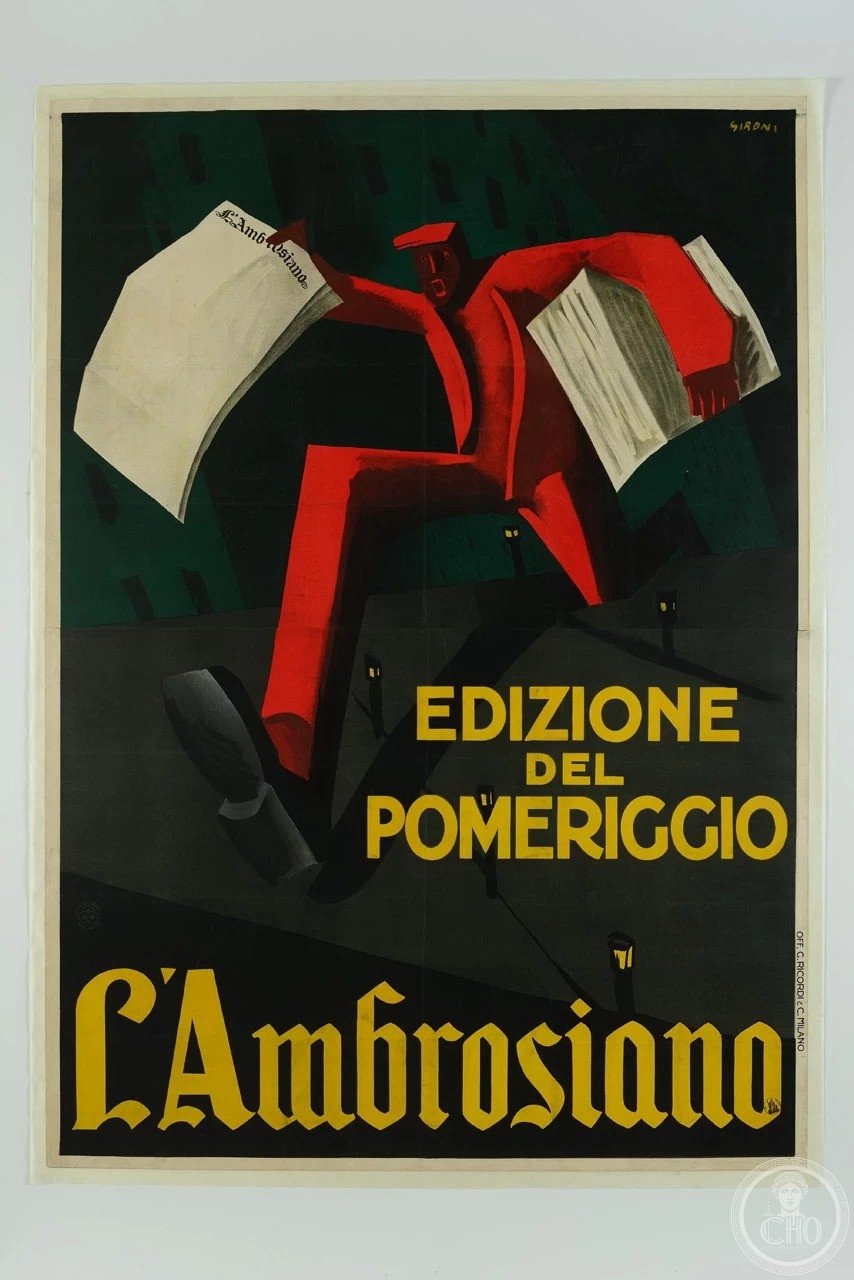
The most dynamic of the series belongs to the afternoon edition: a newsboy in blazing red runs through a darkened street with bundles of fresh papers, his body reduced to pure geometric volumes, his black shadow stretching across the asphalt under a few lamps. The hurry of the city, compressed into one figure.
Drama, art, modernity
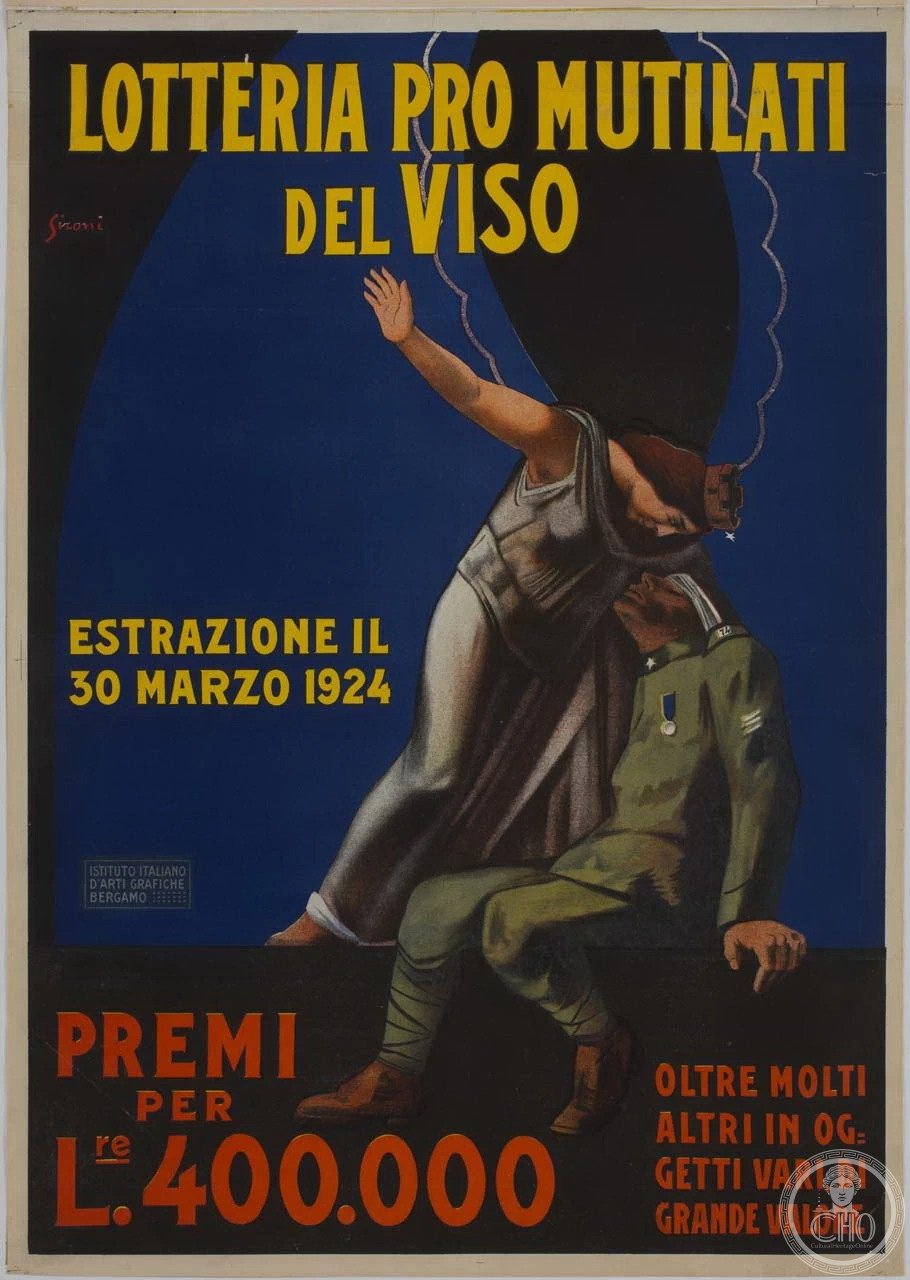
The most affecting sheet advertises a charity lottery for veterans with facial mutilations — the men the French called gueules cassées. A slumped soldier in field grey, his bandaged face turned upward in blind pain, is sheltered by an allegorical woman in classical drapery, her hand extended, her head framed by a graphic halo. Sironi had lived the front; he refuses easy pathos and monumentalizes the pain into Greek tragedy. The poster promises prizes of 400,000 lire, drawing on 30 March 1924, in orange lettering on night blue.
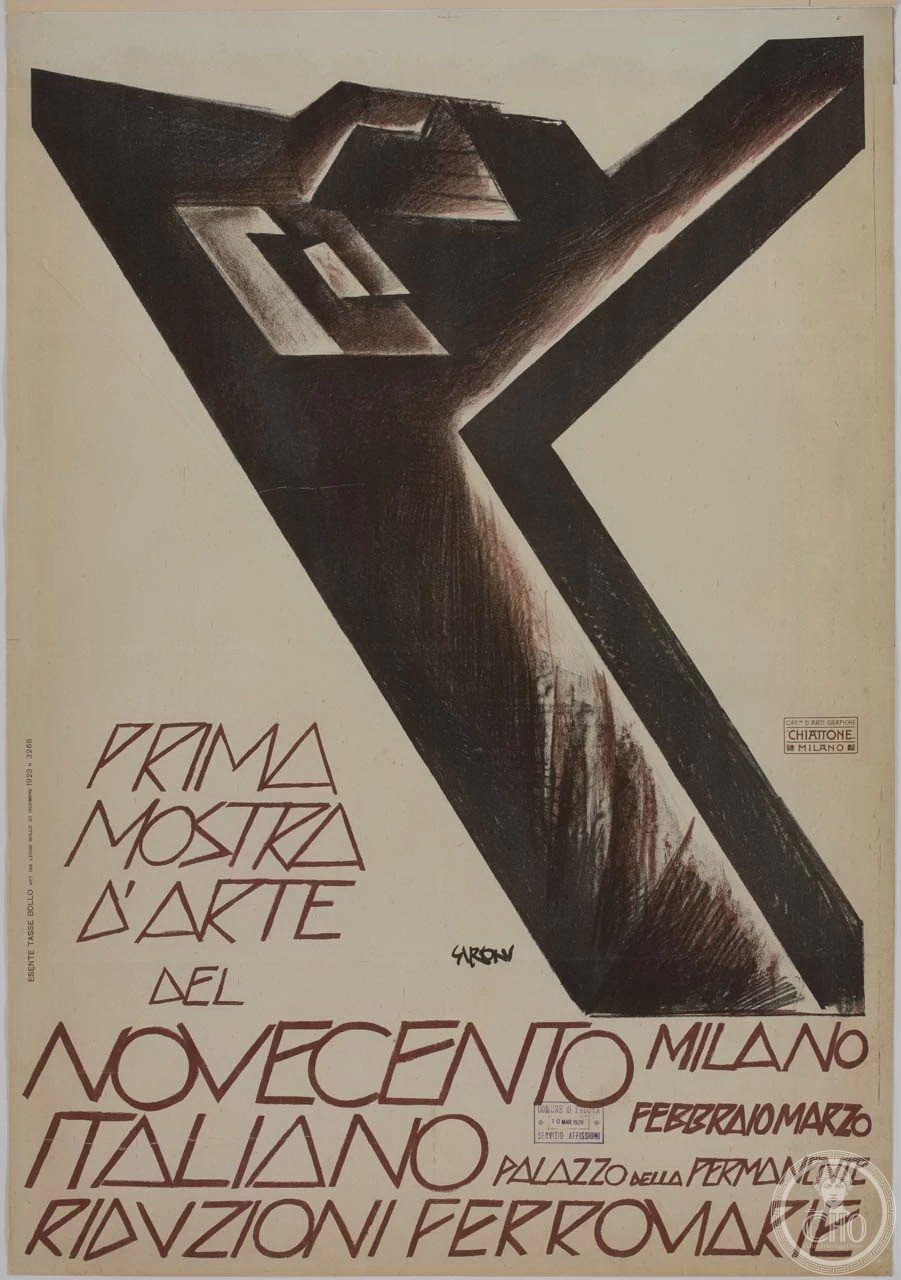
The poster for the first Novecento Italiano exhibition — the movement’s public debut, organized by Sarfatti at Milan’s Palazzo della Permanente in February 1926 — is a manifesto in itself. No figures: an abstract-architectural mass of interlocking volumes, shaded in earth and deep black, that reads as a colossal letter N carved in stone. Solidity, order, constructive rigour. This copy still bears the municipal posting stamp of 10 March 1926.
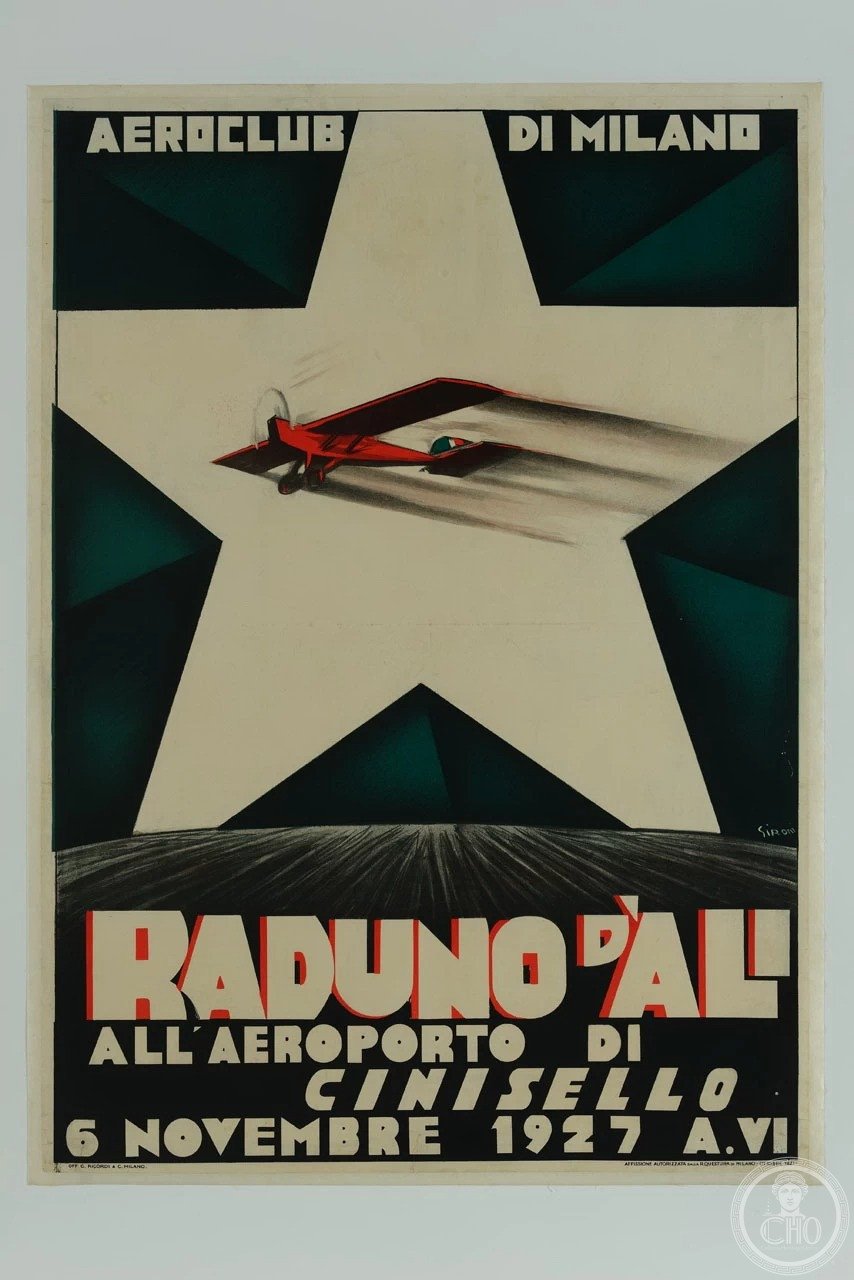
For the Aeroclub di Milano’s “gathering of wings” at the Cinisello airfield, Sironi turned startlingly graphic: a great white star cut like a void into deep night-green space, crossed by a small scarlet monoplane trailing its wake above a runway of fleeing perspective lines. Aviation was one of the great myths of the decade, and this is its cleanest possible synthesis.
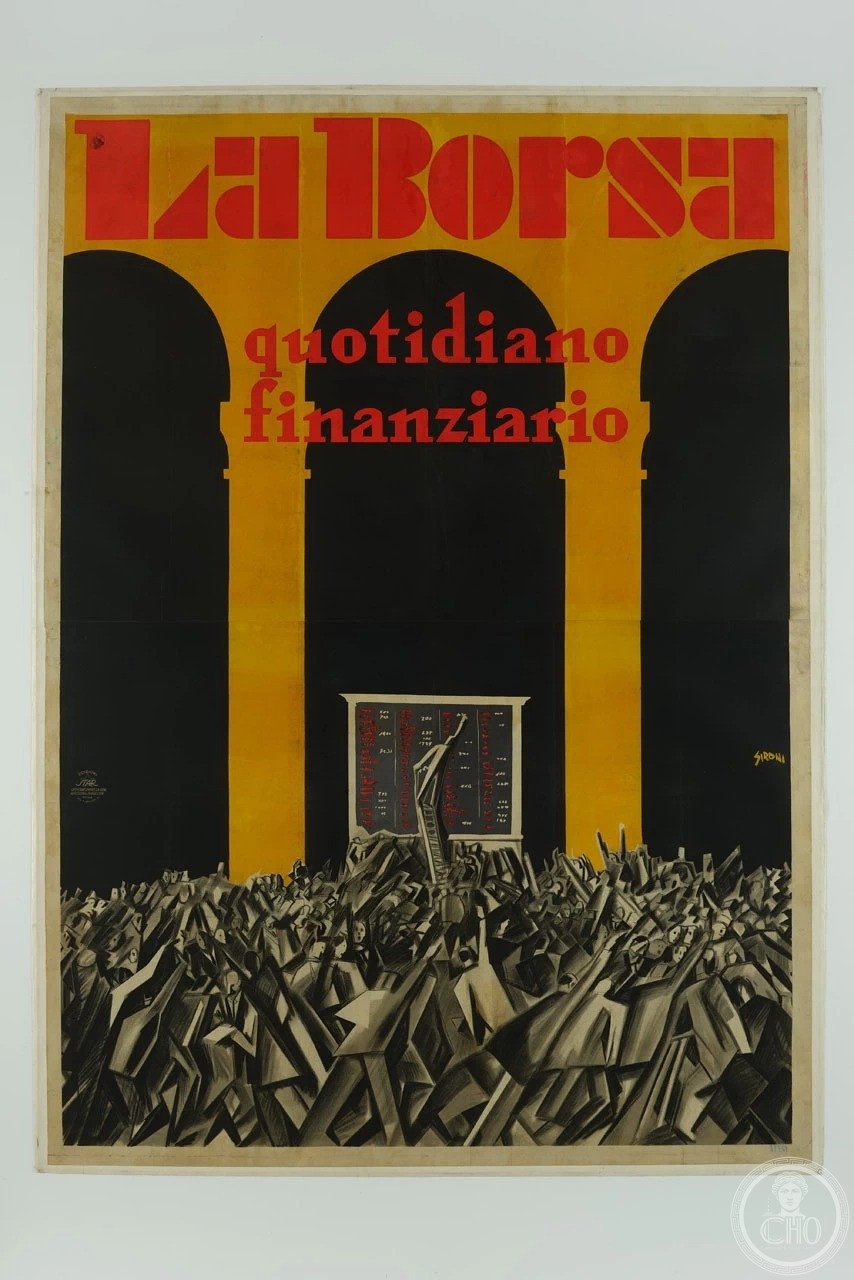
For the financial daily La Borsa, the trading floor becomes a human thicket of raised arms and waving sheets, drawn in angular grisaille. Above the frenzy stand three giant black arches of metaphysical regularity, and at the centre, luminous and detached as a secular altar, the quotation board. The cold monumentality of numbers, presiding over the passions of men.
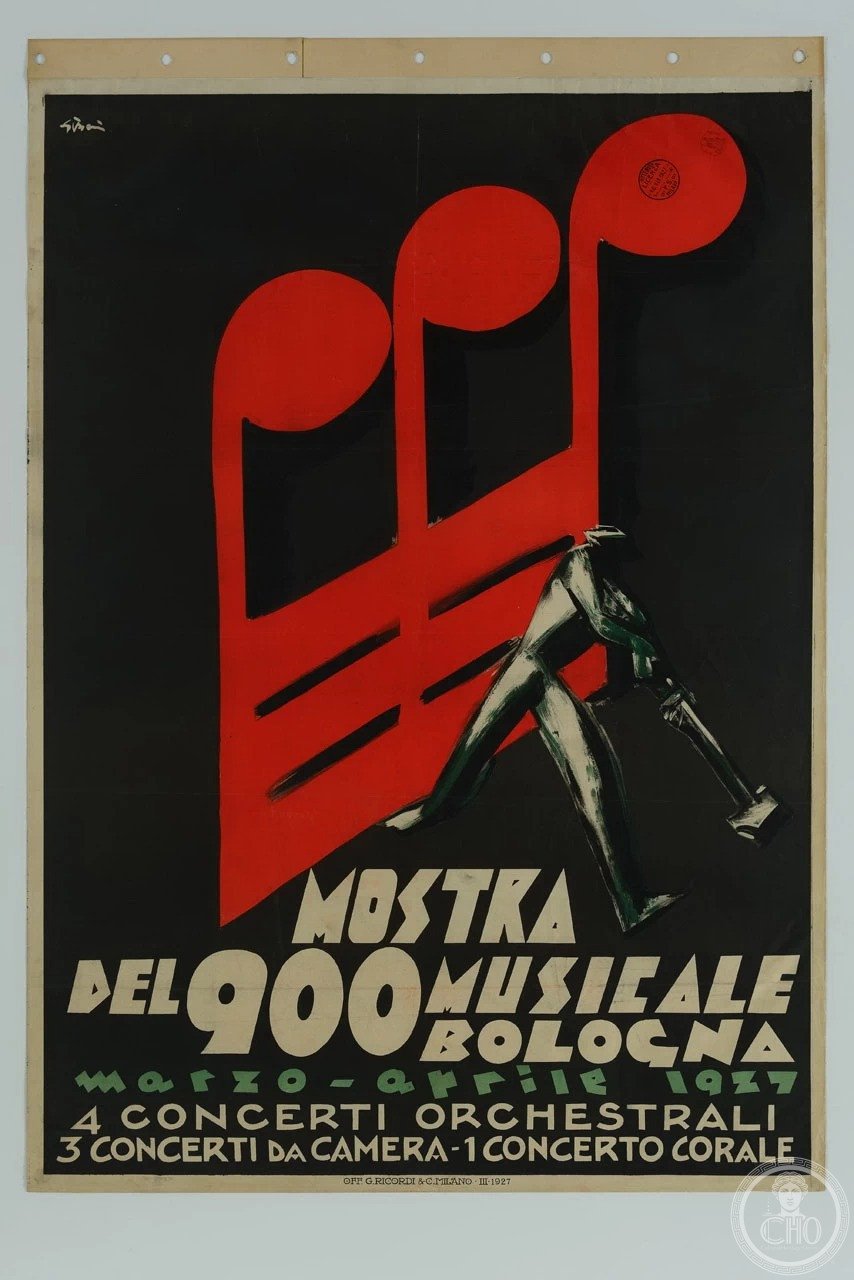
An eleventh sheet extends the find beyond the graphic and political: Bologna’s Mostra del 900 Musicale of March–April 1927 — four orchestral concerts, three chamber, one choral — announced by three giant scarlet notes on black, with a green-shadowed trumpeter walking through them. Printed, like much of the series, by Ricordi in Milan.
The aesthetics of the State
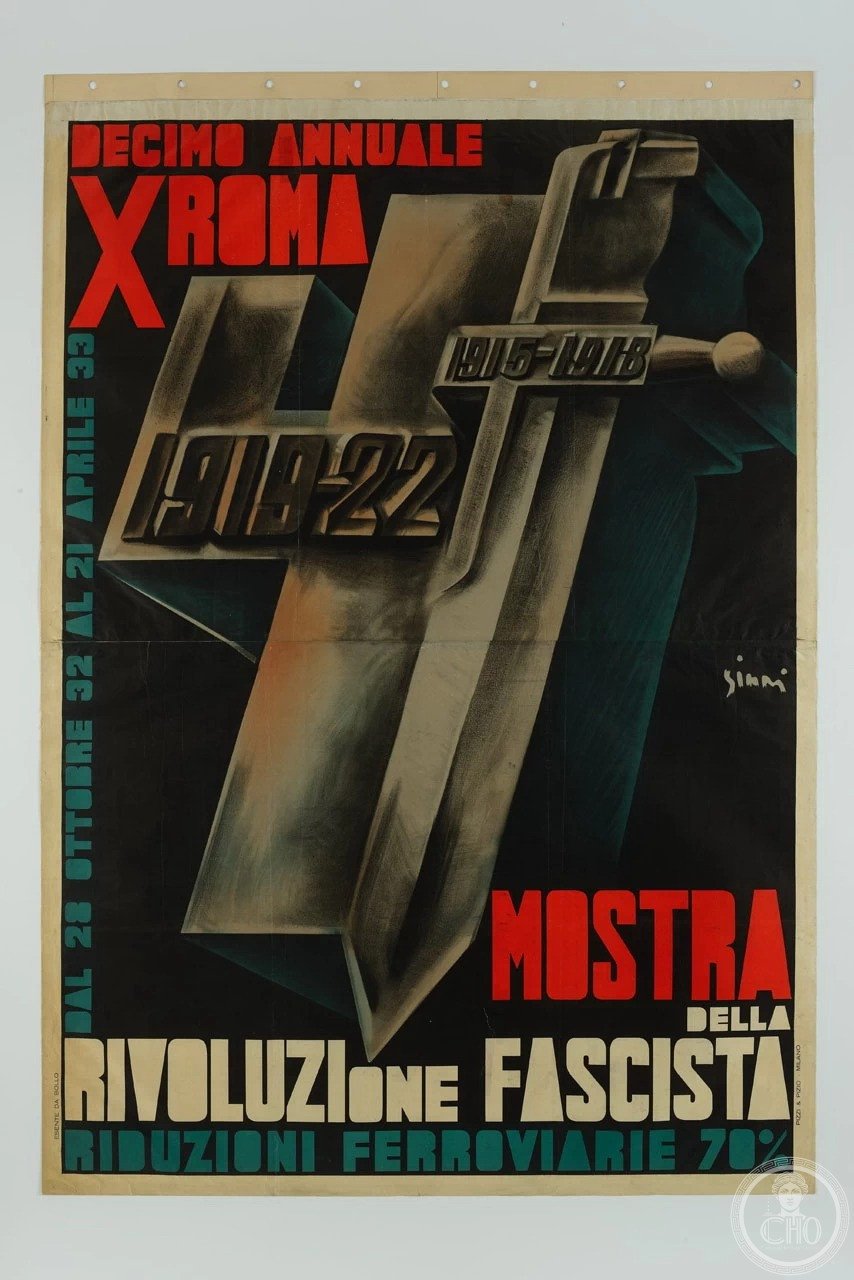
With the poster for the Mostra della Rivoluzione Fascista — the regime’s tenth-anniversary exhibition in Rome, open from 28 October 1932 to 21 April 1933, several of whose rooms Sironi himself designed — we are inside State propaganda at its apex. A colossal Roman numeral X fuses sculpturally with a monumental blade; the dates 1915–1918 and 1919–22 are cut into the metal as if into a monolith. Black ground, iron grey, blood red, and a line promising 70% rail discounts to visitors. There is no humanity in it; only the brute imposition of ideology through pure volume and visual weight.
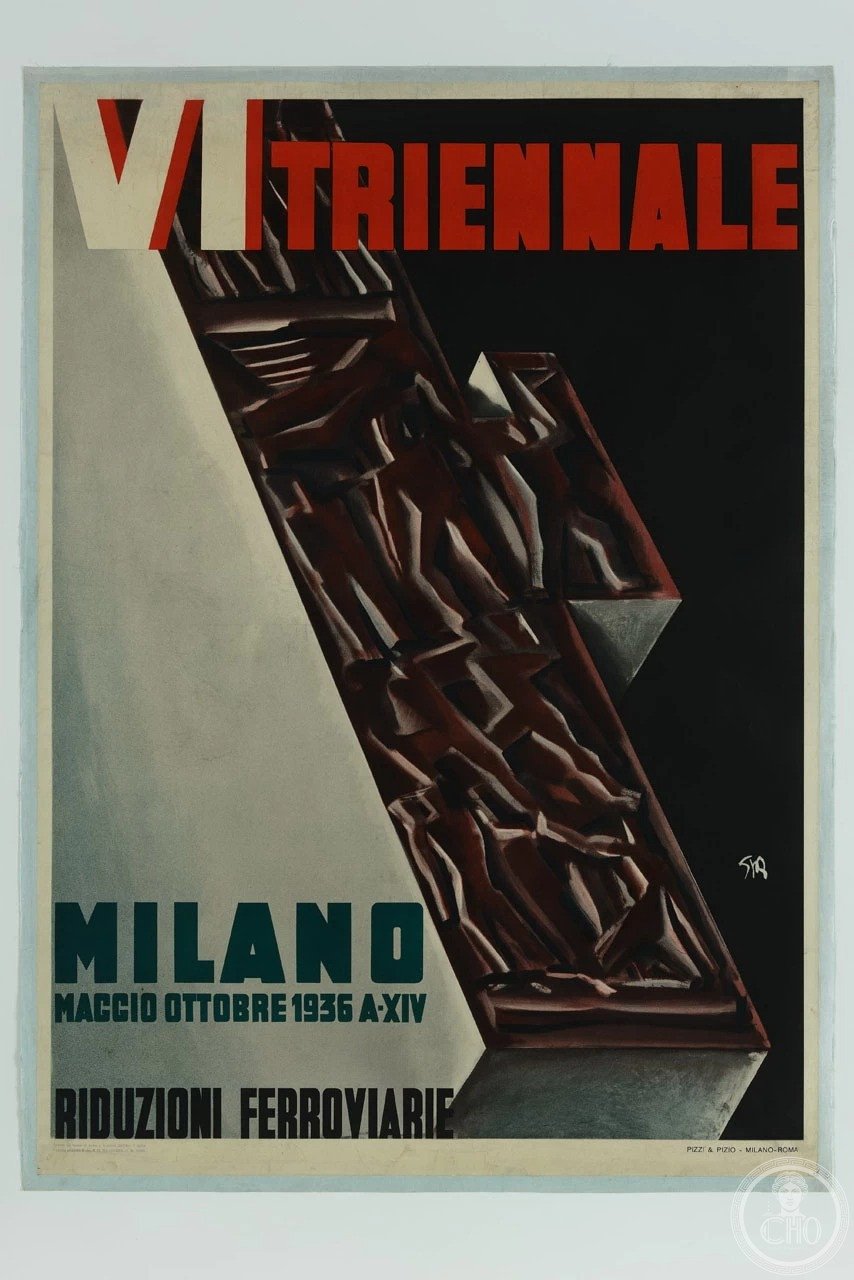
The VI Triennale of 1936 shows the late Sironi, theorist of the synthesis of the arts, painting pure architecture: a vertiginous angled volume like the corner of a Rationalist building, inset with a bas-relief of faceless heroic builders fused into the stone. The poster does not shout. It imposes itself with the silent gravity of a public building — exactly the programme he had signed, with Carrà, Funi and Campigli, in the 1933 Manifesto della pittura murale.
The weight of a visual legacy
Bringing these sheets back from a market stall means recovering fragments of the visual code of an entire epoch. Sironi’s total adhesion to the regime cost him, after the war, a long and painful damnatio memoriae, from which serious historicization has retrieved him only in recent decades. Yet set these posters in their time and the greatness of the graphic sign is impossible to deny. He rejected the prettiness of the floral Liberty style, outgrew Futurist excess, and built posters the way one builds architecture — with weight, balance, foundations, and daring lines of flight. Abyssal blacks, incendiary reds, the tones of earth and steel; human figures compressed into universal archetypes. A found treasure that, a century on, has not stopped questioning us.
Sources
- Catalogo generale dei Beni Culturali (ICCD) — catalogue entries for Sironi’s L’Ambrosiano poster series.
- Fondo Ambiente Italiano (FAI) and Museo del Novecento literature on Sironi and the Novecento Italiano movement.
- L’Ambrosiano: founding data (Umberto Notari, first issue 7 December 1922).
- Primary evidence: the eleven posters themselves — titles, dates, printers’ marks (Ricordi, Pizzi & Pizio, Chiattone, Istituto Italiano d’Arti Grafiche Bergamo) and the 10 March 1926 posting stamp readable on the sheets. Collection Stefano Vigolo.