
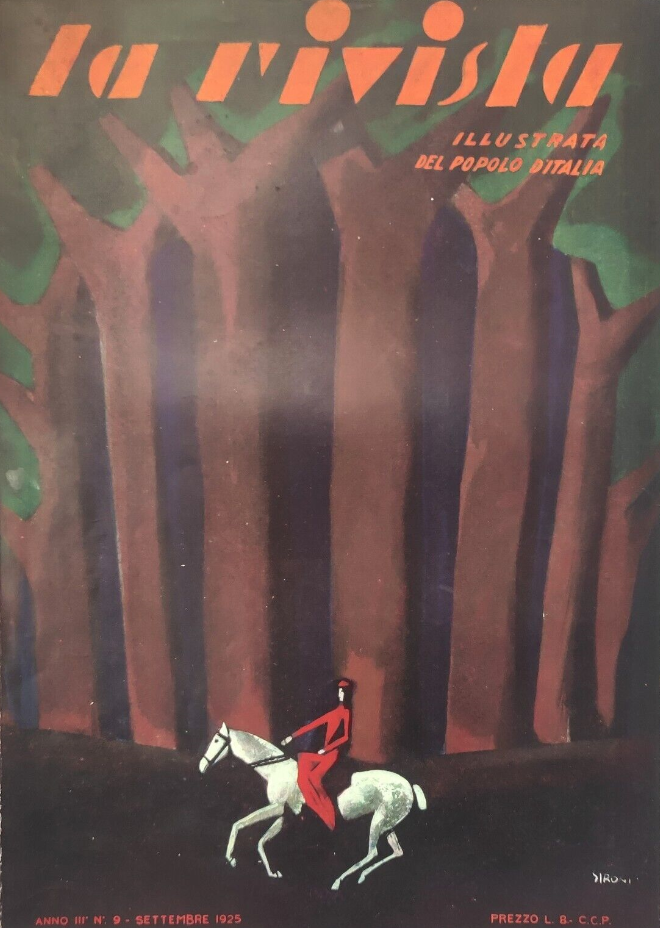
This magazine cover was illustrated by Mario Sironi in 1925. The work reflects the Italian Modernist artist’s distinctive approach to visual design, marked by substantial, immobile forms and a characteristically somber aesthetic.
Sironi was an accomplished painter, sculptor, illustrator, and designer whose career spanned the twentieth century. His illustrations for magazines and periodicals demonstrated the same formal language evident in his fine art practice—a visual vocabulary rooted in Modernist principles and geometric severity. This cover represents one facet of his prolific engagement with commercial and editorial design during the 1920s, a period of significant artistic innovation in Italy.
About Mario Sironi
Born in Sassari, Sardinia, in 1885, Sironi initially pursued engineering before turning to painting after a nervous breakdown in 1903. He studied at the Accademia di Belle Arti di Roma under Giacomo Balla, whose influence shaped his early Divisionist practice. Sironi traveled to Paris in 1906 and visited Germany between 1908 and 1911, where he encountered Expressionist works that informed his artistic development. His paintings became known for their monumental, restrained formal qualities.
Details
- Creator: Mario Sironi
- Year: 1925
- Object type: Magazine cover illustration
- Movement: Italian Modernism
Frequently asked questions
Who was Mario Sironi?
Mario Sironi (1885–1961) was an Italian Modernist artist active as a painter, sculptor, illustrator, and designer. His works are characterized by massive, immobile forms and a somber palette. He studied under Giacomo Balla at the Accademia di Belle Arti di Roma and traveled extensively to Paris and Germany, where he encountered avant-garde movements that shaped his artistic practice.
What was Sironi’s background?
Born in Sassari, Sardinia, Sironi came from a family with strong cultural ties—his father was an engineer and his maternal grandfather was architect and sculptor Ignazio Villa. Sironi spent his childhood in Rome and initially studied engineering at the University of Rome before abandoning that path in 1903 to pursue painting.
What movements influenced Sironi’s work?
Sironi began painting in a Divisionist style under Giacomo Balla’s guidance after meeting him at the Accademia di Belle Arti di Roma. During visits to Germany between 1908 and 1911, he encountered Expressionist works that broadened his artistic vocabulary, contributing to the development of his distinctive Modernist aesthetic.


