
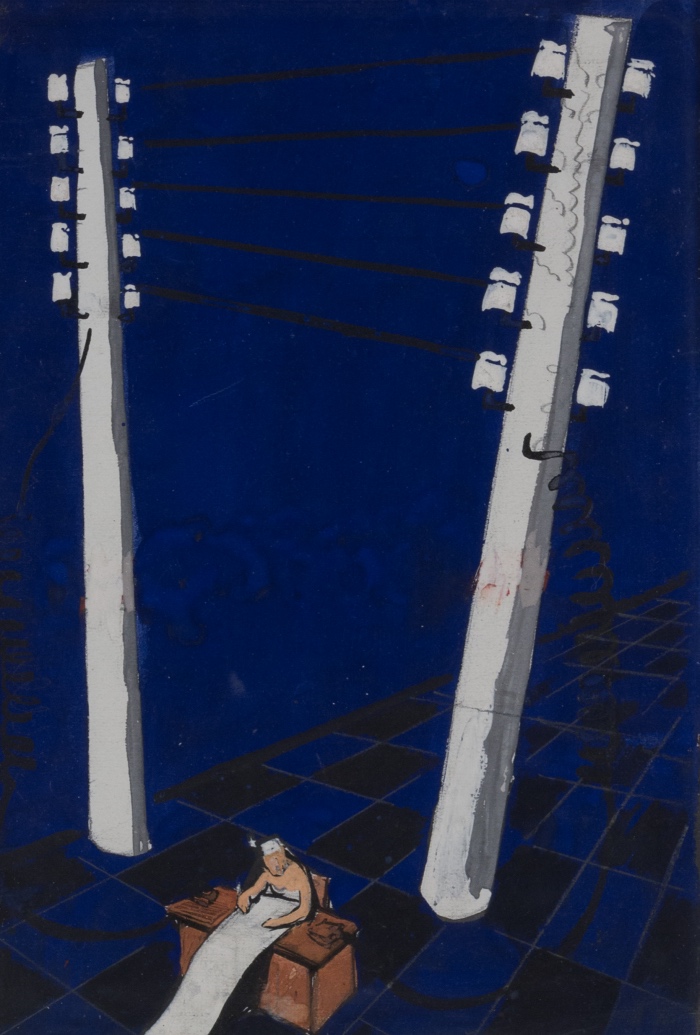
Il Telegrafista is a painting by Mario Sironi created around 1926. The work depicts a telegraph operator and exemplifies the artist’s distinctive approach to Modernist painting, marked by massive, immobile forms and a somber aesthetic.
Sironi’s career spanned multiple artistic movements and disciplines. Born in Sassari in 1885, he initially trained as an engineer before shifting to painting at the Accademia di Belle Arti di Roma, where he studied under Giacomo Balla. His early work absorbed Divisionist principles, and later experiences in Germany and Rome shaped his evolving style toward the monumental figuration characteristic of his mature work.
About Mario Sironi
Sironi was an Italian Modernist active as painter, sculptor, illustrator, and designer. His artistic trajectory moved through Divisionism and Expressionism before settling into a practice defined by weighty, static compositional forms. He remained a major figure in twentieth-century Italian art until his death in 1961.
Details
- Artist: Mario Sironi
- Date: circa 1926
- Medium: Painting
- Movement: Italian Modernism
On video
Frequently asked questions
Who was Mario Sironi?
Mario Sironi was an Italian Modernist artist born in Sardinia in 1885. He studied painting at the Accademia di Belle Arti di Roma under Giacomo Balla and worked as a painter, sculptor, illustrator, and designer throughout his career.
What characterizes Sironi’s artistic style?
Sironi’s paintings are typically somber and characterized by massive, immobile forms. His work evolved through Divisionist and Expressionist influences before developing the monumental figuration for which he became known.
What does the painting depict?
Il Telegrafista depicts a telegraph operator, rendered in Sironi’s characteristic style of weighty, static forms.
Sources
- S1 — Pontiggia, Elena. Il Novecento Italiano. Abscondita, 2003. ISBN 978-88-8416-048-5.
- S2 — Bossaglia, Rossana. Il Novecento italiano. Electa, 1995. ISBN 978-88-435-6178-0.
Spotted an error? Write to editorial@culturalheritageonline.com and we correct it the same day.


