
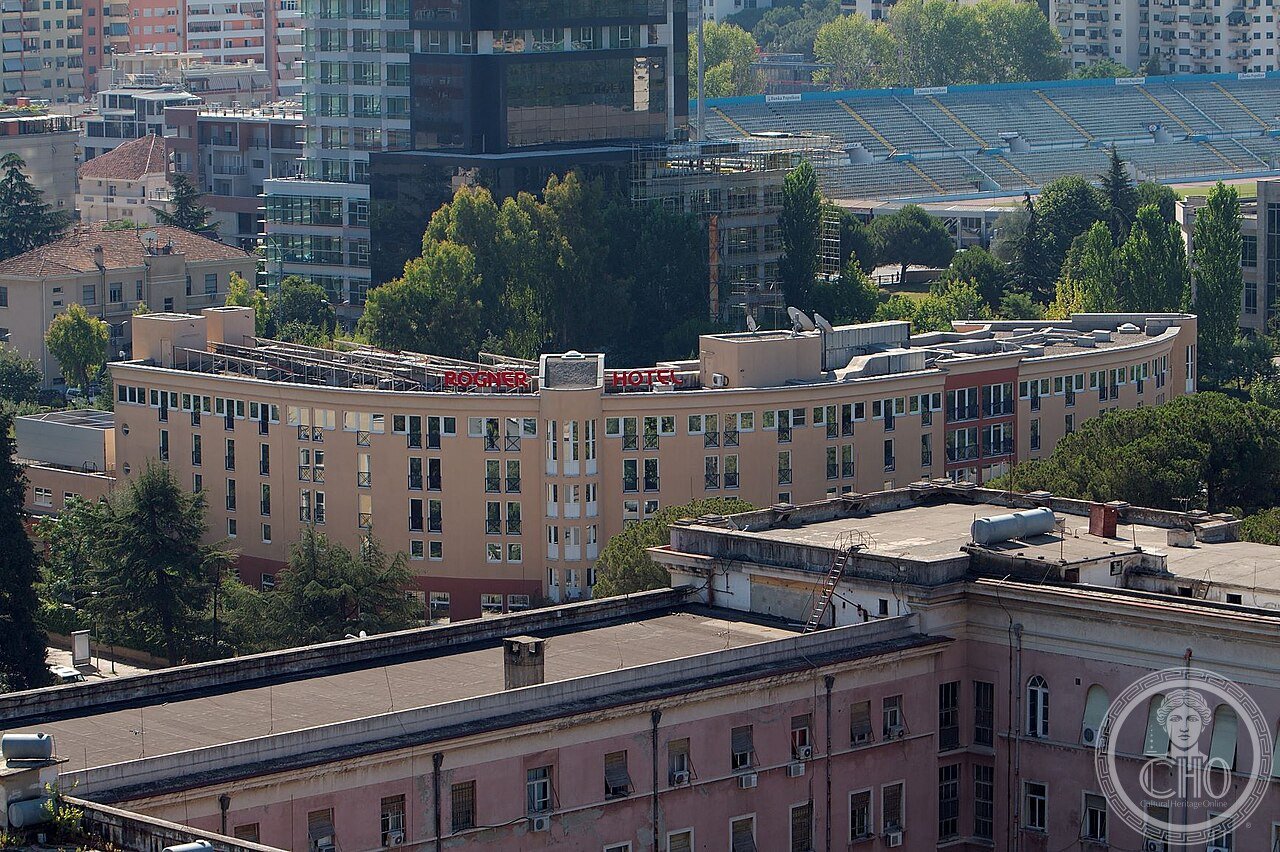
Built by Austrian developer Robert Rogner in 1995, this crescent-shaped hotel was the first international luxury property to open in Albania after the fall of communism.
At a glance
The Rogner Hotel Tirana — also known as Rogner Europapark — occupies a prominent position on Bulevardi Dëshmorët e Kombit, the grand ceremonial boulevard that connects the city centre to the embassy district. Its four-storey crescent form encloses Mediterranean gardens unusual for a capital that had been sealed behind an iron curtain for nearly five decades. The hotel remains a significant conference venue and a symbol of Albania’s rapid post-1991 opening to the world. With 136 rooms, it set the standard for international hospitality in a city that had virtually none.
Key facts
- Built: 1995 by Robert Rogner (Austrian developer)
- Style: Post-Communist Modernism; Mediterranean references
- Status: Operating luxury hotel, 136 rooms
- Address: Bulevardi Dëshmorët e Kombit 9, 1010 Tirana, Albania
- GPS: 41.3258, 19.8197 — Open in Google Maps
- UNESCO/Listed: No national listing
History
Albania emerged from one of Europe’s most isolationist communist regimes in 1991, leaving Tirana without a single internationally rated hotel. Robert Rogner, an Austrian entrepreneur, recognised the gap and committed to building from scratch in conditions that required importing materials and machinery through the port of Trieste and training 120 Albanian workers in Austrian technical colleges before construction could begin.
The hotel opened in 1995 and immediately became the address of choice for diplomats, journalists, and business delegations arriving in the newly democratic capital. Its location adjacent to the Presidential Palace and the embassies concentrated on the southern boulevard reinforced that strategic role. The property has operated continuously since opening, maintaining its position as a landmark despite the rapid growth of Tirana’s hospitality sector after 2000.
Today the Rogner remains one of the best-known addresses in Albania, hosting international summits and press conferences alongside its core hotel operations. The gardens — rare green space in the Albanian capital — have become as recognisable as the building’s curved outline.
What you see
The hotel’s most distinctive external feature is its crescent plan, which allows the principal guest rooms to face the interior gardens rather than the busy boulevard. The four-storey facade is rendered in pale stucco with regularly spaced balconies, a restrained language that reads as international modernism tempered by Mediterranean warmth. Low-rise garden wings extend from the main arc, keeping the whole ensemble approachable in scale.
Inside, the public areas reflect the mid-1990s international hotel aesthetic — generous lobbies, marble finishes — updated through successive refurbishments. The gardens themselves, planted with mature palms and Mediterranean shrubs, provide an unexpected oasis that the curved building embraces on three sides.
Practical information
- Open to hotel guests and conference attendees; restaurants accessible to non-guests
- Best season: spring and autumn for comfortable temperatures; summer heat is intense
- Guided tours available: no dedicated heritage tours; hotel staff can provide history on request
- Estimated visit time: 1–2 hours for a meal or coffee in the gardens
Getting there
Tirana International Airport Nënë Tereza is approximately 17 km north of the hotel; taxis and airport transfers take 25–40 minutes depending on traffic. The hotel sits on Bulevardi Dëshmorët e Kombit, walkable in under 15 minutes from Skanderbeg Square, Tirana’s central landmark. City buses serve the boulevard regularly.
Nearby
- Presidential Palace (Pallati i Brigadave): Adjacent to the hotel, the monumental communist-era presidential complex remains a defining piece of Tirana’s architectural landscape.
- Skanderbeg Square: The vast central plaza of Tirana, around 700 m north, flanked by the National Historical Museum with its celebrated mosaic facade.
- Bunk’Art 2: A former Cold War nuclear bunker beneath the Interior Ministry converted into a museum of communist-era repression, a short walk from the boulevard.
- National Gallery of Arts: Albania’s principal fine arts museum, housing Socialist Realist and contemporary Albanian works, located on the same boulevard.
Sources
Find it on the map
See this place and what’s around it →📷 Become a Cultural Heritage Online photographer
Share your photos of places: they stay published under your name as the author. The more they're seen, the more you get noticed — and soon a contest will reward the most appreciated photos.
Log in or sign up free to add a photoIs this page about you?
This page is read by travellers and heritage enthusiasts who find it on Google. Tell us how you are connected to this place and we will take it from there.