
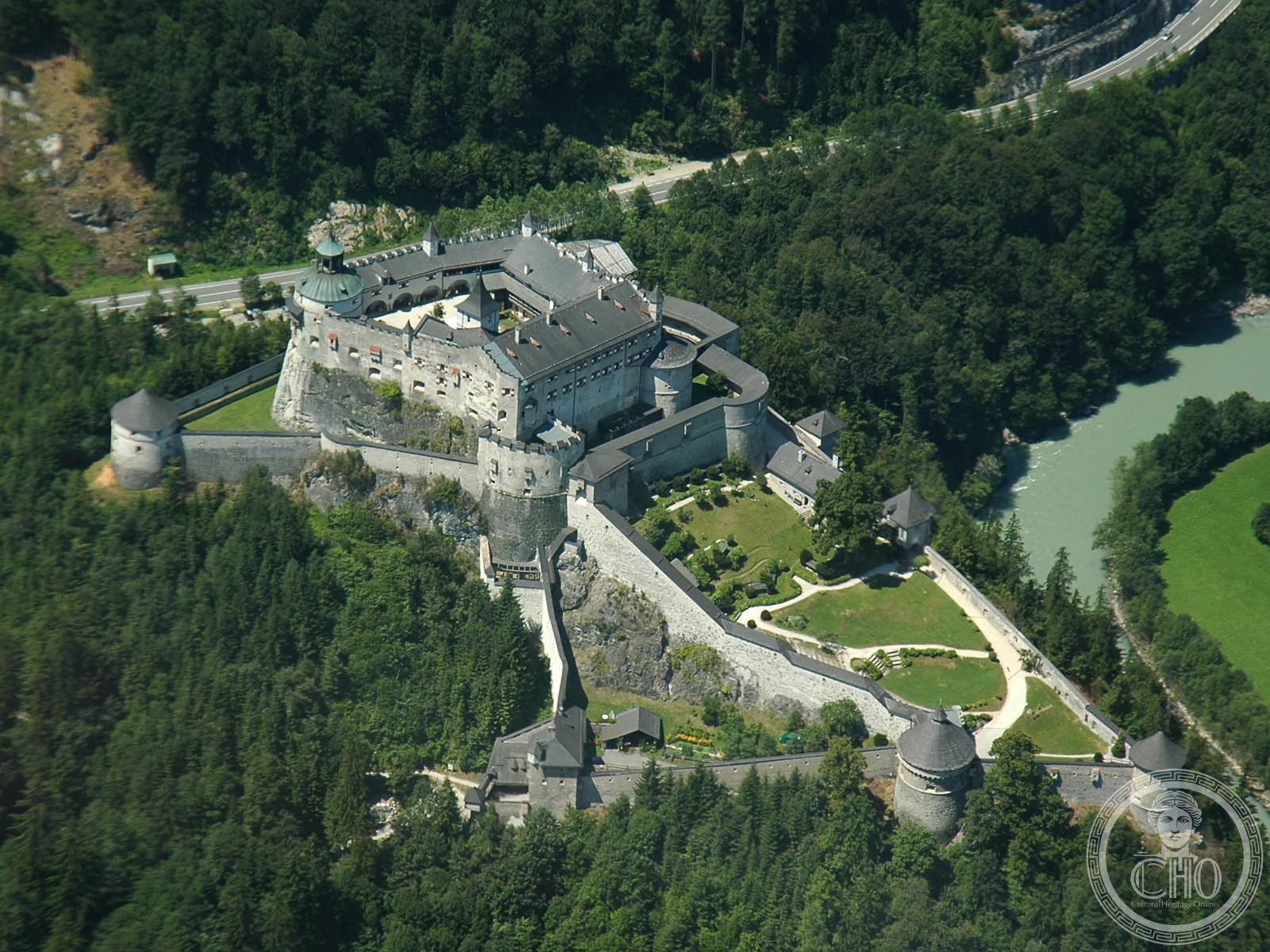
Hohenwerfen Fortress
Hohenwerfen Castle is a medieval rock fortress perched at 623 metres altitude on a 155-metre rock pillar overlooking the Austrian market town of Werfen in the Salzach valley, approximately 40 kilometres south of Salzburg. Built in the eleventh century by the Archbishops of Salzburg — contemporaneously with its sister fortress Hohensalzburg — and expanded repeatedly through the sixteenth century, Hohenwerfen combines dramatic Alpine scenery with one of the best-preserved medieval castle complexes in Central Europe. It is also known internationally as a filming location for the 1968 film Where Eagles Dare.
At a glance
- Type
- Medieval rock castle (Felsenburg)
- Period
- Founded 1077; major expansions 12th–16th century
- Style
- Romanesque to late-Gothic defensive architecture
- Location
- Werfen, Salzburg district, Austria — Salzach valley, surrounded by the Berchtesgaden Alps and Tennen Mountains
- Coordinates
- 47.4829° N, 13.1868° E
Overview
Hohenwerfen is encircled by the Berchtesgaden Alps and the Tennen Mountains, placing it within one of the most scenically compelling settings of any castle in the Alpine region. As a sister fortress to Hohensalzburg, both built under the Archbishops of Salzburg during the Investiture Controversy, Hohenwerfen illustrates the strategic reach of ecclesiastical power across the medieval Salzach valley. Today it functions as a popular tourist attraction offering guided castle tours, a falconry display, and panoramic views across the surrounding Alpine peaks.
History
The castle was first established in 1077 by Archbishop Gebhard of Salzburg, who ordered fortifications to be built on the dramatic rock spur as part of the ecclesiastical-imperial conflicts of the Investiture Controversy. It was used as a place of exile and imprisonment throughout the medieval and early modern periods, most notably holding rebellious Protestant nobles during the sixteenth-century Reformation conflicts in Salzburg. Damaged by fire in 1931, the castle underwent extensive restoration in the 1980s and 1990s, which enabled its reopening as a heritage museum. The international celebrity of the site increased after it was used as an exterior filming location in the 1968 World War II adventure film Where Eagles Dare, starring Richard Burton and Clint Eastwood.
What you see
Approaching the castle — accessible via a short cable car or on foot — visitors first encounter the outer gate and drawbridge before entering the layered defensive enclosure. The inner castle contains the residential palace range with restored period interiors, a chapel with late-Gothic furnishings, and the tower keep. The falconry courtyard hosts regular displays of eagles, falcons, and other birds of prey using traditional techniques. From the battlements, the panorama extends across the narrow Salzach gorge, the Tennen plateau, and the peaks of the Berchtesgaden Alps on the German-Austrian border.
Cultural significance
Hohenwerfen represents a rare example of an Alpine fortress that has remained structurally coherent from the medieval period to the present, serving administrative, military, and penal functions across nine centuries before its current role as heritage attraction. Its architectural continuity — from Romanesque foundation walls to Gothic expansions and Renaissance modifications — offers a layered record of castle-building practice in the Salzburg archbishopric. The castle’s worldwide recognition through cinema has also made it a benchmark for heritage tourism in the Austrian Alpine region.
Practical information
- Address
- Burgstraße 2, 5450 Werfen, Austria
- Opening hours
- Seasonal opening (roughly April–October); check official website for current hours
- Access
- Cable car (included in ticket) or 20-minute walk from the village of Werfen
- Website
- burg-hohenwerfen.at
Getting there
Werfen is served by direct trains from Salzburg Hauptbahnhof (journey approximately 40 minutes on the main rail line toward Villach). By car, take the A10 Tauern Autobahn south from Salzburg and exit at Werfen; the drive takes around 35 minutes. From Werfen railway station the castle is a 15-minute walk to the cable car base station.
Sources & resources
- Wikipedia — Hohenwerfen Castle: en.wikipedia.org/wiki/Hohenwerfen_Castle
- Official website: burg-hohenwerfen.at
- Cultural Heritage Online: culturalheritageonline.com
Find it on the map
See this place and what’s around it →📷 Diventa un fotografo di Cultural Heritage Online
Condividi le tue foto dei luoghi: restano pubblicate con la tua firma come autore. Più vengono viste, più ti fai conoscere — e presto un concorso premierà le foto più apprezzate.
Accedi o registrati gratis per aggiungere una foto