
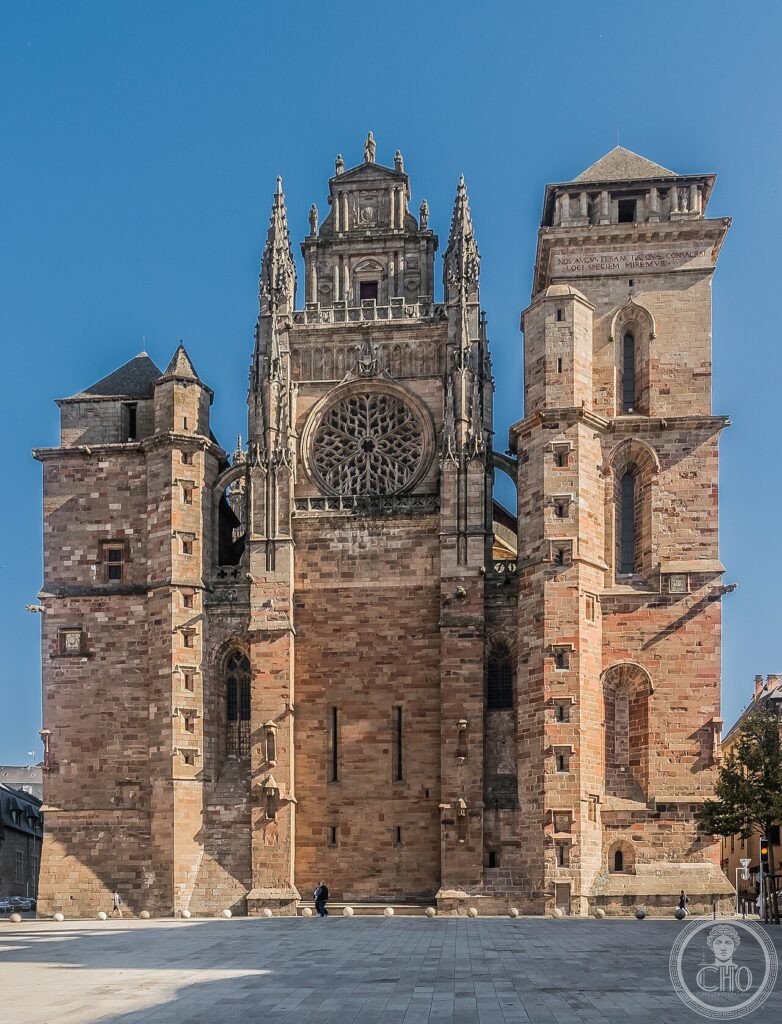
Interamente costruita in grès rosa, la cattedrale di Rodez ha una facciata occidentale che sembra ancora una fortezza — perché un tempo faceva davvero parte delle mura della città. Tra il 1513 e il 1526, l’architetto Antoine Salvanh vi aggiunse un campanile di 87 metri, lavorato come un merletto di pietra.
At a glance
Rodez Cathedral (Cathédrale Notre-Dame) began construction in 1277 and was only completed in the 16th century, its roughly three centuries of building producing one of the most imposing Gothic cathedrals in southern France. The entire building is constructed in pink sandstone (grès rose), giving it a distinctive warm colouring quite different from the pale limestone typical of many northern French cathedrals, and its west facade has a genuinely fortress-like character — a direct consequence of the facade having once formed part of the city’s actual defensive ramparts, rather than a purely decorative architectural choice evoking fortification. The cathedral’s crowning architectural achievement is its bell tower, the work of architect Antoine Salvanh, built between 1513 and 1526 at the commission of Bishop François d’Estaing: rising 87 metres, the tower transitions from a square base to an octagonal upper section, worked with such delicate stone tracery — interlacing statues of saints, gargoyles, and pinnacles — that it is frequently described as resembling stone lace.
Key facts
- Construction: begun 1277, completed 16th century — roughly three centuries of building
- Material: entirely pink sandstone (grès rose), giving the cathedral a distinctive warm colouring among southern French Gothic cathedrals
- West facade: fortress-like in character because it once formed part of Rodez’s actual city ramparts, not merely a stylistic evocation of fortification
- Bell tower: by architect Antoine Salvanh, built 1513-1526 for Bishop François d’Estaing; 87 metres tall, transitioning from square base to octagonal upper section, richly carved with interlaced statues, gargoyles, and pinnacles
- Tower access: exclusive tower visits are suspended in 2026 due to ongoing cathedral restoration work; check current status before planning a visit around this feature
History
Rodez’s roughly three-century cathedral construction, from 1277 through completion in the 16th century, situates the building within the broader pattern of major French Gothic cathedral projects whose scale and ambition routinely outlasted any single bishop’s tenure or any single sustained building campaign, requiring successive generations of patrons and builders to carry the work forward according to their own period’s resources and priorities. The cathedral’s specifically fortress-like west facade — genuinely integrated into Rodez’s defensive city walls rather than merely echoing fortified architecture for symbolic effect — reflects the practical military and political realities of building a major ecclesiastical structure in a period and region where urban defensive considerations remained genuinely pressing, giving the cathedral’s exterior a dual religious and defensive function unusual among French cathedrals more generally.
Bishop François d’Estaing’s early-16th-century commission of Antoine Salvanh’s bell tower represents the cathedral’s culminating architectural statement, arriving near the end of the building’s long construction history and applying the full decorative sophistication of late Gothic (Flamboyant-adjacent) stone-carving technique to a structure whose earlier phases, particularly the fortress-like facade, had been driven more by defensive necessity than pure decorative ambition. The tower’s transition from a solid square base to an intricately worked octagonal upper section, and its extensive sculptural programme of saints, gargoyles, and pinnacles, exemplifies the kind of late medieval and early Renaissance architectural virtuosity that major cathedral bell towers across France increasingly displayed as building techniques and patron ambitions both matured across the following century.
What you see
The pink sandstone construction gives the entire cathedral a distinctive warm colouring immediately apparent from any approach, setting it visually apart from the pale limestone of many comparably scaled French Gothic cathedrals. The west facade’s genuinely fortress-like massing, a direct legacy of its former integration into the city ramparts, rewards attention for what it reveals about the building’s dual religious and defensive origins. The 87-metre bell tower, when accessible, offers panoramic views over Rodez and the surrounding Aveyron countryside, while its stone tracery — interlaced saints, gargoyles, and pinnacles across the transition from square to octagonal form — represents one of the finest examples of this kind of late Gothic decorative bell tower work in southern France.
Practical information
- Opening hours: Monday-Friday 8:00-12:00 and 13:30-18:30; Saturday-Sunday 8:00-12:00 and 13:30-17:30 (subject to Vigipirate security plan adjustments)
- Admission: free
- Access: north portal via Rue Frayssinous (stairs) or south portal via Place Adrien Rozier (stairs and accessible ramp)
- Bell tower: exclusive tower tours suspended in 2026 due to restoration works — check current status
Getting there
Rodez has direct rail connections from Toulouse (approximately 2 hours) and its own regional airport (Rodez-Aveyron). By car, Rodez is reached via the A75 and A20 motorway network. The cathedral stands in the historic centre on Place Emma Calvé. GPS: 44.3508° N, 2.5741° E.
Nearby
- Musée Soulages — in Rodez; a major museum dedicated to the abstract painter Pierre Soulages, born in Rodez
- Rodez historic centre — surrounding the cathedral; well-preserved medieval and Renaissance streets
- Conques — approximately 40 minutes by car; a UNESCO World Heritage Camino de Santiago abbey village with a celebrated Romanesque tympanum
Sources
- Cathédrale de Rodez — official visitor portal (cathedrale-de-rodez.com)
- Office de tourisme Rodez Agglomération — official visitor information (rodez-tourisme.fr)
- Tourisme Aveyron — regional visitor information (tourisme-aveyron.com)
- Wikipedia — “Cathédrale Notre-Dame de Rodez” (fr.wikipedia.org)
Find it on the map
See this place and what’s around it →📷 Become a Cultural Heritage Online photographer
Share your photos of places: they stay published under your name as the author. The more they're seen, the more you get noticed — and soon a contest will reward the most appreciated photos.
Log in or sign up free to add a photoIs this page about you?
This page is read by travellers and heritage enthusiasts who find it on Google. Tell us how you are connected to this place and we will take it from there.