
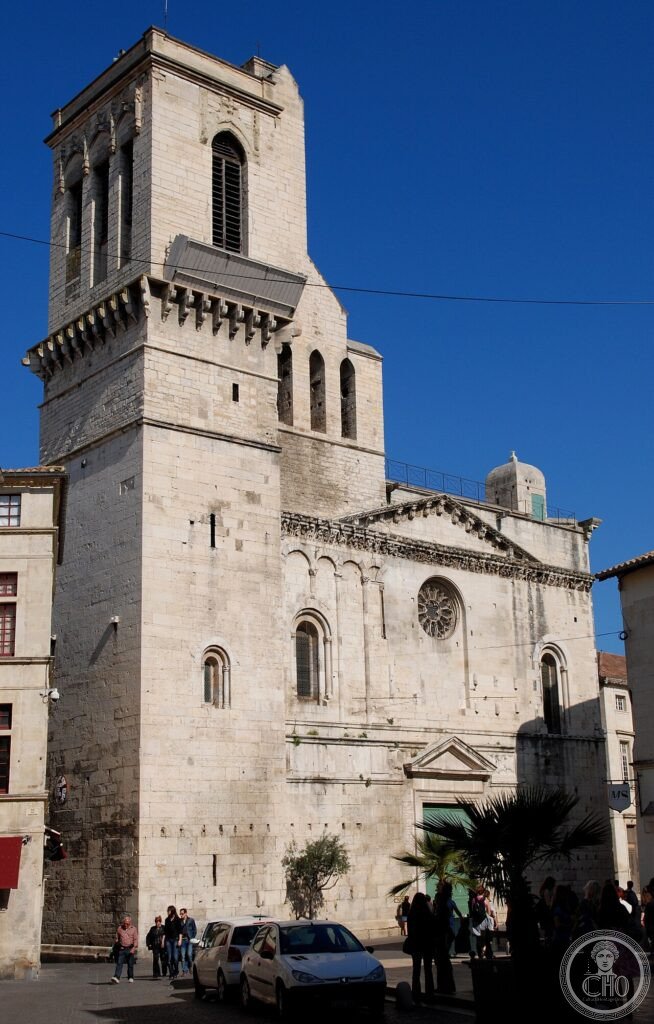
Adamo ed Eva, Caino e Abele: sulla facciata, sette formelle dell’XI-XII secolo raccontano la Genesi con figure inclinate apposta per essere lette da terra. Nel 1567 e nel 1621, i riformati danneggiarono gravemente la cattedrale durante le guerre di religione — parte della frise fu poi ricostruita nel Seicento.
At a glance
Nîmes Cathedral (Cathédrale Notre-Dame-et-Saint-Castor) was consecrated in 1096 by Pope Urban II, built on a site with earlier structures including Roman-period remains, though construction work certainly continued into the 12th century. The facade is rhythmically articulated with Lombard arcading and a triangular “antique-style” pediment typical of Provençal Romanesque art, and shelters, on its left portion, a bas-relief frieze narrating scenes from the Old Testament — the cathedral’s most celebrated surviving decorative element. Of the frieze’s original sequence, the first seven panels survive, carved with figures deliberately shown at an inclined angle so the scenes would read more clearly when viewed from ground level, depicting biblical figures including Adam and Eve and Cain and Abel arranged in zigzagging, flexed poses. Part of the frieze dates to 1170-1190, while another section was rebuilt in the 17th century following severe damage inflicted during the French Wars of Religion, when Reformed (Huguenot) forces seriously damaged the cathedral on two separate occasions, in 1567 and again in 1621.
Key facts
- Consecration: 1096, by Pope Urban II, on a site including earlier Roman-period structures; construction continued into the 12th century
- Facade: Lombard arcading and an antique-style triangular pediment, typical of Provençal Romanesque architecture
- Romanesque frieze: seven surviving bas-relief panels depicting Old Testament scenes (Adam and Eve, Cain and Abel among them), figures deliberately inclined for ground-level legibility; original portion dated 1170-1190
- Wars of Religion damage: the cathedral was seriously damaged twice by Reformed (Huguenot) forces, in 1567 and 1621; part of the frieze was rebuilt in the 17th century after this destruction
- Stylistic layering: the building combines Romanesque, Gothic, Baroque, and later historicist elements across its long construction and restoration history
History
Nîmes’s cathedral occupies ground with a documented Roman-period building presence predating the Christian structure, consistent with the city’s status as a major Roman settlement (Nemausus) whose surviving Roman monuments — the Maison Carrée temple and the Arènes amphitheatre among them — still define much of the historic centre today; the Romanesque cathedral consecrated in 1096 thus represents one layer within a much longer sequence of monumental building on the same urban ground. The Romanesque frieze’s specific design — figures carved at an inclined angle to remain legible from the street below — reflects a practical sculptural solution common to elevated architectural relief carving of the period, where a straightforwardly frontal composition would foreshorten unreadably when viewed from a significant vertical distance below.
The two documented attacks on the cathedral during the Wars of Religion, in 1567 and 1621, place Nîmes within the broader pattern of severe religious violence that struck French cities with significant Protestant populations during this conflict — Nîmes itself had a substantial and historically significant Huguenot community, and the cathedral, as the most prominent physical symbol of Catholic institutional authority in the city, became a repeated target for iconoclastic and destructive action during periods of open conflict between Catholic and Reformed factions. The subsequent 17th-century reconstruction of part of the damaged frieze, rather than simply leaving the destruction visible or replacing the damaged sections with entirely different decorative work, reflects a deliberate choice to restore the frieze’s original narrative and visual coherence as closely as contemporary craftsmen could manage — meaning the frieze visitors see today combines genuine 12th-century Romanesque carving with careful 17th-century restoration work executed specifically to match it.
What you see
The facade’s Romanesque frieze is the cathedral’s essential single artwork, its seven surviving Old Testament panels rewarding close attention both for their biblical narrative content and for the specific carving technique — inclined figures designed for street-level viewing — that distinguishes this kind of elevated architectural relief from more straightforwardly frontal sculptural programmes. The Lombard arcading and antique-style pediment across the wider facade situate the frieze within a broader Provençal Romanesque architectural vocabulary shared with several other churches across the region. Inside, the building’s combination of Romanesque, Gothic, and Baroque elements, the product of centuries of damage, rebuilding, and restoration, gives a layered architectural history distinct from cathedrals built more uniformly within a single stylistic period.
Practical information
- Opening hours: open year-round, free admission
- Address: Place aux Herbes, 30000 Nîmes
- Contact: 04 66 21 42 20
Getting there
Nîmes has direct TGV rail connections from Paris (approximately 3 hours) and Montpellier (approximately 30 minutes). From Nîmes station, the cathedral is approximately a 15-minute walk through the historic centre, or reachable via the local Tango bus network. By car, Nîmes sits on the A9 motorway. GPS: 43.8383° N, 4.3604° E.
Nearby
- Maison Carrée — in Nîmes’s centre, a short walk from the cathedral; an exceptionally well-preserved Roman temple, one of the best-preserved anywhere in the former Roman Empire
- Arènes de Nîmes — in the city centre; a Roman amphitheatre still used for events, among the best-preserved of its kind
- Pont du Gard — approximately 25 minutes by car; the UNESCO-listed Roman aqueduct bridge
Sources
- Cathédrale Nîmes — official visitor and restoration portal (cathedrale-nimes.fr)
- Tourisme Gard — regional visitor information (tourismegard.com)
- INRAP — “La frise de la cathédrale de Nîmes (Gard): nouvelles recherches sur un monument majeur de l’art roman” (inrap.fr)
- Wikipedia — “Cathédrale Notre-Dame-et-Saint-Castor de Nîmes” (fr.wikipedia.org)
Find it on the map
See this place and what’s around it →📷 Become a Cultural Heritage Online photographer
Share your photos of places: they stay published under your name as the author. The more they're seen, the more you get noticed — and soon a contest will reward the most appreciated photos.
Log in or sign up free to add a photoIs this page about you?
This page is read by travellers and heritage enthusiasts who find it on Google. Tell us how you are connected to this place and we will take it from there.