
Per generazioni gli storici dell’arte lo conobbero solo come il “Maestro di Moulins”, un enigma pittorico di altissimo livello. Solo di recente il suo trittico del 1498, commissionato dal duca Pietro II di Borbone, è stato attribuito con certezza a Jean Hey — un olio su tavola di rovere arrivato intatto fino a oggi.
At a glance
Moulins Cathedral (Cathédrale Notre-Dame-de-l’Annonciation) developed across several centuries from the 15th to the 19th, its Flamboyant Gothic choir dating to the original medieval collegiate church later elevated to cathedral status, with a substantial 19th-century Neo-Gothic nave extension completing the building in its present form. The cathedral’s principal artistic treasure is the Triptych of the Master of Moulins, an oil-on-oak-panel masterpiece dated 1498 and commissioned by Pierre II, Duke of Bourbon, and his wife Anne of France (Anne de Beaujeu), depicting the ducal couple and their daughter Suzanne of Bourbon presented by their patron saints before the Virgin and Christ Child. For centuries the identity of its painter remained unknown, referred to purely by the workname “Master of Moulins,” until archival research established the artist’s identity with certainty as Jean Hey — a rare case of a major anonymous Old Master eventually being conclusively named. The triptych survives in exceptional condition, without significant deterioration across more than five centuries, and is presented as a work at the meeting point of Flemish artistic influence and the emerging Italian Renaissance in France.
Key facts
- Construction: Flamboyant Gothic choir from the medieval collegiate church; substantial Neo-Gothic nave extension added in the 19th century
- Triptych of the Master of Moulins: dated 1498, oil on oak panels, commissioned by Duke Pierre II of Bourbon and Anne of France; depicts the ducal family with their patron saints before the Virgin and Christ Child
- Attribution: the painter, long known only as the “Master of Moulins,” has now been identified with certainty as Jean Hey through archival research
- Condition: the triptych survives essentially without deterioration across more than 500 years, a notable rarity for a work of this age and medium
- Current display: the original triptych is on loan to the Louvre Museum until 31 August 2026, after which it moves to the Royal Monastery of Brou in Bourg-en-Bresse from October 2026; a facsimile is displayed in the cathedral’s choir chapel during this period
History
Moulins’s cathedral began as the collegiate church of the Dukes of Bourbon, one of medieval and early modern France’s most powerful noble houses, whose patronage across the 15th century — including Duke Pierre II and Anne of France’s commission of the great triptych in 1498 — reflects the considerable wealth and artistic ambition the Bourbon dukes brought to their capital at Moulins during this period. Anne of France, herself a formidable political figure who had served as regent of France during her brother Charles VIII’s minority, and her husband Pierre II commissioned the triptych specifically to include their own portraits and that of their daughter Suzanne alongside the sacred central scene — a deliberate act of dynastic self-representation typical of major aristocratic religious commissions of the period, using the language of pious donor portraiture to assert the family’s status and piety simultaneously.
The triptych’s painter remained a genuine art-historical mystery for centuries after its creation, known to scholars purely through the workname “Master of Moulins” derived from this single major surviving commission, a situation not unusual for late medieval and early Renaissance painters whose documentary trail was often thin relative to the survival of their actual work; the eventual identification of the artist as Jean Hey through careful archival research represents a genuine art-historical achievement, resolving one of French Renaissance painting’s more significant attribution puzzles and allowing the artist’s other documented or attributed work to be understood as part of a coherent, named career rather than an anonymous corpus. The building’s own architectural completion, with a substantial 19th-century Neo-Gothic nave extension added to the earlier Flamboyant Gothic choir, reflects the broader 19th-century pattern of French cathedral-building projects finally completing medieval-era churches left structurally unfinished for centuries.
What you see
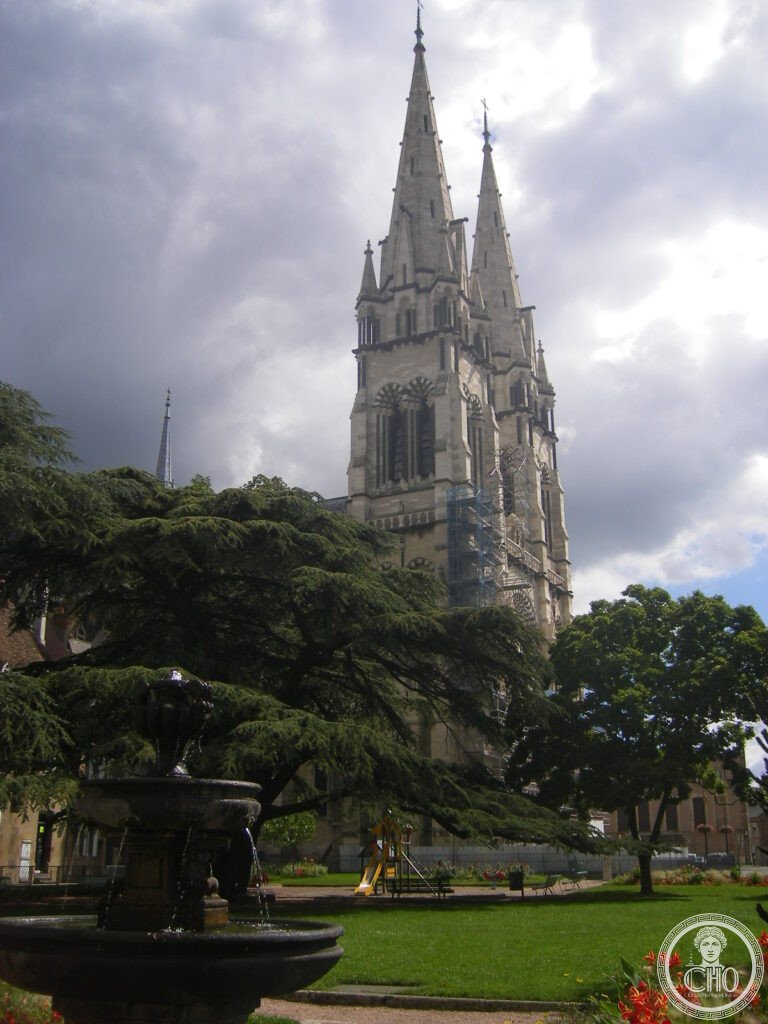
The Flamboyant Gothic choir, the building’s oldest surviving element, gives a direct sense of the original medieval collegiate church’s ambition, while the 19th-century Neo-Gothic nave extension, though a much later addition, was executed with careful attention to stylistic continuity with the earlier structure. The triptych chapel, currently displaying a facsimile of the Master of Moulins’s 1498 masterpiece while the original tours the Louvre and, later, the Royal Monastery of Brou, remains the essential destination for visitors specifically interested in the cathedral’s signature artwork, alongside the building’s further stained glass — including a notable window depicting Godefroy de Bouillon and the Crown of Thorns relic, c. 1540-1550 — and its historic organ.
Practical information
- Opening hours: daily, year-round, 9:00-18:00; no visits during services
- Triptych facsimile: displayed in a choir chapel during the original’s loan period (through 2026); tickets/reservations via the Espace patrimoine, the Moulins tourist office, or moulins-tourisme.com
- Address: Place de la Déportation, 03000 Moulins
Getting there
Moulins is reachable by train from Paris Gare de Bercy (approximately 2-2.5 hours) and from Clermont-Ferrand (approximately 1 hour). From Moulins-sur-Allier station, the cathedral is approximately 15-20 minutes’ walk, or reachable by the local Aléo bus network. The nearest airport is Clermont-Ferrand Auvergne, approximately 90 km south. GPS: 46.5668° N, 3.3318° E.
Nearby
- Mal Coiffée tower — near the cathedral; the surviving keep of the former ducal château of the Bourbons
- Centre National du Costume de Scène — in Moulins; a major national costume and stage design museum
- Souvigny Priory — approximately 15 minutes by car; a significant Cluniac priory church and Bourbon dynastic necropolis
Sources
- Diocèse de Moulins — “La cathédrale de Moulins” (catholique-moulins.fr)
- Moulins Tourisme — official visitor portal and triptych information (moulins-tourisme.com)
- Ministère de la Culture — “Le triptyque de Moulins, histoire de sa restauration” (culture.gouv.fr)
- Wikipedia — “Triptyque du Maître de Moulins” (fr.wikipedia.org)
Find it on the map
See this place and what’s around it →📷 Become a Cultural Heritage Online photographer
Share your photos of places: they stay published under your name as the author. The more they're seen, the more you get noticed — and soon a contest will reward the most appreciated photos.
Log in or sign up free to add a photoIs this page about you?
This page is read by travellers and heritage enthusiasts who find it on Google. Tell us how you are connected to this place and we will take it from there.