
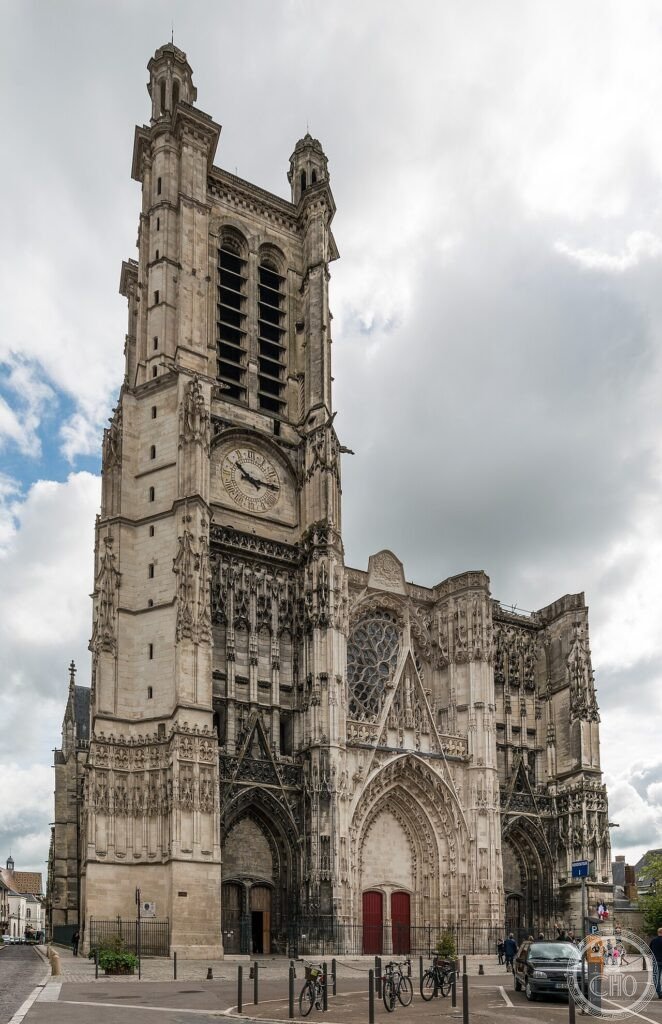
Oltre quattro secoli separano la prima pietra dell’abside, nel 1198, dal completamento della navata: abbastanza tempo perché la stessa cattedrale attraversasse tre fasi del gotico — puro, raggiante, fiammeggiante — leggibili ancora oggi nella sua facciata, opera del maestro Martin Chambiges.
At a glance
Troyes Cathedral (Cathédrale Saint-Pierre-et-Saint-Paul) traces its origins to an earlier church built by Saint Loup in the 5th century, destroyed by Norman raiders in 890 and rebuilt in Romanesque style at the end of the 10th century, before a fire in 1188 damaged that structure badly enough to prompt an entirely new Gothic building, begun in 1198 under bishops Garnier de Trainel and Hervée, starting with the apse chapels. Construction continued for more than four centuries, giving the cathedral a rare architectural completeness across the full evolution of French Gothic style — pure, Rayonnant, and Flamboyant — most visibly in its west facade, whose three Flamboyant portals are the work of the celebrated 16th-century Parisian master mason Martin Chambiges. The cathedral’s stained glass, some 1,500 square metres in total, ranks among the most extensive and significant collections in France, with 13th-century choir windows placed by specialists alongside Chartres and Bourges as one of the three most important surviving mid-13th-century glass ensembles anywhere.
Key facts
- Origins: earlier church built by Saint Loup, 5th century; destroyed 890 by Norman raiders; rebuilt Romanesque late 10th century under Bishop Milon; badly damaged by fire in 1188.
- Gothic rebuilding: begun 1198 under bishops Garnier de Trainel and Hervée, starting with the apse chapels; construction continued more than four centuries.
- West facade: three Flamboyant Gothic portals by Martin Chambiges, celebrated 16th-century Parisian master mason also associated with Sens and Beauvais cathedrals.
- Stained glass: approximately 1,500 square metres, spanning 13th-century choir windows (ranked alongside Chartres and Bourges among the most significant surviving mid-13th-century glass ensembles in France) to 15th-16th-century nave windows.
- Stylistic range: the four-century-plus construction span means the building physically documents pure Gothic, Rayonnant, and Flamboyant Gothic phases within a single structure.
History
Troyes’s cathedral history reflects a pattern of destruction and rebuilding common to major French ecclesiastical sites across the early medieval period: the original 5th-century foundation attributed to Saint Loup fell to Norman raids in 890, part of the wider wave of Viking incursions that struck northern French religious institutions during this period, and the Romanesque rebuilding that followed under Bishop Milon at the close of the 10th century itself proved vulnerable to a further fire in 1188 serious enough to prompt bishops Garnier de Trainel and Hervée to commission an entirely new Gothic cathedral from 1198, beginning, as was common practice, with the liturgically most important apse chapels before working outward toward the nave and facade over the following centuries.
The building’s unusually long construction span — well over four hundred years from the first 1198 apse chapels to the eventual completion of later phases — means Troyes Cathedral offers a rare opportunity to trace the full stylistic evolution of French Gothic architecture within a single coherent building project rather than across separate structures built in different eras; the west facade’s three Flamboyant portals, executed by Martin Chambiges in the 16th century, represent the culmination of this long process, applying the final, most ornamentally elaborate phase of Gothic design to a building whose earlier apse and choir elements already embodied the style’s initial 1198-era form. Chambiges’s involvement connects Troyes directly to a small circle of master masons responsible for some of the most accomplished late Gothic facade work in France, including his documented work at Sens and Beauvais cathedrals during the same broad period.
What you see
The west facade’s three Flamboyant Gothic portals, by Martin Chambiges, present the building’s most visually elaborate single architectural statement, with the characteristic flame-like tracery patterns that give Flamboyant Gothic its name clearly legible across the portal surrounds and gables. Inside, the choir’s 13th-century stained glass — among the earliest and most significant surviving glass ensembles of its period in France — sits within a building whose nave windows, largely 15th and 16th century, allow a direct visual comparison of medieval and Renaissance-period glasswork approaches within the same structure. The cathedral’s overall stylistic range, moving from the earliest 1198 apse chapels through to the latest Flamboyant facade work, rewards a deliberate circuit of the building tracing this architectural evolution end to end.
Practical information
- Opening hours: 1 April-31 October, 9:30-12:30 and 14:00-18:00; 1 November-31 March, closes at 17:00; Sunday mornings reserved for services; open every day of the year including Christmas and Easter.
- Admission: free access and free self-guided visit; guided tours available year-round on request.
- Address: Place Saint-Pierre, 10000 Troyes.
Getting there
Troyes has direct train connections from Paris Gare de l’Est, taking approximately 1.5 hours, making it a practical day trip from the French capital. By car, Troyes sits on the A5 motorway, roughly 2 hours from Paris. The cathedral stands in the historic centre on Place Saint-Pierre, walkable from Troyes train station in approximately 15-20 minutes. GPS: 48.3004° N, 4.0814° E.
Nearby
- Troyes historic centre — immediately surrounding the cathedral; extensive half-timbered medieval streets, among the best preserved in France, with several further Gothic churches.
- Musée d’Art Moderne, Troyes — near the cathedral, in the former bishop’s palace; a significant collection including Fauvist and modern works.
- Champagne vineyard region — Troyes sits at the southern edge of the Champagne wine region, with vineyard touring routes accessible from the city.
Sources
- Cathédrale Saint-Pierre-et-Saint-Paul de Troyes — official visitor portal (cathedraledetroyes.com).
- Troyes Champagne Tourisme — official visitor information (troyeslachampagne.com).
- Ministère de la Culture — heritage listing (culture.gouv.fr).
- Wikipedia — “Troyes Cathedral” (en.wikipedia.org).
Find it on the map
See this place and what’s around it →📷 Become a Cultural Heritage Online photographer
Share your photos of places: they stay published under your name as the author. The more they're seen, the more you get noticed — and soon a contest will reward the most appreciated photos.
Log in or sign up free to add a photoIs this page about you?
This page is read by travellers and heritage enthusiasts who find it on Google. Tell us how you are connected to this place and we will take it from there.