
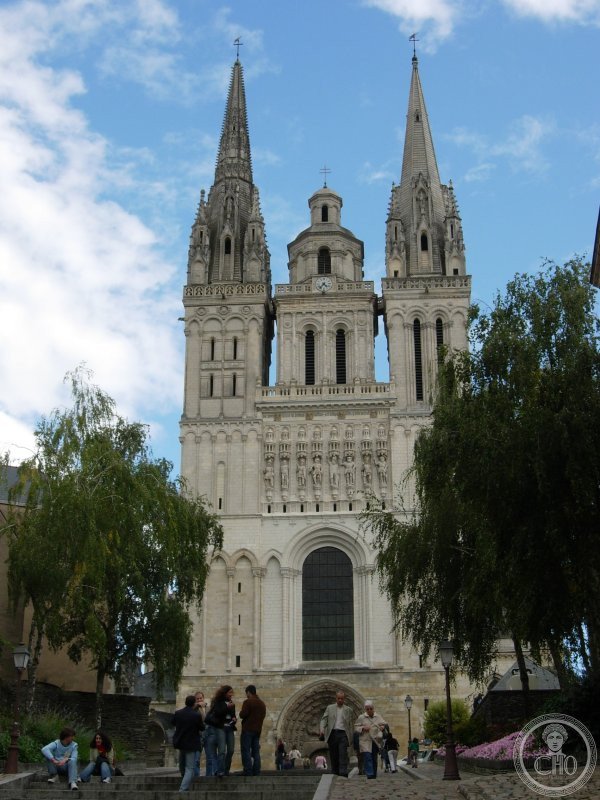
Under Bishop Normand de Doué, around 1150, three square-plan vaults twenty-five metres high were the first in Anjou to introduce the Gothic domed vault — the architectural experiment that would give its name to a whole style, Angevin Gothic, later spread through the Plantagenet domains on both sides of the Channel.
At a glance
Angers Cathedral (Cathédrale Saint-Maurice), standing on the rocky outcrop from which the city itself grew, occupies a site with religious use traceable to a church consecrated in 1025, though the structure visitors see today dates essentially to the 12th and 13th centuries, with the nave built between 1140 and 1160. Its principal claim to architectural significance is the introduction, under Bishop Normand de Doué (1149-1152), of the earliest domed vaults of Angevin Gothic architecture — three great square-bayed vaults rising 25 metres, characterised by a pronounced convex profile reinforced by eight ribs, a genuinely novel structural solution that gave the wider Plantagenet Gothic style, spread across Anjou and the cross-Channel domains of the Plantagenet dynasty, its name.
Key facts
- Earlier church: consecrated 1025 by Bishop Hubert de Vendôme; the lower walls of its nave survive incorporated into the present building
- Nave construction: 1140-1160; the pioneering domed Angevin vaults date from the episcopate of Normand de Doué, 1149-1152
- Angevin (Plantagenet) Gothic vaulting: a distinctive regional variant of Gothic architecture, marked by strongly convex (“domed”) vault profiles reinforced with eight ribs on a square bay plan — first fully realised here before spreading through Anjou and the wider Plantagenet realm
- Stained glass: a significant sequence spanning the 12th to 15th centuries, including rare surviving Romanesque-period windows, among the oldest stained glass in France
- Recent restoration: a contemporary gallery designed by architect Kengo Kuma and restoration of the west portal’s original polychromy have renewed public and scholarly attention to the building in recent years
History
Angers’s medieval cathedral occupies a hilltop site of long-standing religious significance, with the surviving lower nave walls of an earlier church consecrated in 1025 demonstrating physical continuity between the Romanesque-period building and the Gothic structure built over it across the 12th and 13th centuries. The defining moment in the building’s architectural history came under Bishop Normand de Doué in the years 1149-1152, when construction began on vaults that departed decisively from the flatter rib vaults typical of northern French Gothic architecture at the time, instead rising in a pronounced dome-like profile across square bays reinforced by eight ribs — an engineering solution distinctive enough that it gave its name to an entire regional architectural tradition, Angevin or Plantagenet Gothic, subsequently carried across the Plantagenet dynasty’s cross-Channel territories spanning Anjou, Normandy, and England during the same period the dynasty ruled both.
The cathedral’s stained glass, spanning from rare surviving 12th-century Romanesque-period windows through Gothic and into 15th-century work, represents an unusually continuous record of French glasswork across several centuries within a single building, a rarity given how much medieval glass elsewhere in France was lost to later remodelling, revolutionary-era destruction, or 20th-century war damage. In recent years, the cathedral has undergone renewed public attention through the restoration of its west portal’s original medieval polychromy — revealing that the facade’s sculpture was originally painted in vivid colour, as was standard medieval practice though rarely visible today — and the addition of a contemporary visitor gallery designed by the internationally recognised Japanese architect Kengo Kuma, a deliberate juxtaposition of contemporary design with the medieval structure.
What you see
The nave’s three great domed vaults, the building’s principal architectural distinction, rise 25 metres above the floor in the convex, eight-ribbed profile that defines Angevin Gothic — a striking visual departure from the flatter vault profiles typical of contemporary Gothic architecture further north and east in France. The west facade’s sculpted portal, recently restored to reveal traces of its original medieval polychromy, gives visitors a rare sense of how vividly coloured Gothic church facades originally appeared, in contrast to the bare stone most surviving medieval sculpture presents today. Inside, the stained-glass sequence — from 12th-century Romanesque-period windows through later Gothic and Renaissance-period glass — rewards a slow circuit of the nave and transepts, including the rose window in the south transept.
Practical information
- Opening hours: daily, 9:00-19:00, free admission (access suspended during services)
- Guided tours: Saturdays 15:00-18:00; daily 15:00-18:30 in July and August
- Time needed: around 1 hour for a relaxed visit
- Address: 4 rue Saint-Christophe, at the top of the Escalier Saint-Maurice, 49100 Angers
Getting there
Angers has direct TGV rail connections from Paris (approximately 1.5 hours) and Nantes (approximately 30-40 minutes). From Angers-Saint-Laud station, the cathedral is roughly a 13-minute walk, or reachable by tram/bus line 2 to the Sainte-Croix stop. The Ralliement car park, 300 metres from the cathedral, offers the first hour free. GPS: 47.4706° N, -0.5549° E.
Nearby
- Château d’Angers — a short walk from the cathedral; the fortified castle housing the Apocalypse Tapestry, the largest surviving medieval tapestry cycle in the world
- Galerie David d’Angers — in the former Toussaint abbey church, near the cathedral; a museum of sculpture by the Angers-born Neoclassical sculptor David d’Angers
- Loire Valley châteaux — Angers sits at the western edge of the Loire Valley château region, with Saumur roughly 45 minutes away by car
Sources
- Destination Angers — official tourism portal, cathedral visitor information and Kengo Kuma gallery feature (destination-angers.com)
- Ville d’Angers — “Laissez-vous conter la cathédrale Saint-Maurice” (angers.fr)
- Diocèse d’Angers — parish visitor information (diocese49.org)
- Wikipedia — “Cathédrale Saint-Maurice d’Angers” (fr.wikipedia.org)
Find it on the map
See this place and what’s around it →📷 Become a Cultural Heritage Online photographer
Share your photos of places: they stay published under your name as the author. The more they're seen, the more you get noticed — and soon a contest will reward the most appreciated photos.
Log in or sign up free to add a photoIs this page about you?
This page is read by travellers and heritage enthusiasts who find it on Google. Tell us how you are connected to this place and we will take it from there.