
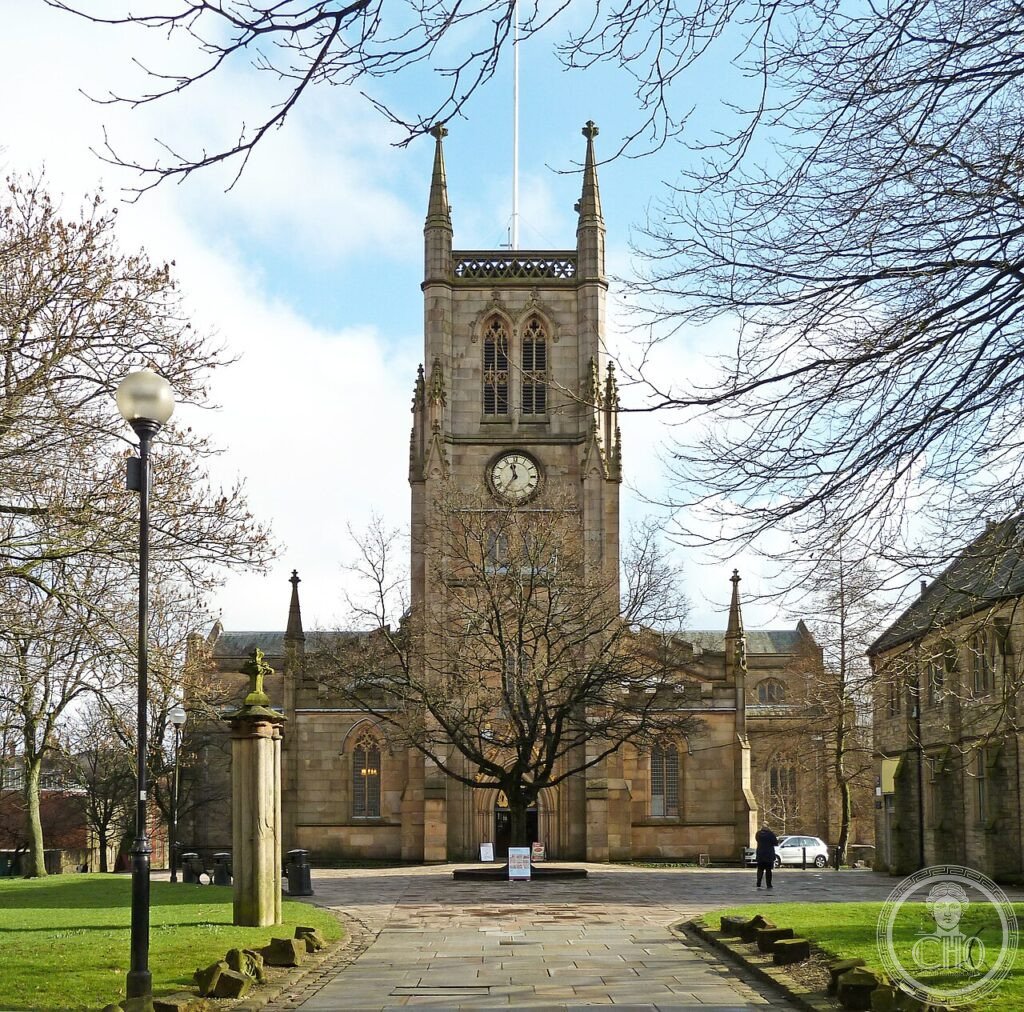
Blackburn Cathedral: A Georgian Parish Church Crowned by a Concrete Lantern Tower
Behind a Gothic Revival shell rebuilt in the 1820s, Blackburn Cathedral hides a defiantly modern heart: an octagonal reinforced-concrete lantern, finished only in 1977, that took four decades and a world war to complete.
At a glance
Blackburn Cathedral, formally the Cathedral Church of Saint Mary the Virgin with Saint Paul, stands on a site of Christian worship that local tradition traces back to 596, though the earliest confirmed structure is a Norman stone church uncovered during 19th-century rebuilding work. The building seen today is largely the work of architect John Palmer, who reconstructed the medieval parish church in Gothic Revival style between 1820 and 1826. Its status changed dramatically in 1926, when the creation of the Diocese of Blackburn elevated the parish church to cathedral rank. What follows is one of English cathedral architecture’s more unusual stories: a 20th-century extension scheme interrupted by war, resumed decades later, and completed only in 1977 with a strikingly modern octagonal lantern tower that now defines the building’s skyline.
Key facts
- Diocese: Diocese of Blackburn, created 1926, Province of York
- Original rebuild: 1820–1826, architect John Palmer, Gothic Revival, on the site of an earlier medieval and Norman church
- Extension architects: William Adam Forsyth (scheme approved 1933); Laurence King, appointed 1961 to complete the work economically
- Lantern tower: octagonal reinforced-concrete structure with aluminium flèche, built 1962–1967
- Listing: Grade II* listed building, designated 28 November 1951
- Notable art: sculptures by John Hayward (corona, seraphim, Christ the Worker); a surviving Burne-Jones stained glass window; “The Healing of The Nations” by Mark Jalland (2001)
- Cathedral Court: completed 2016, the first new ecclesiastical cloister built in the UK since the 16th century
History
The site’s Christian history is old enough that its earliest chapter rests on tradition rather than record: local claims place a foundation as far back as 596, though the first solid archaeological evidence is a Norman stone church, fragments of which came to light when the medieval building was pulled down and rebuilt in the early 19th century. That rebuilding, carried out by architect John Palmer between 1820 and 1826, gave Blackburn the Gothic Revival parish church that still forms the core of today’s cathedral.
Everything changed in 1926, when a new Diocese of Blackburn was carved out and the parish church was raised to cathedral status. A parish church, however handsome, was not built to cathedral scale, and in 1933 an ambitious extension scheme by architect William Adam Forsyth was approved to remedy this. A foundation stone for the new work was laid in 1938, but construction stalled just three years later as wartime shortages of materials and labour brought the project to a halt, leaving Blackburn with an unfinished cathedral for two decades.
Work resumed only in 1961, when Laurence King was appointed to complete the building on a more modest budget than Forsyth’s original design allowed. Between 1962 and 1967, King’s team raised the octagonal reinforced-concrete lantern tower, topped by an aluminium flèche, that gives the cathedral its distinctive silhouette today. Construction was finally declared complete in 1977, and the cathedral was consecrated on 18 November that year — closing a project that had, in total, spanned more than four decades from first stone to final ceremony.
What you see
The building reads, quite literally, as two eras in conversation. Palmer’s early 19th-century Gothic Revival nave and tower anchor the west end in a familiar Georgian-Gothic idiom, while King’s mid-20th-century lantern tower rises over the crossing in bare reinforced concrete, an unapologetically modern form that most Victorian or medieval English cathedrals simply do not have. The interior was deliberately kept bright and uncluttered when the extension was completed, with most of the older memorial monuments removed to let the new spaces breathe.
Look for John Hayward’s sculptural work scattered through the building — a corona, seraphim figures, and a striking Christ the Worker — alongside one of the few stained glass windows by Edward Burne-Jones to survive the building’s several transformations. The 2001 sculpture “The Healing of The Nations” by Mark Jalland adds a contemporary devotional note, and Cathedral Court, completed in 2016 to the east of the main building, added the first newly built ecclesiastical cloister in the UK since the 16th century, along with clergy residences, a library, and a refectory.
Practical information
- Opening hours: Tuesday to Saturday, approximately 8:15am to 5:30pm; Sunday 8:15am to 5pm; Monday access via the side door for morning and evening prayer
- Admission: free, open every day of the year
- Time needed: 30–45 minutes for the nave and lantern tower; longer for a choral service
Getting there
Blackburn Cathedral stands in the town centre at Cathedral Close, a short walk from Blackburn railway station, which has regular services from Manchester, Preston, and Bolton. By road, the town sits just off the M65, with the M6 accessible via the M65’s western end. GPS: 53.7473° N, 2.4814° W.
Nearby
- Turton Tower — a Grade I listed manor house a few miles south of Blackburn, built up from a 15th-century stone pele tower with later timber-framed and Victorian additions
- Hoghton Tower — a fortified hilltop manor house midway between Blackburn and Preston, built in the 1560s and twice restored in the Victorian era
- Whalley Abbey — the ruined remains of a Cistercian abbey east of Blackburn, suppressed in the 16th century; tradition holds that stonework from the abbey was reused at Hoghton Tower
Sources
Find it on the map
See this place and what’s around it →📷 Diventa un fotografo di Cultural Heritage Online
Condividi le tue foto dei luoghi: restano pubblicate con la tua firma come autore. Più vengono viste, più ti fai conoscere — e presto un concorso premierà le foto più apprezzate.
Accedi o registrati gratis per aggiungere una fotoDo you manage this place?
This page is read by travellers and heritage enthusiasts who find it on Google. Keep it accurate — and make it work for you. Free for non-profit heritage institutions.