
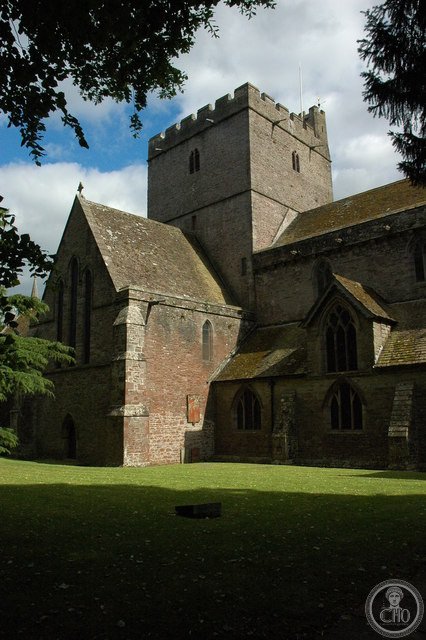
Cattedrale di Brecon (1093): il priorato normanno diventato cattedrale solo nel 1923
Il cimitero circolare tradisce un’origine celtica precedente ai normanni: qui Bernard de Neufmarché fondò una chiesa dopo la conquista di Brycheiniog, diventata priorato benedettino e infine, otto secoli dopo, cattedrale.
At a glance
Brecon Cathedral stands within the only walled cathedral close in Wales, on a site whose round churchyard boundary suggests an earlier Celtic church predating the Normans. The documented history begins in 1093, when Bernard de Neufmarché, the Norman knight who conquered the kingdom of Brycheiniog, ordered a new church dedicated to Saint John the Evangelist built here; a Benedictine priory soon followed, founded by Roger, a monk from Battle Abbey. The church was rebuilt and enlarged in the Gothic style around 1215, during the reign of King John, and its roofed hall dates from between 1237 and 1267. For most of its history the building served as Brecon’s parish church, known locally as the Church of the Holy Rood for a golden rood relic that drew pilgrims; it only became a cathedral in 1923, on the creation of the Diocese of Swansea and Brecon following the disestablishment of the Church in Wales in 1920.
Key facts
- Founded in 1093 by Bernard de Neufmarché, the Norman conqueror of Brycheiniog, as a church dedicated to Saint John the Evangelist.
- A Benedictine priory was established soon after by Roger, a monk from Battle Abbey.
- Rebuilt and extended in the Gothic style around 1215, during the reign of King John.
- The smoke-blackened roof of the hall dates from between 1237 and 1267.
- Became a cathedral only in 1923, with the creation of the Diocese of Swansea and Brecon.
- A Grade I listed building, designated on 16 January 1952.
- The circular shape of the churchyard is read by historians as evidence of an earlier pre-Norman Celtic church on the same site.
History
The round shape of Brecon Cathedral’s churchyard points to a Christian presence on this site before the Normans arrived — a pattern typical of early Celtic church enclosures in Wales. The documented history begins in 1093, when Bernard de Neufmarché, the Norman lord who had recently conquered the kingdom of Brycheiniog, ordered a church built here dedicated to Saint John the Evangelist, at a naturally defensible spot near the confluence of the Usk and Honddu rivers, close to the castle he also raised. A Benedictine priory was founded soon afterward, its first monks sent from Battle Abbey in Sussex under a monk named Roger.
The church was substantially rebuilt and enlarged in the Gothic style around 1215, during the reign of King John, and the surviving roofed hall of the priory buildings dates from this broader phase of construction, completed between 1237 and 1267. For centuries the building was known locally as the Church of the Holy Rood, after a golden rood — a cross bearing a figure of Christ — that made it a site of pilgrimage in its own right, quite apart from its role as a priory church.
Following the dissolution of the monasteries, the priory church became Brecon’s parish church, a role it held for nearly four centuries. Its status changed only in the 20th century: after the Church in Wales was disestablished from the Church of England in 1920, the new Diocese of Swansea and Brecon was created in 1923, and the old priory church was elevated to cathedral status. A restoration in the 1860s and a strengthening of the tower in 1914 mark its more recent structural history.
What you see
Brecon Cathedral preserves the layered character of a building that grew from Norman origins through Gothic rebuilding without ever being designed from scratch as a single grand cathedral — a modesty that sets it apart from cathedrals founded as such from the start. The early 13th-century Gothic nave and chancel, raised under King John, sit within a churchyard whose round outline hints at a Celtic past older than the Norman conquest of Brycheiniog itself.
The former priory hall, with its smoke-blackened medieval roof timbers dating from the mid-13th century, survives as a rare piece of monastic domestic architecture attached to the church, now used as part of the cathedral’s heritage centre. Ten bells hang in the tower, rung in the traditional full-circle English style, a living continuation of the cathedral’s centuries as a parish and pilgrimage church before its comparatively recent elevation to cathedral status in 1923.
Practical information
- Opening hours: daily, approximately 09:00–18:00.
- Admission: free entry.
- Time needed: 30–45 minutes, longer with the heritage exhibition.
- Address: Brecon Cathedral, Cathedral Close, Brecon, Powys, LD3 9DP.
Getting there
Brecon has no railway station of its own; the nearest is Abergavenny, about 20 miles away, from which bus services connect to Brecon, or Merthyr Tydfil to the south. Cardiff Airport lies roughly 40 miles to the southeast. By road, Brecon sits at the junction of the A40 and A470, on the edge of the Bannau Brycheiniog (Brecon Beacons) National Park; a pay-and-display car park sits next to the cathedral. GPS coordinates: 51.950949, -3.392229.
Nearby
- Brecon Castle — the Norman castle built by Bernard de Neufmarché at the same time as the cathedral, now partly incorporated into a hotel, a short walk from the cathedral close.
- Y Gaer Roman Fort — the remains of a Roman auxiliary fort just west of Brecon.
- Castell Bronllys — a 12th-century stone keep on an earlier motte, in the Brecon Beacons countryside northeast of the town.
Sources
- Wikipedia, “Brecon Cathedral”
- Brecon Cathedral, official visitor information (breconcathedral.org.uk)
Find it on the map
See this place and what’s around it →📷 Diventa un fotografo di Cultural Heritage Online
Condividi le tue foto dei luoghi: restano pubblicate con la tua firma come autore. Più vengono viste, più ti fai conoscere — e presto un concorso premierà le foto più apprezzate.
Accedi o registrati gratis per aggiungere una fotoDo you manage this place?
This page is read by travellers and heritage enthusiasts who find it on Google. Keep it accurate — and make it work for you. Free for non-profit heritage institutions.