
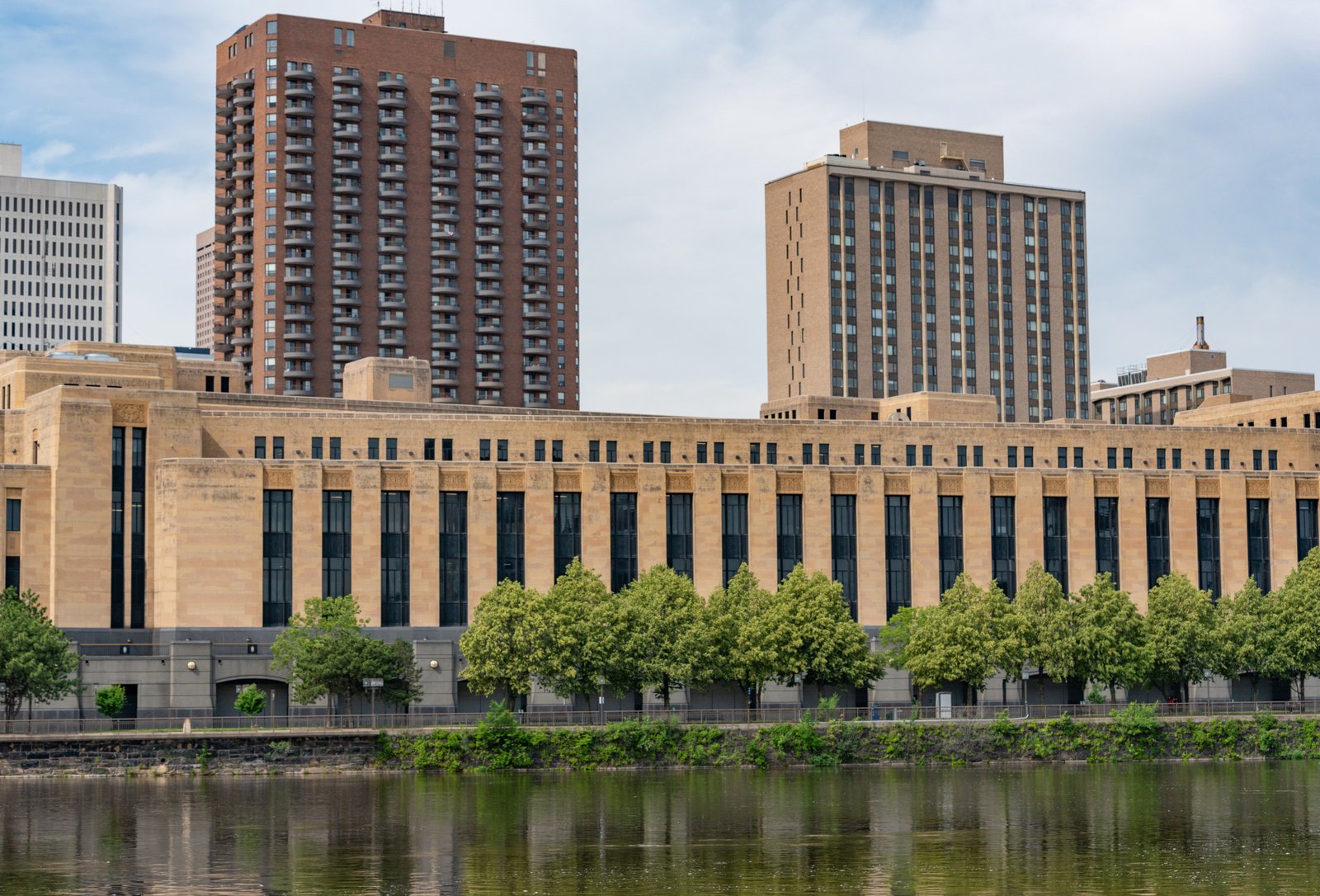
Five hundred and forty feet of PWA Moderne limestone along the Mississippi, with a 350-foot bronze chandelier that has hung at the center of it all since 1933.
At a glance
The Martin Olav Sabo Post Office stretches 540 feet along the west bank of the Mississippi River between the Hennepin Avenue and Third Avenue bridges. Built in the PWA Moderne Art Deco style and completed in 1933, it is one of the longest continuous Art Deco facades in the American Midwest. The architects were the Minneapolis firm Magney & Tusler, with Léon Eugène Arnal as chief designer — the same team behind the Foshay Tower downtown. The building remains a working post office and is publicly accessible during business hours, its original interior nearly untouched after ninety years of daily use.
Key facts
- Address: 100 South First Street, Minneapolis, MN 55401
- Style: PWA Moderne Art Deco
- Completed: 1933
- Architects: Magney & Tusler (chief designer: Léon Eugène Arnal)
- Construction cost: $4.5 million (approximately $64 million in 2006 USD)
- Main building length: 540 feet (165 m)
- Chandelier: 350 feet (107 m) long, 16 tons, bronze
- Renamed: 2023, in honor of Rep. Martin Olav Sabo (D-MN)
- Coordinates: 44.9833° N, 93.2650° W
History
Minneapolis has operated post offices since 1854, when the first facility opened on High Street on the Mississippi’s west bank, handling mail that arrived by stagecoach every ten to fourteen days from Fort Snelling. The present-day building replaced a predecessor on nearly the same site as part of the New Deal’s Public Works Administration, one of thousands of civic structures funded by the federal government between 1933 and 1939 to put construction workers back to work and leave durable civic monuments behind.
Léon Eugène Arnal, the chief designer for Magney & Tusler, brought PWA Moderne discipline to the commission: massive limestone volumes, restrained Art Deco ornament, and a 540-foot façade whose horizontal sweep mirrors the river itself. The firm had already built the Foshay Tower downtown — a vertical exclamation mark — and answered this commission with civic gravitas rather than theatrical height. The building was renamed in 2023 for Martin Olav Sabo, the Minnesota congressman who served eleven terms (1979–2007) and was instrumental in securing funding for Minneapolis infrastructure and transit.
What you see
From the river, the building reads as a disciplined band of pale limestone — continuous pilasters, restrained geometric ornament, and stone reliefs framing the main entry from First Street. The mass is monumental but not aggressive: PWA Moderne’s answer to the question of how a democratic government should present itself to its citizens. Inside, the public lobby is almost completely original. The bronze teller cages stand in their original positions; sandstone walls rise to the ceiling; and the 350-foot-long bronze chandelier — one of the longest light fixtures ever made — runs the full length of the lobby at head height, its weight suspended from above by a structure designed to both light and, improbably, regulate the lobby’s temperature.
The corridors contain peepholes installed in the 1930s so that inspectors could observe employees handling the mail, a detail that makes tangible the institutional seriousness with which the New Deal treated its public buildings. The three-room postmaster’s suite, paneled in walnut, still occupies its original position off the main hall.
Practical information
- Hours: Monday–Friday 7:30 am–6:00 pm, Saturday 8:00 am–1:00 pm.
- Access: Active post office; public lobby accessible during business hours. Arrive before 5 pm to see the chandelier in full operation.
- Photography: Interior photography permitted in the public lobby; no tripods.
- Time needed: 30–45 minutes to take in the exterior facade, lobby, and chandelier.
Getting there
The post office is at 100 South First Street on the west bank of the Mississippi, at the western end of the Hennepin Avenue Bridge. Metro Transit bus routes serve Hennepin Avenue through downtown Minneapolis. The building is a 15-minute walk from Nicollet Mall or Target Field Station. Street parking is limited; paid ramps are available one block north on Washington Avenue.
Nearby
- Stone Arch Bridge: the 1883 railway bridge now converted to a pedestrian and cycling path — 8-minute walk east across the river.
- Mill Ruins Park: excavated ruins of the 19th-century flour mills that made Minneapolis the world’s grain capital — 10-minute walk northeast in the Mill District.
- Guthrie Theater: acclaimed regional theater with a cantilevered “Endless Bridge” overlooking the river — 5-minute walk east along the riverbank.
Sources
- Minneapolis Post Office — Wikipedia: en.wikipedia.org
- Minnesota Historical Society — Magney & Tusler Architectural Records
- U.S. General Services Administration — Historic Buildings Portfolio
Find it on the map
See this place and what’s around it →Record researched and written by Luigi De Marchi for Cultural Heritage Online, 2026.
📷 Become a Cultural Heritage Online photographer
Share your photos of places: they stay published under your name as the author. The more they're seen, the more you get noticed — and soon a contest will reward the most appreciated photos.
Log in or sign up free to add a photoIs this page about you?
This page is read by travellers and heritage enthusiasts who find it on Google. Tell us how you are connected to this place and we will take it from there.