
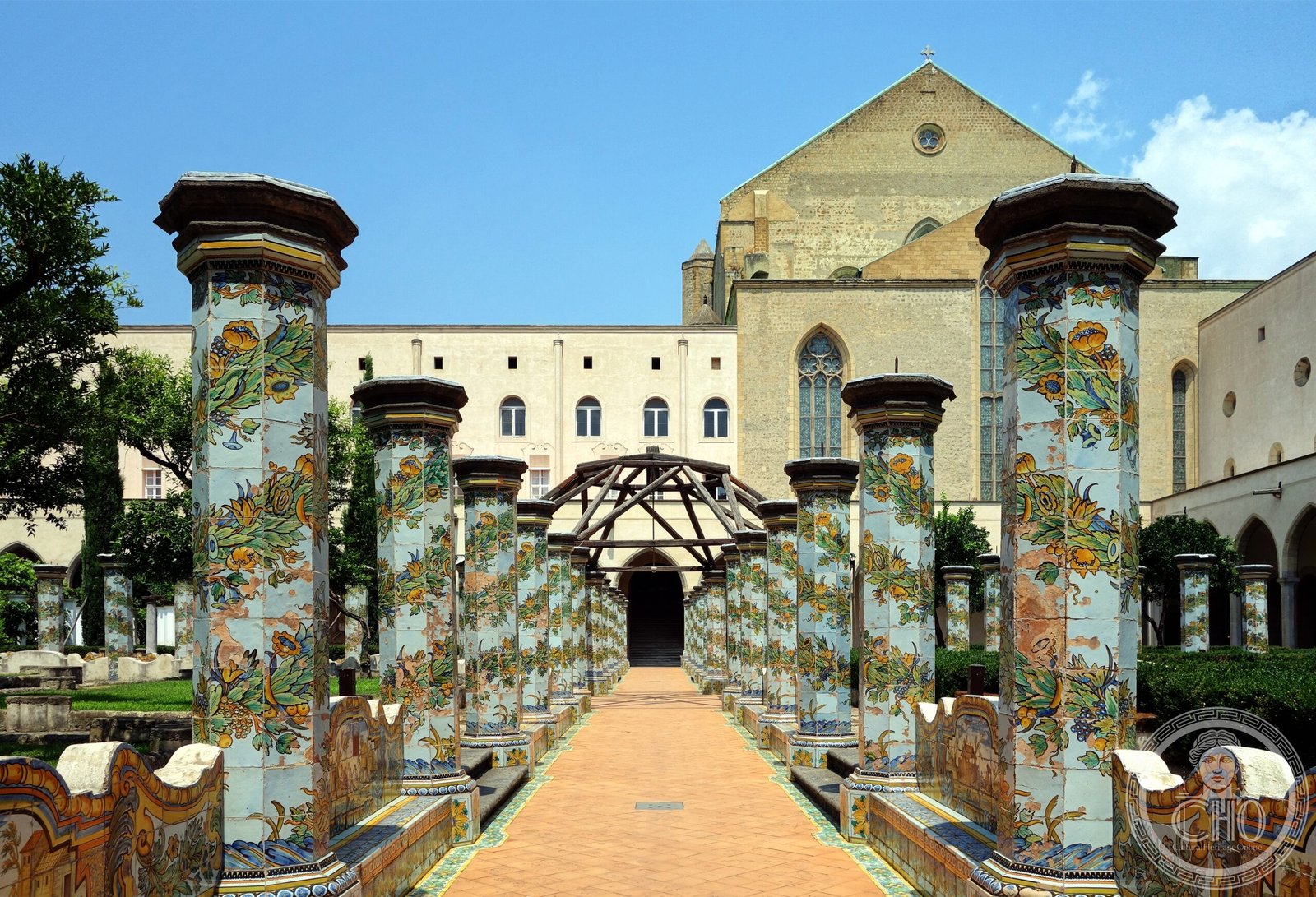
The Monumental Complex of Santa Chiara is one of the most important Gothic religious ensembles in Naples, founded in the early 14th century by Robert of Anjou and his wife Sancia of Majorca for the Franciscan Order of Poor Clares. Heavily damaged by Allied bombing in 1943 and subsequently restored to its medieval austerity, the complex today encompasses the basilica, a Franciscan monastery, a museum of archaeology and decorative arts, and the celebrated majolica-tiled cloister of the Clarisses — a masterpiece of 18th-century Neapolitan ceramics.
At a glance
- Type
- Franciscan monastic complex and basilica
- Period
- Founded 1310–1340; rebuilt after WWII bombing (1953)
- Style
- Provençal Gothic; 18th-century Baroque cloister
- Location
- Via Benedetto Croce, Naples, Campania, Italy
- Coordinates
- 40.8471° N, 14.2527° E
Overview
Santa Chiara is a religious complex in Naples that includes the church of Santa Chiara, a monastery, tombs and an archaeological museum. The basilica church of Santa Chiara faces Via Benedetto Croce, the easternmost leg of Via Spaccanapoli. The church façade is diagonally across from the church of Gesù Nuovo, making this corner one of the most visited intersections of the city’s historic centre.
History
Construction began in 1310 at the order of Robert I of Naples (Robert the Wise) and his wife Sancia of Majorca, who wished to create a dynastic sanctuary for the Angevin crown. The basilica was consecrated in 1340 and became the mausoleum of the Angevin kings of Naples. On 4 August 1943, Allied incendiary bombs reduced the interior to ruins; decades of restoration work, completed in 1953, stripped away Baroque additions and returned the nave to its original austere Gothic volume.
What you see
The basilica’s single nave preserves the monumental Gothic proportions intended by the original builders, with royal Angevin tombs including that of Robert the Wise by the Florentine sculptors Giovanni and Pacio Bertini. Adjacent to the church, the Chiostro delle Clarisse (Cloister of the Poor Clares) was redecorated between 1739 and 1742 by Domenico Antonio Vaccaro with majolica-tiled columns and benches painted with pastoral and mythological scenes — considered the finest 18th-century ceramic cycle in Italy. The complex also contains Roman thermae excavated beneath the monastery, now visible in the underground museum.
Cultural significance
Listed as part of the UNESCO World Heritage Site “Historic Centre of Naples” (1995), the complex is a key monument of the Angevin period and one of Southern Italy’s most complete medieval religious ensembles. Its majolica cloister is regarded as an outstanding example of Neapolitan applied arts and attracts scholars of decorative history from around the world.
Practical information
- Address
- Via Benedetto Croce 16, 80134 Napoli NA, Italy
- Hours
- Check the official website for current opening times; the museum and cloister have separate ticket counters
- Admission
- Church free; museum and cloister ticketed — check official website for current prices
Getting there
The complex is located in the heart of the Spaccanapoli district. Take Naples Metro Line 1 to Dante station and walk south along Via Toledo, then turn onto Via Benedetto Croce (approximately 10 minutes on foot). Buses R2 and E1 stop nearby on Corso Umberto I.
Sources & resources
See the place
Find it on the map
See this place and what’s around it →📷 Become a Cultural Heritage Online photographer
Share your photos of places: they stay published under your name as the author. The more they're seen, the more you get noticed — and soon a contest will reward the most appreciated photos.
Log in or sign up free to add a photoIs this page about you?
This page is read by travellers and heritage enthusiasts who find it on Google. Tell us how you are connected to this place and we will take it from there.