
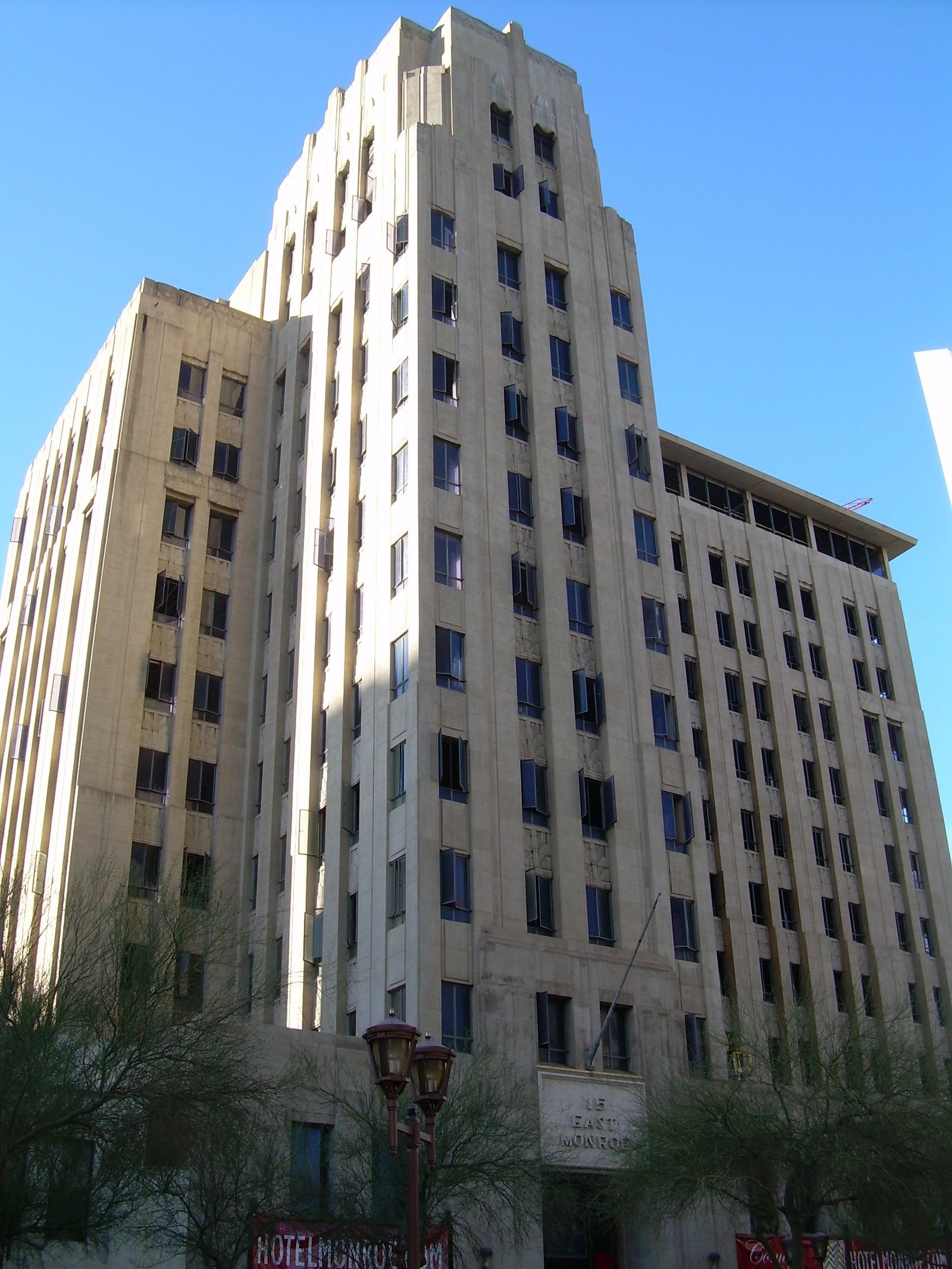
Phoenix’s earliest surviving Art Deco skyscraper, the Professional Building of 1932 on Washington Street was built to house the Maricopa County Medical Society and Valley Bank and Trust — became nationally known when Alfred Hitchcock’s Psycho (1960) used its exterior in the film’s opening aerial sequence — and now operates as a Hilton Garden Inn following a comprehensive 2015 restoration that earned it National Register recognition in 1993.
At a glance
The Professional Building stands in downtown Phoenix, Arizona, at the intersection of Washington Street and Central Avenue. Completed in 1932 as a combined professional office building and bank, the ten-story tower is Phoenix’s oldest surviving Art Deco skyscraper and one of only a handful of Art Deco buildings in the Southwest to hold National Register of Historic Places status. The building was listed on the National Register in January 1993. After decades as an office building and a period of vacancy in the 1990s, it was comprehensively renovated and reopened as a Hilton Garden Inn in December 2015.
Key facts
- Built: 1932
- Style: Art Deco
- Stories: 10
- Original tenants: Maricopa County Medical Society (upper floors); Valley Bank and Trust Company (lower floors)
- Distinctive feature: 49-foot rotating sign (installed 1958)
- Film credit: Opening aerial sequence of Psycho (Alfred Hitchcock, 1960)
- NRHP listed: January 8, 1993 (#85003563)
- Current use: Hilton Garden Inn (since December 2015)
- Address: 302 N. First Avenue, Phoenix, Arizona (corner of Washington and Central)
- GPS: 33.45010, −112.07350
History
When construction of the Professional Building began in 1932, Phoenix was still a small regional city of approximately 50,000 people — not yet the Sun Belt metropolis it would become in the post-war decades. The building’s two original tenant groups represent the two economic pillars of the Depression-era Arizona economy: medicine and banking. The Maricopa County Medical Society occupied the upper seven floors as professional office space for the county’s physicians; Valley Bank and Trust Company occupied the lower three floors, bringing a banking presence to the building’s Washington Street face. The ten-story height made it one of the tallest buildings in Phoenix at the time of its completion, and its Art Deco facade — employing setback massing, geometric ornament, and the clean-surfaced, light-toned treatment characteristic of the Southwestern version of the style — positioned it immediately as a marker of the city’s architectural modernity.
In 1958, a 49-foot rotating sign was added to the building’s exterior — a mid-century advertising technology that was at that moment transforming the visual landscape of American downtowns. Two years later, the building entered film history when Alfred Hitchcock used its exterior for the opening aerial sequence of Psycho (1960). The camera’s pan across the Phoenix skyline before entering a hotel window establishes the film’s setting; the Professional Building is visible in those shots, the sign prominently featured. The film’s cultural ubiquity has made the building’s connection to Psycho one of its most widely cited attributes. The building fell into vacancy in the 1990s after its commercial function declined; a comprehensive renovation completed in December 2015 converted it to a Hilton Garden Inn, the format that secured the building’s preservation as a functioning structure.
What you see
The Professional Building’s exterior articulates a restrained desert-climate variant of Art Deco commercial design. The facade is organized in buff-colored masonry with geometric terra cotta ornamental elements at the spandrel panels and entrance surround; the massing employs the standard setback formula of the late 1920s and early 1930s commercial tower in a reduced ten-story form appropriate to the scale of Phoenix’s downtown at the time of construction. The building’s proportional language is upright and vertical without the theatrical ornamental excess of larger-budget metropolitan examples — the Southwestern Art Deco idiom characteristically favors clean surfaces and geometric precision over the polychromatic terracotta of Midwest and East Coast buildings.
The 49-foot rotating sign added in 1958 is preserved as part of the building’s heritage; it is a significant example of mid-century signage and adds to the building’s historical character. The renovation to Hilton Garden Inn preserved the exterior fabric and the public areas of the original building, adapting the upper floors to hotel use while maintaining the street-level presence and the lobby character established in 1932. The combination of original 1932 fabric with the 1958 sign layer makes the building a compressed record of downtown Phoenix’s commercial evolution across three decades.
Practical information
- Now operating as a Hilton Garden Inn; the lobby and exterior are accessible to hotel guests and the general public.
- The exterior and the rotating sign are freely visible from Washington Street and Central Avenue.
- Located in downtown Phoenix adjacent to the light rail corridor and within walking distance of the Phoenix Convention Center.
Getting there
The Professional Building is at 302 N. First Avenue (corner of Washington Street and Central Avenue) in downtown Phoenix, Arizona. Phoenix Sky Harbor International Airport (PHX) is approximately 4 miles east, connected to downtown by the Valley Metro Rail light rail (approximately 15 minutes to the Washington/Central Avenue station immediately outside the building). By car, Interstate 10 runs along the southern and western edges of downtown Phoenix, with the 7th Avenue and 7th Street exits providing direct access to the Washington Street corridor.
Nearby
- Heard Museum — the preeminent museum of Native American art and culture in the United States, approximately 8 blocks north at 2301 N. Central Avenue, with a collection of over 35,000 objects
- Arizona Capitol Museum — the 1900 Arizona territorial and state capitol building, with Art Deco additions, approximately 10 blocks west on W. Washington Street; the copper dome is one of Phoenix’s most distinctive architectural landmarks
- Phoenix Art Museum — the largest art museum in the Southwest, approximately 10 blocks north on N. Central Avenue, with a collection of over 20,000 works across American, European, and Latin American traditions
Sources
- Wikipedia: “Professional Building (Phoenix, Arizona)”
- National Register of Historic Places, listing #85003563, January 8, 1993
- Phoenix Historic Preservation Office: Professional Building nomination form
- Wikimedia Commons: ProfessionalBldg.JPG, Public Domain, JCordova
Find it on the map
See this place and what’s around it →Record researched and written by Luigi De Marchi for Cultural Heritage Online, 2026.
📷 Become a Cultural Heritage Online photographer
Share your photos of places: they stay published under your name as the author. The more they're seen, the more you get noticed — and soon a contest will reward the most appreciated photos.
Log in or sign up free to add a photoIs this page about you?
This page is read by travellers and heritage enthusiasts who find it on Google. Tell us how you are connected to this place and we will take it from there.