
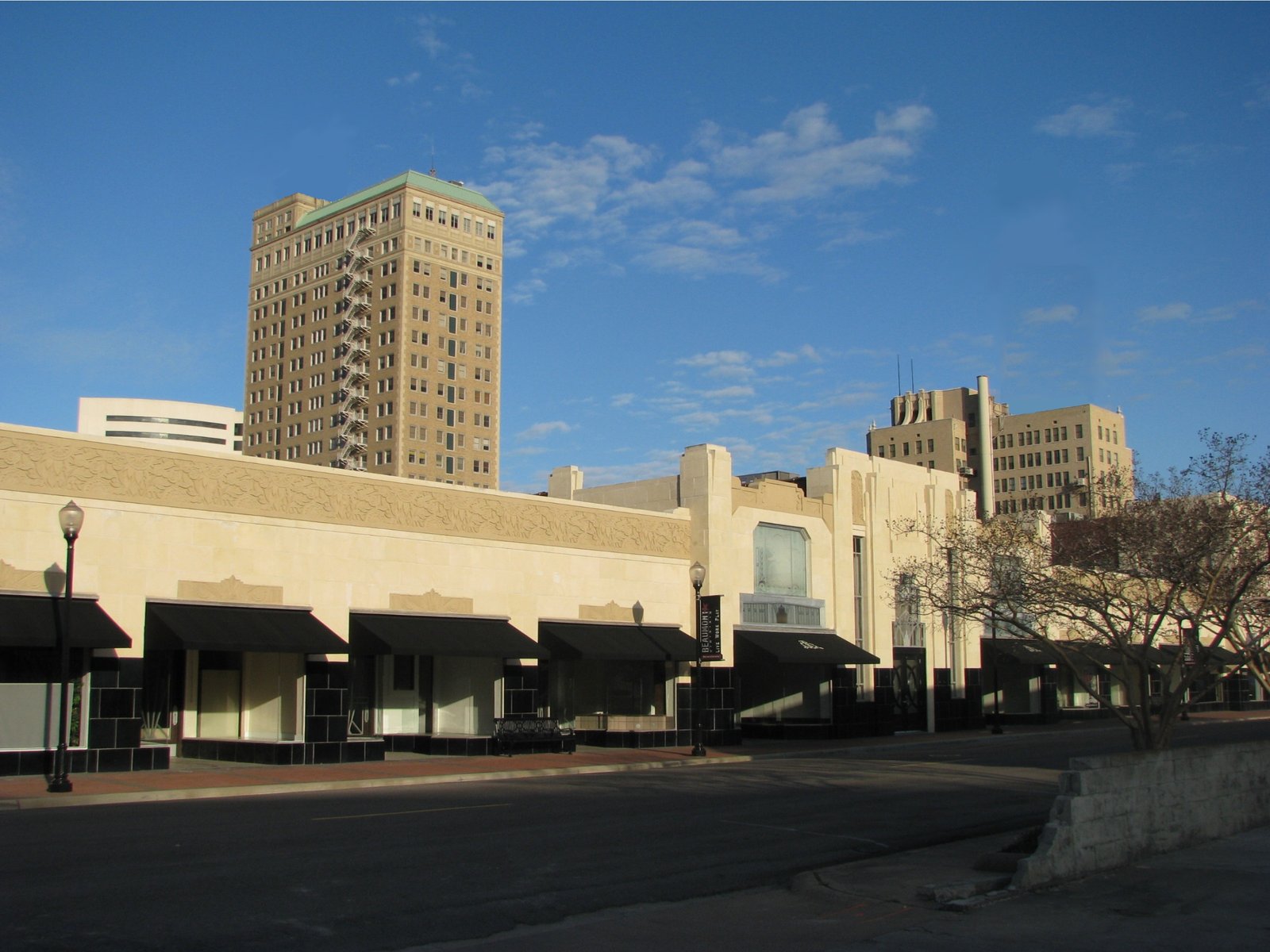
One of the most intact Zig-Zag Art Deco commercial facades on the Texas Gulf Coast, the Kyle Building (1933) in downtown Beaumont is a five-story block whose polished black granite base and stepped geometric terra cotta ornament represent the Deco vocabulary deployed in a regional city with architectural ambition equal to anything in the larger Texas metros — a contributing structure to the federally recognized Beaumont Commercial Historic District.
At a glance
The Kyle Building stands in downtown Beaumont, Texas, in the Beaumont Commercial Historic District — a concentration of early twentieth century commercial architecture recognized by a federal historic district listing in 1978. Completed in 1933, the five-story building is among the district’s best-preserved examples of Zig-Zag Art Deco commercial architecture: a style characterized by chevron, stepped, and geometric ornamental motifs applied to the exterior surfaces with linear precision. Its polished black granite base contrasts with the geometric terra cotta ornament of the upper floors in a material hierarchy that is characteristic of the highest-quality commercial Deco construction of the early 1930s.
Key facts
- Built: 1933
- Style: Zig-Zag Art Deco
- Architect: Not documented in available sources
- Stories: 5
- Historic district: Beaumont Commercial Historic District (contributing property)
- NRHP (district): April 14, 1978 (#78002959)
- Address: Downtown Beaumont, Texas
- GPS: 30.08470, −94.10090
History
Beaumont, Texas, occupies a specific and underappreciated place in American architectural history. The city’s commercial core was developed primarily in the first three decades of the twentieth century — the decades of the oil boom that began with the Spindletop well of January 10, 1901, just south of the city. This discovery transformed southeast Texas and made Beaumont the first city to witness the industrial oil economy at full scale; the commercial wealth generated in the following two decades funded the downtown construction that the Beaumont Commercial Historic District now preserves. The Kyle Building was completed at the tail end of this building period in 1933, during the Great Depression, when construction costs had fallen far enough to allow commercial development that might not have been possible a few years earlier at peak land and labor prices.
In the early 1930s, the Zig-Zag Art Deco style — its sharp geometric ornament derived from the 1925 Paris Exposition Internationale des Arts Décoratifs et Industriels Modernes — was reaching smaller American cities with a delay of five to seven years from the major metropolitan centers. The Kyle Building represents this diffusion of the style to a Gulf Coast regional city, demonstrating that by 1933 the Deco vocabulary had become sufficiently standardized and well-understood by local contractors and fabricators that a building of genuine architectural quality could be realized without the involvement of nationally prominent architects. The Beaumont Commercial Historic District, listed on the National Register in 1978, recognized the concentration of buildings like the Kyle as a body of work with collective historical significance that exceeded any single structure’s individual importance.
What you see
The Kyle Building’s facade is organized in three horizontal registers: the polished black granite at street level establishes the building’s commercial presence at eye level and pavement scale — the high-polish granite veneer acts as a mirror, reflecting the street life and the sky and giving the base a dynamic, light-responsive quality. Above the granite, the middle floors are faced in warm-toned terra cotta with geometric ornamental panels at the spandrels: chevron patterns, stepped pyramidal forms, and linear incised decoration repeated across all bays with the systematic precision that distinguishes Zig-Zag ornament from the more varied surface programs of the earlier Beaux-Arts commercial buildings it replaced. The parapet terminates in a stepped crown — the building’s most recognizable silhouette feature — that echoes the setback massing of contemporary skyscrapers in reduced, five-story form.
The quality of the terra cotta fabrication is notable: each panel is crisply formed and the color gradation from the cream-to-buff tones of the mid-floors to the slightly deeper accents of the ornamental keystones is consistent with the production standards of specialized regional tile manufacturers who supplied the Gulf Coast commercial construction market in the late 1920s and early 1930s. The combination of reflective black granite at grade with warm terra cotta above is a material strategy that achieves a vertical dynamism out of proportion to the building’s modest five-story height.
Practical information
- The Kyle Building’s exterior is freely visible from the street in downtown Beaumont at all times.
- The Beaumont Commercial Historic District encompasses several blocks of early twentieth-century commercial architecture; the Kyle Building is among the best-preserved facades in the district.
- The Texas Energy Museum on Main Street, approximately 3 blocks from the building, provides context for the oil boom history that funded Beaumont’s commercial development.
Getting there
The Kyle Building is in downtown Beaumont, Texas, approximately 85 miles east of Houston along Interstate 10. The nearest commercial airport is Jack Brooks Regional Airport (BPT), approximately 6 miles west of downtown. Beaumont is also served by the Amtrak Sunset Limited (Los Angeles to New Orleans) with a stop at the Beaumont Amtrak Station. By car, downtown Beaumont is accessed via Interstate 10 (take the 11th Street or 7th Street exits) or US Route 69/96/287 from the north.
Nearby
- Jefferson Theatre (1927) — a Spanish Revival movie palace at 345 Fannin Street, now a performing arts venue, approximately 2 blocks from the Kyle Building; one of the anchor structures of the Beaumont Commercial Historic District
- Texas Energy Museum — a museum dedicated to the 1901 Spindletop oil discovery that transformed southeast Texas and funded downtown Beaumont’s commercial development, approximately 3 blocks from the Kyle Building on Main Street
- Spindletop-Gladys City Boomtown Museum — a reconstruction of the 1901 Spindletop boomtown at Lamar University, approximately 6 miles south of downtown; the site where the Lucas Gusher inaugurated the Texas oil boom
Sources
- Wikipedia: “Kyle Building (Beaumont, Texas)”
- National Register of Historic Places: Beaumont Commercial Historic District, listing #78002959, April 14, 1978
- Texas Historical Commission: Beaumont Commercial Historic District documentation
- Wikimedia Commons: KyleBESTEDIT.JPG, CC BY 3.0, Reagan Rothenberger
Find it on the map
See this place and what’s around it →Record researched and written by Luigi De Marchi for Cultural Heritage Online, 2026.
📷 Become a Cultural Heritage Online photographer
Share your photos of places: they stay published under your name as the author. The more they're seen, the more you get noticed — and soon a contest will reward the most appreciated photos.
Log in or sign up free to add a photoIs this page about you?
This page is read by travellers and heritage enthusiasts who find it on Google. Tell us how you are connected to this place and we will take it from there.