
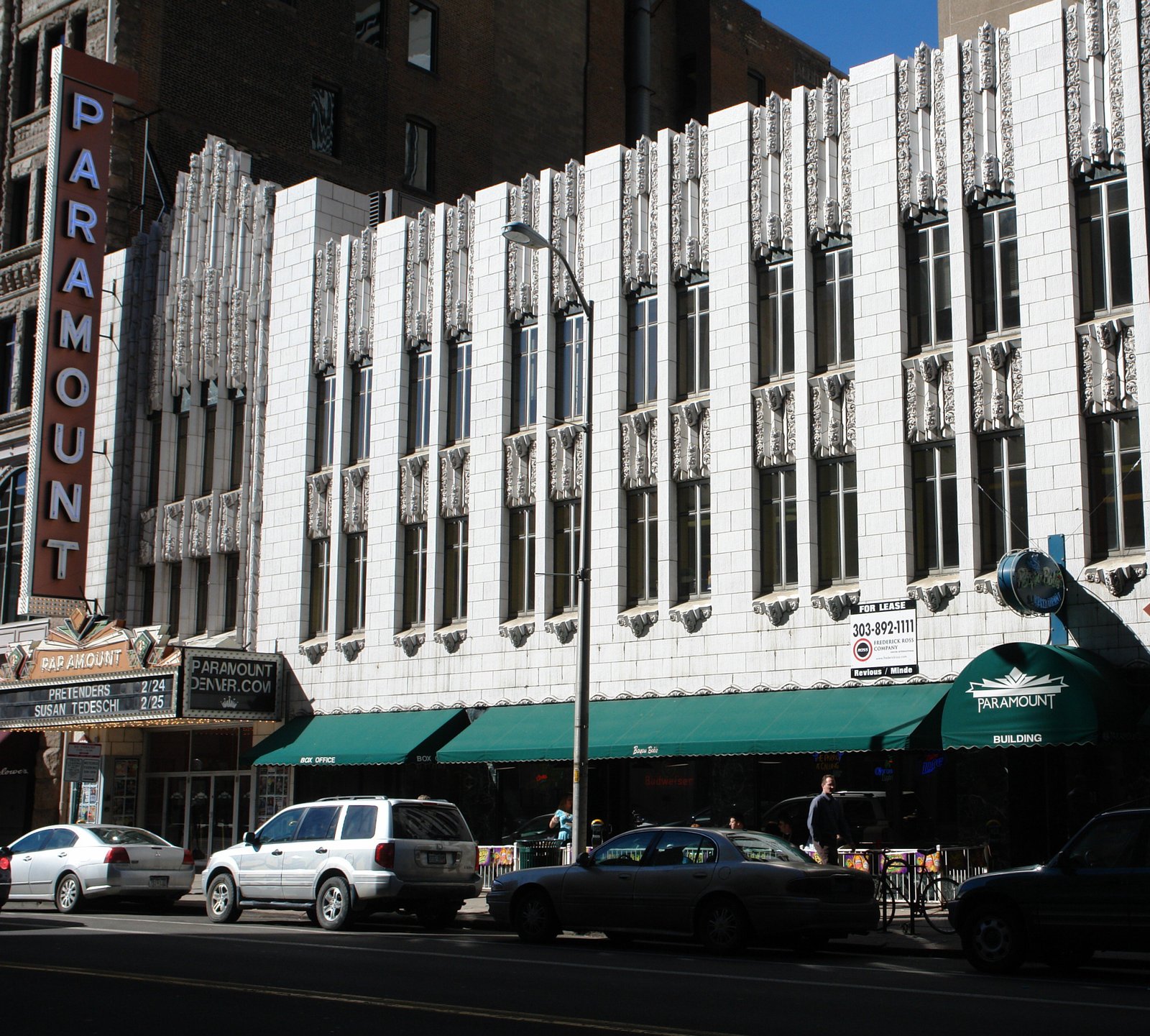
The last surviving movie palace in the Denver metropolitan area, Temple H. Buell’s 1930 Paramount Theatre on Glenarm Place is a five-story Art Deco building whose Gothic-inflected white terra cotta facade stands as the defining Arts Deco landmark of the Rocky Mountain region — listed on the National Register in 1980, designated a Denver landmark in 1988, and still in daily use as one of the city’s premier live performance venues.
At a glance
The Paramount Theatre stands at 1621 Glenarm Place in downtown Denver, Colorado. Designed by Temple H. Buell — one of the foremost Colorado architects of the twentieth century, later better known for the Cherry Creek Shopping Center and Elitch Gardens — the building was completed in 1930 as a Paramount Pictures showcase theater. Its five-story white terra cotta facade on Glenarm Place employs Gothic-inflected Art Deco ornament in a style that closely parallels Chicago’s Civic Opera House, completed the same year. Listed on the National Register of Historic Places in November 1980 and designated a Denver Landmark in 1988, the building survives as the only historic movie palace in the Denver metropolitan area in continuous use as a performance venue.
Key facts
- Built: 1930
- Style: Art Deco (Gothic-inflected)
- Architect: Temple H. Buell
- Original capacity: approximately 2,000 seats (movie palace configuration)
- Current configuration: 1,870 capacity (standing room / flexible; stage renovated 2014)
- Current use: Live music and performing arts venue
- NRHP listed: November 21, 1980 (#80000893)
- Denver Landmark: 1988
- Address: 1621 Glenarm Place, Denver, Colorado
- GPS: 39.74442, −104.99021
History
When the Paramount Pictures chain commissioned a new flagship theater for Denver in the late 1920s, Temple H. Buell was the natural choice: he had already established himself as the city’s most active commercial architect, with credits across retail, office, and institutional commissions. Buell designed the Paramount as a “modernized Art Deco interpretation of the Gothic style” — a phrase from the original building description that captures the deliberate synthesis at work. The white terra cotta skin of the facade reproduces Gothic proportional principles — the vertical emphasis, the pointed-arch motif at the entrance bays, the intricate surface enrichment — but translates all of it into geometric, linear, Deco vocabulary without a column or crocket in sight. The building opened in 1930 as one of the most elaborate theatrical venues between Chicago and Los Angeles.
For three decades the Paramount served as the premiere movie venue in Denver, hosting major studio releases in its fully equipped single-screen auditorium. As the movie palace model collapsed in the 1950s–60s under competition from suburban multiplexes and television, the Paramount faced the fate that befell hundreds of similar theaters across the country. Several alternative uses were considered; the building was saved in part by its 1980 National Register listing, which gave preservation advocates a formal tool in any future demolition or alteration proceedings. By 1988, when the City of Denver added it to the local landmarks register, the building was already in use as a live performance venue — the format that would secure its survival into the 21st century. A significant stage renovation in 2014 increased technical capacity for contemporary live music production. The Paramount today books national touring acts across rock, pop, country, electronic, and comedy programming, consistently ranked among Colorado’s top venues by capacity and booking activity.
What you see
The Paramount’s Glenarm Place elevation is organized as a five-story white terra cotta screen — the cladding material chosen because it can be cast in any shape and retains its bright, light-reflecting quality in the semi-arid Denver climate without the grime accumulation that stone surfaces suffer. Buell’s ornamental program is concentrated at the entrance bays and the upper parapet: pointed-arch recesses above the main doors echo the Gothic skyline of a cathedral, but the spandrel panels filling each arch are filled not with religious imagery but with geometric interlaced patterns of pure Deco lineage. The cornice terminating the facade at its fifth-floor level is crenellated in a stepped, abstracted form that reads simultaneously as Gothic battlement and Deco saw-tooth — one of the most technically accomplished exercises in style fusion in the Rocky Mountain region.
Inside, the auditorium has been reconfigured for live performance but retains the material richness of the original 1930 interior: plaster moldings, gilded ornamental screens, and the spatial generosity of a building designed to hold 2,000 people under a single roof. The stage area, equipped to current technical standards, sits within a proscenium arch that is still one of the largest of any venue in Colorado — a physical legacy of the movie palace’s ambition to combine theatrical grandeur with cinema presentation.
Practical information
- The Paramount is an active live performance venue; admission requires a ticket for scheduled events.
- The exterior is freely visible from Glenarm Place between the 16th Street Mall and 17th Street.
- The 16th Street Mall — Denver’s main pedestrian and transit spine — runs one block west.
Getting there
The Paramount Theatre is at 1621 Glenarm Place in downtown Denver, Colorado. Denver International Airport (DEN) is approximately 25 miles northeast, connected to downtown by the RTD University of Colorado A Line commuter rail (35 minutes to Denver Union Station). Denver Union Station — also a notable 1914 Beaux-Arts / 1950 streamlined renovation building — is approximately 7 blocks northwest. RTD light rail lines serve multiple downtown stops; the 16th Street Mall runs one block west with its free MallRide shuttle connecting to Union Station and the RTD Civic Center Station hub.
Nearby
- Denver Union Station (1914; 1950 streamline renovation) — the city’s main railway terminus, with a Beaux-Arts central hall and a 1950 streamline modern addition; now a transit hub, market hall, and hotel, approximately 7 blocks northwest
- Brown Palace Hotel (1892) — Denver’s historic grand hotel designed by Frank Edbrooke in the Romanesque Revival style, with a nine-story atrium lobby, approximately 3 blocks east on 17th Street
- Molly Brown House Museum (1889) — the Victorian mansion of Titanic survivor Molly Brown, now a museum, approximately 9 blocks southeast on Pennsylvania Street
Sources
- Wikipedia: “Paramount Theatre (Denver)”
- National Register of Historic Places, listing #80000893, November 21, 1980
- City of Denver Landmark designation, 1988
- Wikimedia Commons: Paramount_Theater_Denver_CO.jpg, CC BY-SA 3.0, Hustvedt
Find it on the map
See this place and what’s around it →Record researched and written by Luigi De Marchi for Cultural Heritage Online, 2026.
📷 Become a Cultural Heritage Online photographer
Share your photos of places: they stay published under your name as the author. The more they're seen, the more you get noticed — and soon a contest will reward the most appreciated photos.
Log in or sign up free to add a photoIs this page about you?
This page is read by travellers and heritage enthusiasts who find it on Google. Tell us how you are connected to this place and we will take it from there.