
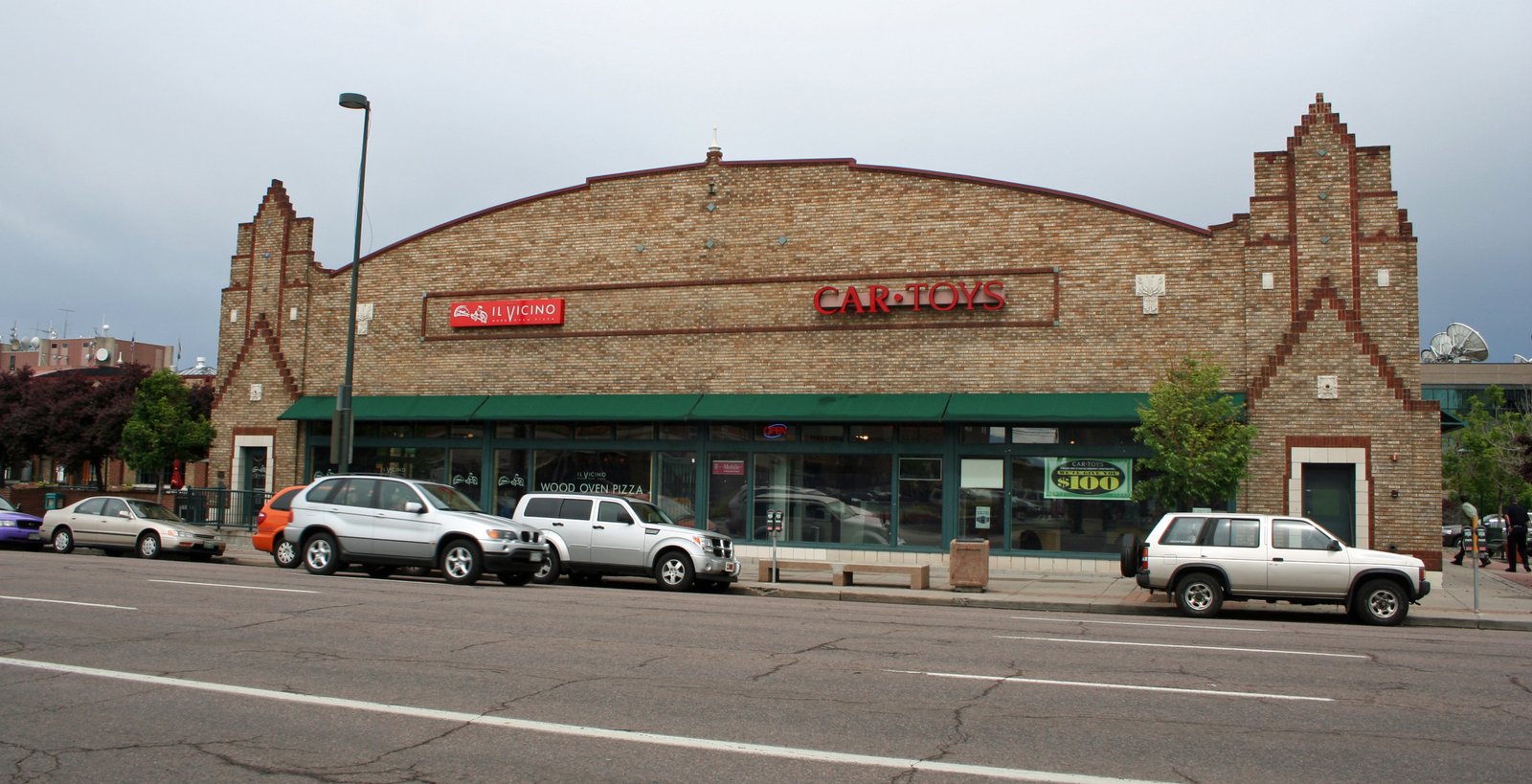
Built in brick and terra cotta in 1932 and expanded two years later, the L-shaped Leeman Auto Company Building at 550 Broadway is one of Denver’s best-preserved examples of the automobile showroom type in the Art Deco idiom — a building type that expressed the commercial ambition of the American car industry in the years before the Depression reshaped the market.
At a glance
The Leeman Auto Company Building occupies the corner of Broadway and an adjacent street in Denver, Colorado, approximately one mile south of the city’s central business district. Designed by architect Raymond Harry Ervin — documented for the 1934 expansion and probably responsible for the 1932 original as well — the one-story structure takes an L-shaped plan adapted to the corner site, with brick and terra cotta cladding applied in the Art Deco style then current for commercial architecture. It was built and expanded as an automobile showroom and service facility for the Leeman Auto Company. Listed on the National Register of Historic Places in 2001, it is one of the few surviving examples of its specific type in Denver.
Key facts
- Built: 1932 (original); expanded 1934
- Style: Art Deco
- Architect: Raymond Harry Ervin (documented for 1934 expansion)
- Original function: Automobile showroom and service facility
- NRHP listed: September 27, 2001 (#01001054)
- Address: 550 Broadway, Denver, Colorado
- GPS: 39.72528, −104.98639
History
The automobile industry’s expansion across American cities in the 1920s and early 1930s generated a distinct building type: the auto dealership and showroom, designed to display and sell cars while also accommodating service and repair operations. These buildings required large unobstructed floor areas for vehicle display, prominent street frontage for visibility, and a commercial facade that communicated modernity and quality to prospective buyers. Art Deco provided the appropriate architectural language — bold geometry, decorative terra cotta, and a crisp machine-age aesthetic that aligned with the character of the product being sold.
The Leeman Auto Company built its Denver facility at 550 Broadway in 1932, at a moment when the Depression was already contracting the automobile market but before the industry’s recovery. The expansion in 1934 extended the building’s L-shaped footprint to accommodate additional service operations, completing the structure essentially in its surviving form. The building remained in automotive use through much of the twentieth century before transitioning to other commercial tenants. Raymond Harry Ervin, its documented designer, was active in Denver commercial architecture during the 1920s and 1930s, with a practice focused on the commercial and industrial building types generated by the automobile era.
What you see
The Leeman Auto Company Building is a one-story structure whose Art Deco character is concentrated in the terra cotta ornament at the facade parapet and entrance surround, applied against a brick ground. The horizontal emphasis of the massing — appropriate to a building designed around automobile-scale interior volumes — is given vertical counterpoint by the terra cotta banding and the entrance bay composition. The L-shaped plan wraps two street frontages, giving the building a corner presence on Broadway that was strategically important for a commercial enterprise dependent on passing traffic.
The terra cotta work, characteristic of the period’s commercial Art Deco, combines geometric abstraction with applied ornamental motifs — a relatively economical surface decoration that gave buildings like this one the fashionable appearance of the style without the expense of carved stone. The building’s NRHP significance rests in part on the rarity of intact surviving examples of the automobile showroom type in Art Deco, a building category that has been heavily altered or demolished across American cities.
Practical information
- The building currently hosts commercial tenants; the exterior is freely visible from Broadway at all times.
- The NRHP nomination includes 43 accompanying photographs from 2001 documenting the building’s condition and details.
- Located on the Broadway commercial corridor connecting downtown Denver to the South Broadway district, approximately one mile south of the 16th Street Mall.
Getting there
The Leeman Auto Company Building is at 550 Broadway in Denver, approximately one mile south of Denver’s downtown core. Denver International Airport (DEN) is approximately 25 miles east. By light rail, the D Line stops at the Broadway and I-25 station approximately half a mile south; the C and E Lines connect downtown Denver to the broader south Broadway area. The building is on the primary north-south commercial corridor running from downtown Denver toward the Platte River valley.
Nearby
- South Broadway Antique & Arts District — a concentrated stretch of antique dealers, vintage shops, galleries, and restaurants along South Broadway south of the building
- Denver Art Museum — one of the leading art museums in the Rocky Mountain West, approximately one mile north in the Civic Center precinct
- Paramount Theatre Denver — the city’s surviving 1930 Art Deco movie palace, now a concert venue, approximately one mile north on Glenarm Place
Sources
- Wikipedia: “Leeman Auto Company Building”
- National Register of Historic Places Registration Form #01001054, National Park Service, February 23, 2001 (preparer: Nancy L. Widmann)
- Wikimedia Commons: 550BroadwayDenver.JPG, CC BY-SA 3.0, Jeffrey Beall
Find it on the map
See this place and what’s around it →Record researched and written by Luigi De Marchi for Cultural Heritage Online, 2026.
📷 Become a Cultural Heritage Online photographer
Share your photos of places: they stay published under your name as the author. The more they're seen, the more you get noticed — and soon a contest will reward the most appreciated photos.
Log in or sign up free to add a photoIs this page about you?
This page is read by travellers and heritage enthusiasts who find it on Google. Tell us how you are connected to this place and we will take it from there.