
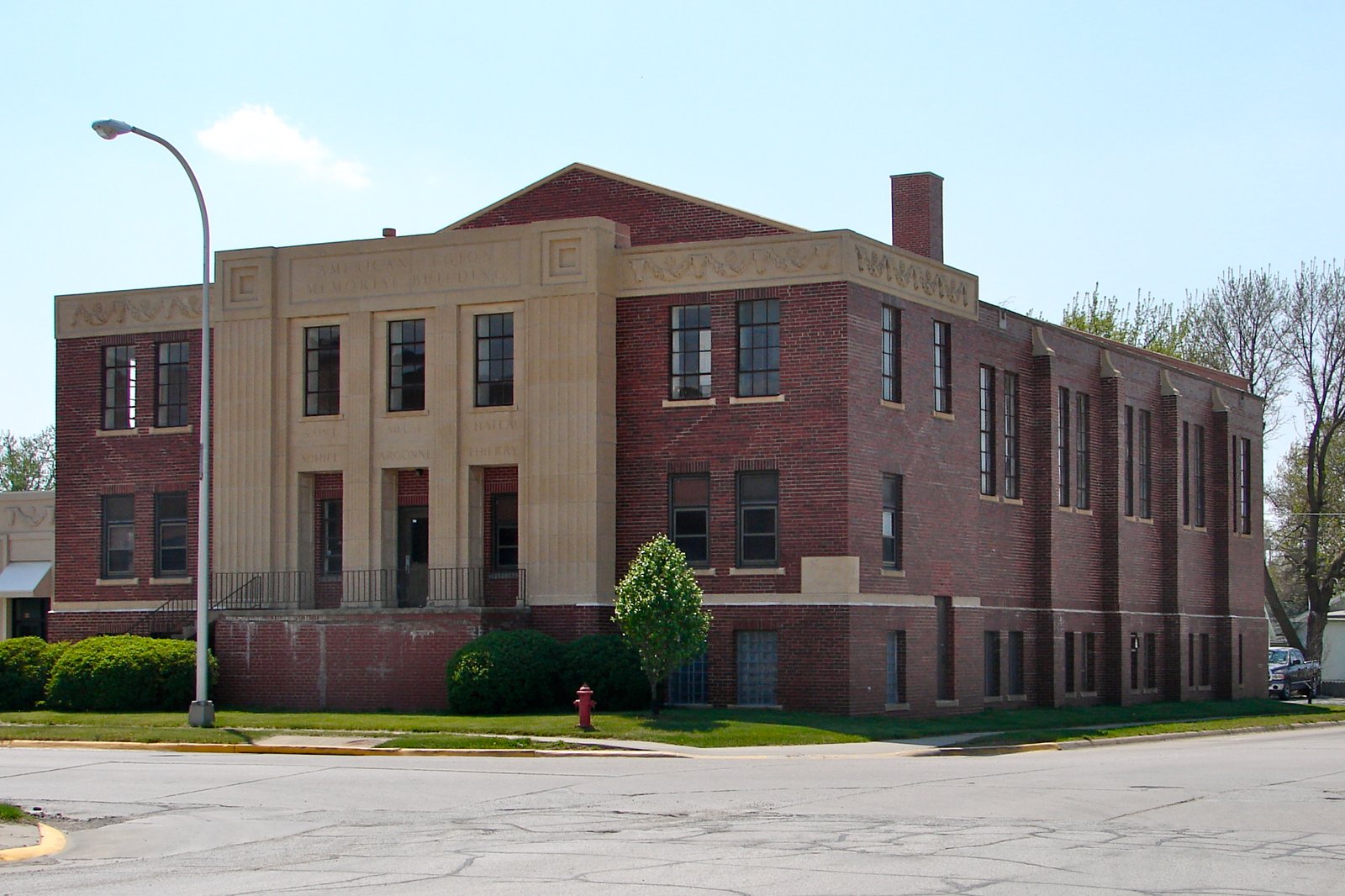
A compact Moderne and Art Deco armory in Cass County, Iowa — built to honor veterans and store the state’s arms, it blends civic memory with the streamlined design language of the late 1920s.
At a glance
The American Legion Memorial Building — also known as the Atlantic National Guard Armory — stands at 201 Poplar Street in Atlantic, Iowa. Designed by Council Bluffs architect George A. Spooner and built in 1929-1930 by G.F. Construction Company of Exira, Iowa, it brings Moderne and Art Deco architectural vocabulary to a small southwestern Iowa county seat. The building was listed on the National Register of Historic Places on December 12, 2006.
Key facts
- Built: 1929–1930
- Architect: George A. Spooner (Council Bluffs, Iowa)
- Builder: G.F. Construction Company, Exira, Iowa
- Style: Moderne / Art Deco
- Also known as: Atlantic National Guard Armory
- NRHP listed: December 12, 2006 (refnum 06001121)
- Address: 201 Poplar Street, Atlantic, Iowa
- Coordinates: 41.4089°N, 95.0139°W
History
Atlantic, Iowa, seat of Cass County, commissioned this armory building at the end of the 1920s — a moment when communities across America were memorializing World War I veterans and simultaneously providing militia storage and drill facilities. The American Legion Memorial Building served multiple overlapping functions: as a monument to the war dead, as a military facility for arms storage, as a meeting hall for civic and veterans’ organizations, and as a sports facility for community events.
George A. Spooner, a Council Bluffs architect with practice across western Iowa, brought a design that balanced the memorial gravity required by the commission with the contemporary Moderne aesthetic that was reshaping American public buildings in the late 1920s. The building’s Art Deco ornamental vocabulary — geometric forms, angular relief — reads as modern ambition without abandoning the civic solemnity expected of a veterans’ memorial.
The National Register of Historic Places recognized the building on December 12, 2006, acknowledging its combination of architectural quality and historical significance as a rare surviving example of the Iowa armory building type from the interwar period.
What you see
The exterior presents the characteristic Moderne blend: classical proportional organization (a clearly articulated base, shaft, and cornice) stripped of historicist ornamental grammar and re-dressed in the angular, geometric vocabulary of Art Deco. Spooner’s design for a small Iowa city shows the reach of the era’s design culture — the Moderne aesthetic had penetrated even rural county seats by 1929-1930, arriving through architectural journals, pattern books, and the sensibilities of practitioners like Spooner who kept pace with national trends.
The building’s dual identity — as a memorial and as a military facility — is expressed in its architectural character: assertive but not monumental, purposeful but not bleak. It occupies a middle register between the civic institutions of a small town and the ambitions of a generation that had survived the Great War.
Practical information
- Access: Civic building; exterior freely viewable
- Address: 201 Poplar Street, Atlantic, Iowa 50022
- Season: Year-round for exterior viewing
- Time needed: 15 minutes for exterior
Getting there
Atlantic, Iowa, is located on Interstate 80 approximately 75 miles east of Omaha, Nebraska, and 120 miles west of Des Moines. The nearest major airports are Eppley Airfield (Omaha) and Des Moines International Airport.
Nearby
- Cass County Courthouse — historic courthouse in Atlantic’s town square
- Des Moines Building (1930) — a 14-story Art Deco tower in Iowa’s capital, 120 miles east
- Iowa State Capitol — Beaux-Arts capitol dome in Des Moines, accessible via Interstate 80
Sources
- Wikipedia, “American Legion Memorial Building”
- National Register of Historic Places, refnum 06001121, listed December 12, 2006
- Smallbones, photographer (CC0), Wikimedia Commons
Find it on the map
See this place and what’s around it →Record researched and written by Luigi De Marchi for Cultural Heritage Online, 2026.
📷 Become a Cultural Heritage Online photographer
Share your photos of places: they stay published under your name as the author. The more they're seen, the more you get noticed — and soon a contest will reward the most appreciated photos.
Log in or sign up free to add a photoIs this page about you?
This page is read by travellers and heritage enthusiasts who find it on Google. Tell us how you are connected to this place and we will take it from there.