
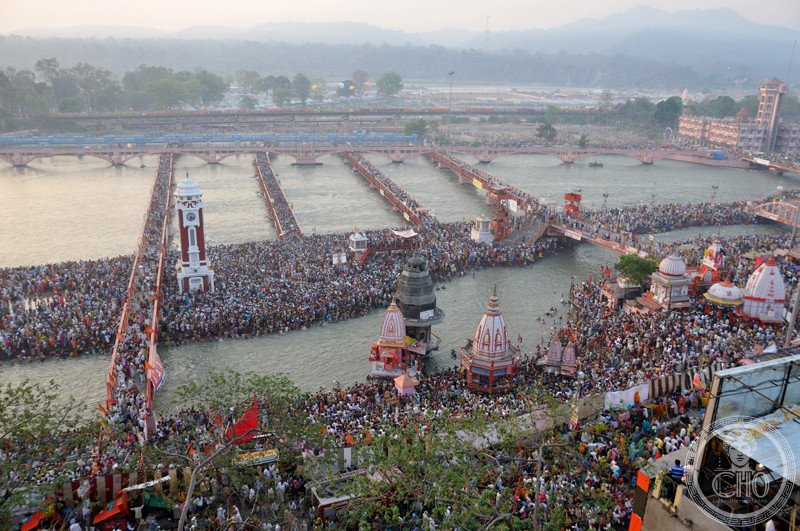
A Hindu pilgrimage held every four or twelve years at four sacred river confluences, drawing millions to ritually bathe in waters believed to cleanse sins and grant spiritual atonement.
At a glance
The Kumbh Mela is one of the world’s largest human gatherings. Approximately 660 million people attended in 2025. The festival lasts one to three months, with the new-moon day drawing the largest crowds. Pilgrims immerse themselves in rivers at four locations—Prayagraj, Haridwar, Nashik, and Ujjain—each on a twelve-year cycle aligned with Jupiter’s position in the Hindu zodiac.
Origins & history
Hindu cosmology holds that these four sites received drops of divine nectar (amrita) during the mythological churning of the ocean of milk. An annual bathing festival called Magh Mela had been held at Prayag for centuries, documented in classical texts like the Ramcharitmanas. Before 1858, the name “Kumbh” referred only to the twelfth occurrence of Haridwar’s annual mela. The first formally organized Kumbh Mela at Prayag took place in 1870, following a proposal by the Pragwals—a traditional priest community—to establish an orderly pilgrimage under British administration after the 1857 Indian Rebellion.
The practice
Pilgrims gather to perform ritual bathing (snana) in sacred rivers at predetermined moments determined by astronomical alignment. The festival encompasses religious discourse, mass assemblies of monks and ascetics, educational events, and fairs. The Amavasya (new-moon) day attracts the most devotees, creating some of the densest concentrations of people on Earth. Participants wade into rivers believing the waters purify them of past transgressions and spiritual debt.
Cultural significance
The Kumbh Mela embodies core Hindu beliefs about sacred geography, celestial cycles, and ritual purification. It represents the continuity of pilgrimage traditions spanning centuries. The event also demonstrates the enduring power of community gathering and shared spiritual practice at an unprecedented scale. For millions, attendance fulfills a fundamental aspiration of Hindu devotional life.
Key facts
- Held at four locations: Prayagraj, Haridwar, Nashik, and Ujjain
- Cycle: approximately 12 years, based on Jupiter’s revolution and the Hindu luni-solar calendar
- Duration: one to three months per gathering
- Attendance (2025): approximately 660 million
- UNESCO Intangible Cultural Heritage inscription: 2017 (reference 01258)
- Coordinates (Prayagraj): 25.4383°N, 81.84133°E
Where to experience it
Prayagraj, at the confluence of the Ganges and Yamuna rivers, is the primary heartland of the Kumbh Mela tradition and hosts some of the largest gatherings. Specific festival dates depend on astronomical calculations; consult official sources or local pilgrimage guides for current scheduling, as the timing varies by location and shifts across years.
Sources & resources
- Kumbh Mela – Wikipedia
- Kumbh Mela – UNESCO Intangible Cultural Heritage
- Cultural Heritage Online
Find it on the map
See this place and what’s around it →📷 Become a Cultural Heritage Online photographer
Share your photos of places: they stay published under your name as the author. The more they're seen, the more you get noticed — and soon a contest will reward the most appreciated photos.
Log in or sign up free to add a photo