
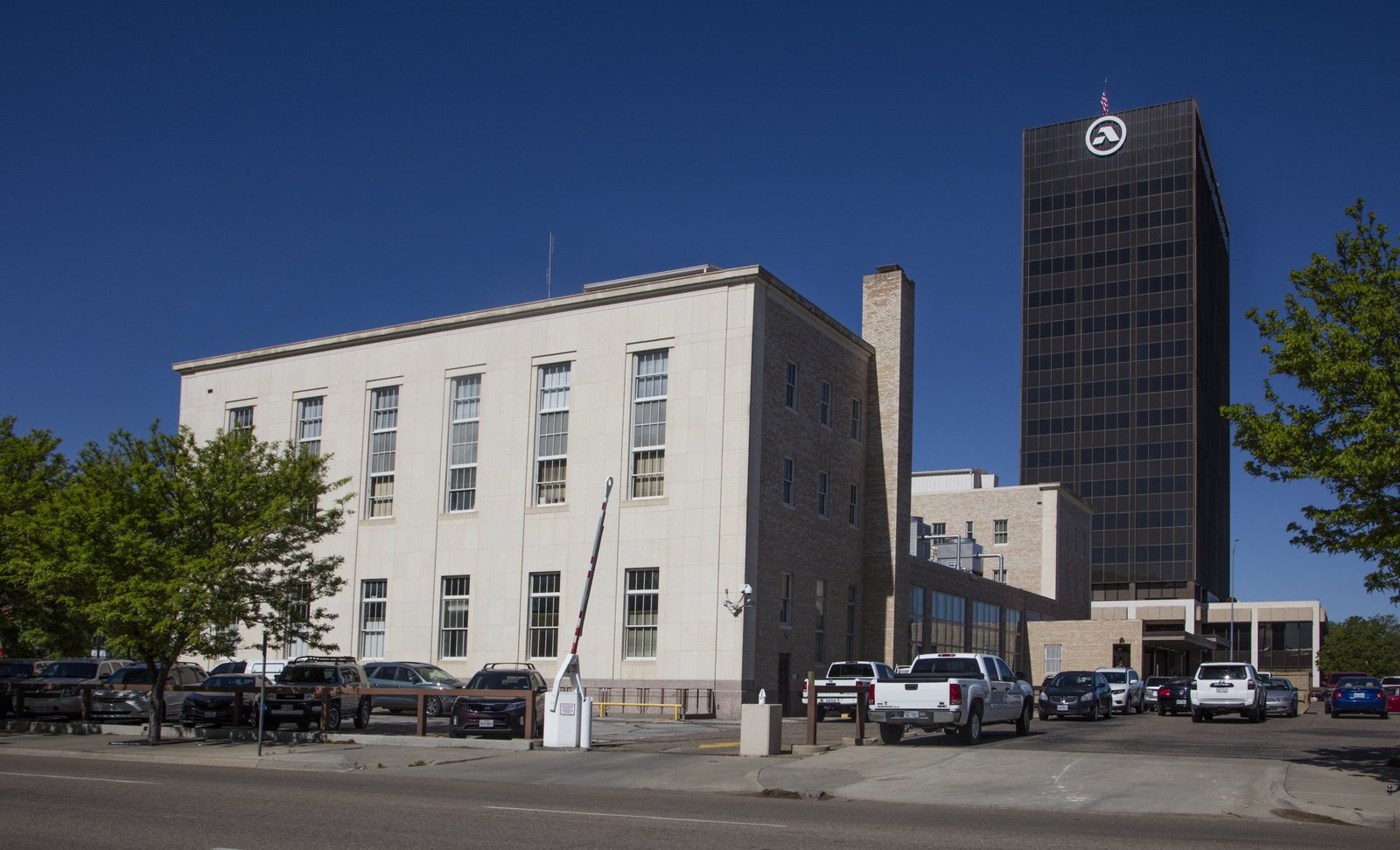
A self-assured 1937 courthouse in the Texas Panhandle where Art Deco geometry and Moderne restraint meet in limestone and steel.
At a glance
The J. Marvin Jones Federal Building and Mary Lou Robinson United States Courthouse anchors Amarillo’s downtown with the authority of New Deal federal architecture. Designed in 1937 by Wyatt C. Hedrick and built as the Amarillo U.S. Post Office and Courthouse, it has served continuously as a seat of federal justice for nearly nine decades. The building reflects the dual vocabulary of Art Deco and Moderne — a pairing typical of the late New Deal era, when stripped classicism gave way to streamlined forms while retaining a sense of civic gravity.
Key facts
- Built: 1937
- Architect: Wyatt C. Hedrick
- Style: Art Deco / Moderne
- Original name: Amarillo U.S. Post Office and Courthouse
- Court: U.S. District Court for the Northern District of Texas
- NRHP listed: September 29, 2000
- Coordinates: 35.2086°N, 101.8342°W
History
Constructed in 1937 as the Amarillo U.S. Post Office and Courthouse, the building was part of the broader wave of New Deal federal construction that endowed dozens of American cities with monumental public buildings. The program, administered through the Treasury Department’s Procurement Division, set high architectural standards — the Amarillo building reflects those standards in the care of its massing and detail.
Over the following decades the building was renamed to honor J. Marvin Jones, a West Texas congressman who served as federal judge, and Mary Lou Robinson, the first female chief judge of the Northern District of Texas. Its continuous use as an active courthouse has preserved the building in remarkably good condition, a rarity among federal structures of this generation.
The National Register of Historic Places recognized the building’s architectural significance on September 29, 2000, confirming its status as one of the finest surviving examples of New Deal federal architecture in the Texas Panhandle.
What you see
The exterior presents the disciplined vocabulary of late Art Deco — a limestone-clad facade where classical proportions are reinterpreted through the geometric language of the 1930s. Hedrick’s design balances formal symmetry with Moderne restraint: piers rise without historicist capitals, ornamental carving is spare but purposeful, and the silhouette reads as civic weight without grandeur for its own sake.
Inside, the building has served as a post office, customhouse, and government office complex, in addition to its primary courthouse function. The layered history of federal use is written into the interior spaces, which retain the solidity of New Deal construction — terrazzo, metal, marble — common to buildings of this program and period.
Practical information
- Access: Active federal courthouse — exterior freely viewable; interior requires official business
- Location: Downtown Amarillo, Potter County, Texas
- Season: Open year-round for exterior viewing
- Time needed: 15–30 minutes for exterior study
Getting there
The building is located in downtown Amarillo, Texas, accessible via Interstate 40 (historic U.S. Route 66 corridor). Amarillo is approximately 360 miles west of Dallas/Fort Worth and 100 miles east of the New Mexico state line. The nearest major airport is Rick Husband Amarillo International Airport.
Nearby
- Herring Hotel (1928) — Art Deco hotel in downtown Amarillo, a companion landmark of the same era
- U-Drop Inn (1936), Shamrock, Texas — one of the most iconic Streamline Moderne structures on Route 66, about 90 miles east
- Palo Duro Canyon — the “Grand Canyon of Texas,” 25 miles southeast
Sources
- Wikipedia, “J. Marvin Jones Federal Building and Mary Lou Robinson United States Courthouse”
- National Register of Historic Places, NRHP Reference No. added September 29, 2000
- Carol M. Highsmith Photography Collection, Library of Congress, LC-DIG-highsm-lccn2016648289 (Public Domain)
Find it on the map
See this place and what’s around it →Record researched and written by Luigi De Marchi for Cultural Heritage Online, 2026.
📷 Become a Cultural Heritage Online photographer
Share your photos of places: they stay published under your name as the author. The more they're seen, the more you get noticed — and soon a contest will reward the most appreciated photos.
Log in or sign up free to add a photoIs this page about you?
This page is read by travellers and heritage enthusiasts who find it on Google. Tell us how you are connected to this place and we will take it from there.